
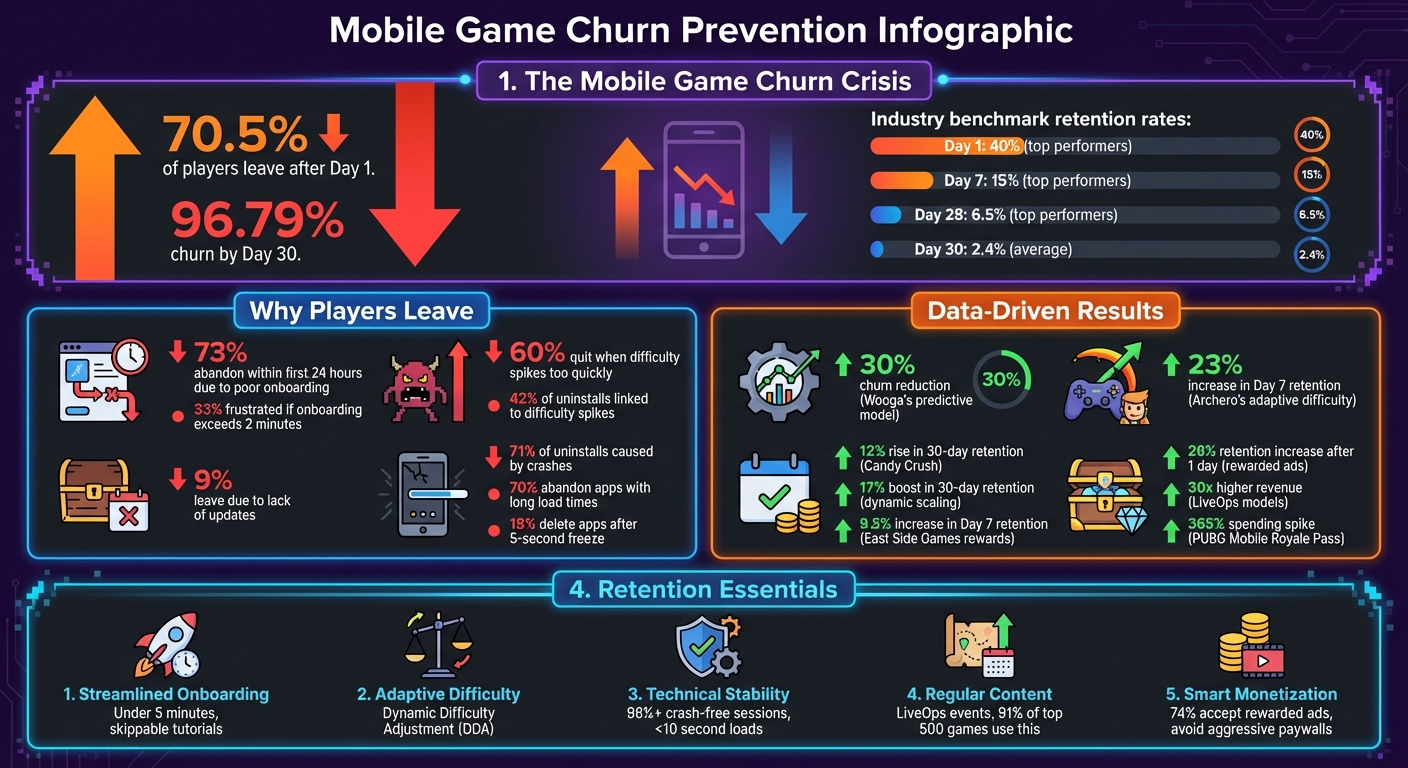
Player churn is a major challenge in mobile gaming, with 70.5% of players leaving after Day 1 and industry averages showing 96.79% churn by Day 30. High churn rates hurt profitability, increase user acquisition costs, and weaken player communities. The good news? You can reduce churn by addressing common issues like poor onboarding, technical glitches, and aggressive monetization. Here’s a quick breakdown:
- Why Players Leave: Frustrating tutorials, difficulty spikes, aggressive ads, lack of updates, and app crashes.
- How to Prevent Churn:
- Streamline onboarding with short, skippable tutorials.
- Use Dynamic Difficulty Adjustment (DDA) to balance challenges.
- Introduce regular events, rewards, and social features like guilds.
- Personalize retention efforts with data-driven insights.
- Fix bugs and optimize performance to avoid crashes and long load times.
- Data-Driven Retention: Predict churn using player segmentation, funnel analysis, and machine learning models. Target at-risk players with tailored rewards or offers.
- Monetization That Retains Players: Respect non-paying users with top revenue models for free-to-play games, and use rewarded ads strategically.
Mobile Game Player Churn Statistics and Prevention Strategies
Predicting 1st-Day Churn in Real-Time – MLOps Live #7 – With Product Madness (an Aristocrat co.)
Why Players Leave Mobile Games
To keep players engaged, it’s crucial to understand why they leave in the first place. From clunky onboarding to technical glitches, numerous factors can push players away. Let’s break down the main reasons behind player churn and how to address them.
Poor Onboarding and Early Drop-Offs
Nearly 73% of players abandon a mobile game within the first 24 hours[10]. Why? Overly long tutorials and early permission requests – like push notifications – are major culprits, doubling churn rates and driving players away almost immediately[1][9][10][11]. If new players can’t quickly grasp what makes your game enjoyable, they’ll move on to something else.
The numbers back this up: 33% of users feel frustrated if onboarding drags on for more than two minutes[15]. The solution? Keep tutorials short – ideally under five minutes – and always include options to "skip" or "fast-forward", especially for returning players[10].
Difficulty Spikes and Progression Problems
Unbalanced gameplay is a big reason players quit. If levels are too hard, they face repeated failures, leading to frustration. If they’re too easy, boredom sets in[12]. 60% of players stop playing when a game becomes too difficult too quickly[11]. A steep learning curve often robs players of the satisfaction that keeps them coming back.
Progression systems also play a huge role. If players don’t feel like they’re hitting meaningful milestones or improving their skills, they lose motivation[12]. Sudden changes, like increasing XP requirements mid-game, can make things worse[14]. These "nerfs" can feel like a bait-and-switch, further discouraging players.
Aggressive Monetization and Paywalls
Nothing irritates players more than feeling exploited. Pushy in-game purchase systems and hard paywalls, especially early on, can make players quit before they’ve even formed a connection to the game[12][14]. Forced interstitial ads – those full-screen interruptions – are particularly notorious for driving players away[2].
Pay-to-win mechanics are another sore spot. Free players often leave when they realize progression is impossible without spending money. Meanwhile, paying players may eventually notice the game’s economy feels unbalanced, leading them to lose interest as well[1]. This combination shrinks the player base and damages long-term retention.
Lack of New Content and Updates
Even the best games can feel stale without fresh content. 9% of players – both new and loyal – leave due to a lack of updates[2]. Without new maps, characters, or seasonal events, players lose the motivation to keep progressing[1][4]. With nearly 400,000 mobile games competing for attention, anything that feels repetitive will quickly be replaced by something newer[7][2].
Stagnation also impacts in-game communities. As players leave, social features lose their value, accelerating churn for those who remain[1][14]. Games that use LiveOps – regular updates and limited-time events – stand out here. These strategies can generate 30 times more revenue than games without them[4].
Bugs, Crashes, and Performance Issues
Technical problems are one of the quickest ways to lose players. 71% of app uninstalls are due to crashes, while 70% of users will abandon an app if it takes too long to load[7]. Even minor issues, like a freeze lasting just five seconds, can lead to immediate uninstalls – 18% of users will delete an app on the spot[7].
Players expect their entertainment to work seamlessly. When technical failures disrupt their experience, 79% will only retry an app once or twice before giving up entirely[7]. Colin Contreary, Head of Content at Embrace, sums it up perfectly:
Technical stability is what props up the game design; having complete observability into the user experience is how you will solve technical churn and improve retention rates[7].
Unlike design flaws, technical issues affect everyone, regardless of the game’s genre. If the app doesn’t function properly, the intended experience falls apart.
Up next, we’ll dive into how data-driven strategies can help predict and resolve these challenges.
Using Data to Predict and Prevent Churn
Knowing when players are likely to leave a game allows developers to take action before it’s too late. By analyzing player data, developers can turn insights about churn into strategies that keep players engaged and coming back.
Player Segmentation and Predictive Models
Not all players are the same, and their behaviors often require different approaches. Segmenting players based on factors like session frequency, playtime, spending habits, and social activity can help identify those at risk of leaving. For example, a sudden drop in playtime, reduced spending, or players stuck at challenging levels can indicate potential churn[16][18].
Machine learning models – such as Logistic Regression, Random Forest, or Recurrent Neural Networks (RNNs) – are often used to predict churn. These models assign a risk score to each player, helping developers focus on those most likely to leave. Players with scores between 0.4 and 0.7 are usually the best candidates for targeted interventions[17]. A great example of this is Wooga, which in 2014 used predictive models to identify high-value players at risk. By sending them notifications and free in-game currency, they reduced churn by 30% compared to a control group[19].
Different types of players also respond to different strategies. For instance:
- Players who have spent money before might react well to discounts or special offers.
- Non-spenders might be more interested in free rewards or trials.
- Casual players often appreciate friendly reminders or small incentives.
- Hardcore players are drawn to exclusive events or competitive features like leaderboards[11].
Social engagement matters too. Players with fewer in-game connections are more likely to churn, so encouraging them to join guilds or invite friends can make a big difference[16].
Funnel Analysis and Player Heatmaps
Funnel analysis helps developers track how players progress through key stages, like completing a tutorial or finishing early levels, to pinpoint where they drop off[16]. These problem areas, or "bottlenecks", often reveal issues like poorly balanced difficulty, confusing interfaces, or gaps in content. For example, by breaking down the first-time user experience into steps like "App Open → Tutorial Start → Tutorial End → First Level Completion", developers can see exactly where players lose interest.
Monitoring level completion rates can also highlight whether a level is too frustrating or too easy. If a particular stage has a low completion rate, developers might introduce tools like boosters or adjust the difficulty dynamically to help players move forward. Another key metric is time to first churn, which measures how long a player stays engaged after their first session. If players drop out quickly, it may indicate that the early-game experience isn’t grabbing their attention.
Personalizing Retention Based on Player Data
Retention efforts work best when they’re tailored to individual players. Instead of sending generic push notifications, developers can use player data to craft messages that feel timely and relevant. For example, a message like "Just 2 wins away from a Legendary Chest!" can encourage players to stay engaged[11].
Automated actions based on predictive models can also help. For example, giving in-game rewards or exclusive skins to high-value players who show signs of disengagement can bring them back[16]. Similarly, dynamic difficulty adjustments can lower the challenge for players who are struggling, reducing frustration and keeping them in the game[11]. Features like streak systems with escalating daily rewards can build habits, though removing harsh penalties for missing a day can ease player pressure[3]. Nicholas Kerr, VP of Loyalty and Lifecycle at Mistplay, highlights the importance of this approach:
By rewarding players for their continued participation and achievements, game studios can create a more competitive yet rewarding environment that enhances the overall user experience[4].
The data backs this up: 95% of players who don’t receive push notifications within their first 90 days are likely to churn[3]. Meanwhile, retargeting campaigns can lead to a 50% increase in paying users[11]. With an average Day 30 retention rate of just 2.4%[4], using data to personalize retention strategies isn’t just helpful – it’s critical to keeping players engaged.
Improving Player Experience to Reduce Churn
Once you’ve pinpointed the reasons behind player churn and identified at-risk users, the next step is to focus on improving the core gameplay experience. The most effective retention strategies aren’t about flashy tricks – they’re about making the game genuinely enjoyable from the very first interaction.
Better Onboarding and First Session Engagement
The first session sets the tone for a player’s entire experience. Top-performing games achieve a Day 1 retention rate of 40%, but many new users never return because the initial experience fails to hook them[13][20].
Interactive tutorials are a great way to teach players the ropes. Instead of overwhelming them with information, let them learn by doing. The goal is to guide players to that "Aha!" moment as quickly as possible – the point where they realize the game is worth their time[4][14][20]. Gradual introductions to game mechanics help prevent players from feeling overloaded during the tutorial phase.
Personalization can make a big difference early on. Allow players to customize their characters, pick starter items, or set up profiles. These small touches create a sense of ownership and emotional connection right from the start[4]. Structured checklists with progress bars can also guide players toward key milestones while giving them a sense of accomplishment[20]. Early objectives should be designed to guarantee success – small wins build confidence and momentum[21].
Take Marvel Snap as an example. In 2023, it revamped its onboarding process to simplify the complexity of a collectible card game, getting players into the action in under four minutes. This approach made the game accessible to a broader audience and boosted retention rates[3]. The takeaway? Respect players’ time and get them to the fun part quickly.
Once onboarding is nailed down, the next step is to keep players engaged with challenges that feel fair and rewarding.
Adaptive Difficulty and Progression Rewards
Frustration is one of the quickest ways to lose players. A whopping 67% of players quit a game if they hit a progression wall within the first two sessions, and 42% of uninstalls are linked to sudden difficulty spikes[22]. The solution? Adaptive difficulty that adjusts to players’ skill levels in real time.
Dynamic Difficulty Adjustment (DDA) uses data like completion times, failed attempts, and input patterns to tailor the challenge. For instance, Archero implemented adaptive difficulty, tweaking stage complexity based on player skill. This led to a 23% increase in Day 7 retention[22]. Similarly, Candy Crush Saga reduced drop-off rates by adding dynamic hints and "easy-mode" boosters after failure spikes, resulting in an 18% increase in session length and a 12% rise in 30-day retention[22].
Near-win scenarios also play a powerful role in keeping players hooked. Players are 2.4× more likely to continue after a near-win compared to repeated failures[22]. Features like "second chance" items or optional assist tools after consecutive losses can ease frustration without making the game feel too easy[22]. Celebrating smaller milestones – like completing 10 levels – can reduce quit rates by 34%[22].
Reward systems should scale with effort. Whether it’s game economy design elements like in-game currency, cosmetic items, or power-ups, rewards need to feel earned and satisfying. As William Grosso, CEO of Game Data Pros, explains:
By claiming regular rewards – especially when the rewards get incrementally larger – players get into the habit of logging in, which in turn increases their attachment to the game[23].
Games that incorporate dynamic scaling mechanics tend to see an average 17% boost in 30-day retention compared to those with static difficulty settings[22]. The key is to strike a balance: keep players challenged, but never let them feel defeated.
These strategies are even more effective when paired with fresh, engaging content.
Regular Events and Player Rewards
No one sticks around for a game that feels stale. 91% of the top 500 mobile games use LiveOps models to keep players engaged, and games that adopt LiveOps strategies can achieve 30x higher revenue than those that don’t[3][4].
Seasonal events, like Halloween or Lunar New Year themes, and limited-time challenges create urgency and give players a reason to log back in. Competitive features, such as leaderboards, player-versus-player tournaments, and guild-based raids, foster community and encourage teamwork[24][11]. Notably, 60% of top-grossing mobile games incorporate "Social Clans" to strengthen player connections and drive engagement[4].
Daily login streaks are another effective tool. Escalating rewards over a 7-day streak can encourage consistent play[3][11]. Time-based rewards, like bonuses at 30 minutes, 1 hour, and 2 hours of active play, can keep players engaged for longer sessions[1]. However, avoid punishing players for missing a day – this can lead to frustration rather than motivation.
In 2023, East Side Games introduced a rewards system through a tROAS (Target Return on Ad Spend) campaign with Mistplay. By offering points for specific in-game actions, they saw a 9.5% increase in Day 7 retention[4]. This worked because the rewards were tied to effort, not handed out indiscriminately. Players had to meet certain milestones or complete challenges, which kept them engaged without creating a sense of entitlement[14].
Personalized rewards take things even further. By analyzing player data, you can offer incentives that align with individual playstyles. For example, dungeon-specific items for PvE players or exclusive gear for competitive players make rewards feel meaningful and tailored[1][11]. The goal is to make every event feel like it was designed just for them.
sbb-itb-fd4a1f6
Monetization That Supports Player Retention
Monetization isn’t just about generating revenue; it’s also a key factor in keeping players engaged. Strike the right balance, and you can boost both retention and profitability. Push too hard, and players may leave. Go too light, and you risk missing out on potential earnings.
Freemium Models That Respect All Players
Overly aggressive monetization is one of the fastest ways to lose players. The goal is to create freemium models that respect both paying and non-paying players, ensuring everyone enjoys the game without feeling pressured.
For competitive games, avoid pay-to-win mechanics, which can disrupt fairness and alienate the player base. Instead, focus on monetizing cosmetics, exclusive skins, or convenience features that enhance the experience without impacting game balance. For instance, some games offer "Builder Boosts" to speed up upgrades, giving paying players a time-saving advantage without compromising fairness [11].
Timing also matters. Avoid bombarding players with new offers immediately after a purchase. Data shows that 75% of spenders convert by their tenth day, so aligning offers with natural player progressions can improve results [25].
Tiered systems like battle passes or subscriptions are another effective approach. These allow non-paying players to access seasonal content while rewarding spenders with added perks. A great example is PUBG Mobile’s introduction of the "Royale Pass" in June 2018, which led to a 365% spike in global player spending during its first week compared to the three weeks prior [11].
Milestone-based monetization is also worth considering. One multiplayer match-3 game successfully boosted long-term engagement by identifying key retention milestones – like reaching specific levels or unlocking trophies – and offering free perks at each stage [26].
Once monetization is balanced, incorporating player-friendly ads can further enhance retention.
Rewarded Ads That Don’t Disrupt Gameplay
Poorly placed ads can frustrate players, but rewarded ads – when done right – can actually improve retention. Studies reveal that 74% of U.S. mobile gamers are open to watching video ads in exchange for in-game rewards [5]. Popular rewards include extra items, in-game currency, or gacha pulls [4].
Strategic placement is key. For example, offering a revive after a failed level or a boost when resources are low makes the ads feel like a natural part of the experience. Research shows that well-placed ads can increase player retention by 26% after one day, 8% after seven days, and 3% after 30 days [4].
Gaetano Di Lietro, Campaign Manager at MAF, highlights the importance of early retention:
D1 is where most of the retention is made. If your monetization strategy is too aggressive, you’ll notice a low retention rate from the beginning [27].
For new players, start with a lower ad frequency and gradually increase it as engagement grows. Offerwalls – where players complete tasks for rewards – are another effective option. Players who engage with offerwalls show a Day 90 retention rate of 14%, compared to less than 3% for those who don’t [4].
To keep players engaged over time, AI-powered personalization is becoming a game-changer.
AI-Generated Content for Dynamic Engagement
Static content can quickly lose its appeal, especially in mobile games that thrive on variety. AI-driven tools are transforming this by dynamically adjusting game challenges, levels, and recommendations based on individual player behavior and skill [5].
One standout feature is adaptive difficulty scaling, where AI adjusts enemy strength or level complexity in real time. This keeps players in the "flow state" – engaged but not overwhelmed. Considering that 60% of players quit games that become too hard too quickly, this approach can significantly reduce churn [11].
AI also enables personalized missions, rewards, and store offerings. For example, PvP-focused players might be invited to competitive events, while PvE players could receive dungeon-specific challenges [1]. Similarly, AI can recommend skins, power-ups, or bundles tailored to a player’s playstyle, boosting conversions without coming across as intrusive [5][11].
Predictive AI models take things a step further by identifying "at-risk" players. Developers can then offer targeted discounts or exclusive rewards to re-engage them. When used effectively, AI doesn’t just personalize the experience – it also strengthens monetization strategies that keep players coming back.
For more tips on freemium game design and live operations, check out our services at Adrian Crook & Associates – we specialize in creating engaging and profitable games across genres.
Performance Optimization and Metric Tracking
Even the most engaging game design can’t make up for technical issues. Did you know that 71% of app uninstalls are due to crashes, and 70% of users will abandon an app if it takes too long to load? [7][8] Players encountering freezes, lag, or slow performance are quick to uninstall, leaving little room for second chances.
Testing and Bug Fixes Before Launch
Thorough pre-launch testing is critical to minimizing technical churn. Here’s why: 79% of users will only retry an app once or twice if it fails to work the first time [7][8]. In other words, you’ve got a razor-thin margin for error.
To reduce these risks, track user interactions in detail to identify pain points that could lead to app crashes. For example, monitoring "input spam" – where a user taps 30–100 times in five minutes – can reveal bugs that might trigger frustration-induced quits [28]. Heatmaps can also highlight areas where players experience friction, allowing you to address those issues before launch.
Set clear performance goals: aim for 98%+ crash-free sessions, ensure a frame rate of 30 FPS or higher on low-end devices, and keep your build size under 150MB [28]. Colin Contreary, Head of Content at Embrace, emphasizes the importance of this:
"Technical stability is what props up the game design; having complete observability into the user experience is how you will solve technical churn and improve retention rates" [7].
Meeting these benchmarks not only reduces technical churn but also boosts player retention. To stay ahead, schedule dedicated "fixing days" after each release to address bugs and regressions before they impact your audience [30]. Once pre-launch testing is solid, turn your attention to optimizing load times.
Reducing Load Times and Crashes
18% of users will delete an app if it freezes for just five seconds [7]. That’s why your initial load time should be under 10 seconds – anything longer, and you risk losing players [28][31].
To make waits feel shorter, break long load times into smaller steps with engaging visuals or helpful tips [31]. Avoid downloading all game data upfront; instead, segment content into blocks and stream non-essential assets (like cosmetics) as needed [28][31]. This reduces memory usage and gets players into the game faster.
Keep an eye on CPU, memory, and battery usage to identify issues like overheating or crashes [7]. Also, inspect network calls during sessions to pinpoint where latency or freezes disrupt the experience [7]. Once performance is fine-tuned, tracking the right metrics will help you stay ahead of potential churn.
Monitoring Retention Metrics and KPIs
Tracking key performance indicators (KPIs) is essential for catching problems before they lead to player drop-off. Focus on session-level data like Session Length, which can reveal if crashes are cutting playtime short, and App Open Rate, which flags issues like blank screens or failed launches [30][7]. Pair these metrics with user behavior data to get a full picture of retention challenges.
Pay close attention to Day 1 and Day 7 retention rates. A large gap between these numbers often points to poor first-time user experiences or technical barriers [29][3]. The best-performing mobile games typically hit 40% retention on Day 1, 15% on Day 7, and 6.5% on Day 28 [7][6]. Use these figures as benchmarks.
Segment your data by device and OS version to uncover issues specific to certain hardware or software configurations. These hidden problems can quietly chip away at your player base if left unresolved [30][7]. Additionally, track ANRs (App Not Responding events), as these freezes are a major source of frustration and uninstalls [7].
Compare your current KPIs to historical data to measure progress or identify regressions [30]. To gather more context, incentivize players to report bugs by offering in-game rewards. This feedback not only enriches your data but also helps you prioritize fixes effectively [11][4].
Conclusion: Reducing Churn Through Better Design and Data
Player churn doesn’t have to be a given – it can be tackled head-on. The key lies in combining thoughtful design with smart use of data. Together, these elements ensure that every part of the game experience works to keep players engaged.
It all starts with the basics. Smooth onboarding, difficulty that adjusts to the player’s skill, and a technically stable game that avoids crashes – these are non-negotiable. After all, crashes alone account for 71% of uninstalls [7]. Nail these fundamentals, and you set the groundwork for players to stick around beyond the first day.
Data takes the guesswork out of retention strategies. Tools like predictive analytics, funnel analysis, and A/B testing help pinpoint where players are falling off and what might bring them back. For instance, a targeted campaign led to a 9.5% increase in Day 7 retention [4][5][11], showing how data-driven approaches can directly impact engagement.
Monetization also plays a role in keeping players around – but it’s a balancing act. Rewarded video ads, for example, appeal to 74% of players [5], while aggressive paywalls can push them away. Thoughtful tiered systems can encourage spending without alienating your audience.
Finally, think beyond the short term. Features like regular in-game events, social elements such as guilds and leaderboards, and personalized gameplay experiences foster emotional connections. These connections turn casual users into loyal fans. With 81% of consumers valuing personalized services [5], tailoring the experience to individual players is no longer just a nice-to-have – it’s essential.
For more expert advice on freemium game design and live operations, visit us at Adrian Crook & Associates. We specialize in creating games that are both engaging and profitable across various genres.
FAQs
How does Dynamic Difficulty Adjustment (DDA) help retain players in mobile games?
Dynamic Difficulty Adjustment (DDA) keeps players hooked by adjusting the game’s challenge to align with their skill level. This approach ensures the game stays enjoyable – neither overly frustrating nor too simple – motivating players to stick around longer.
When the difficulty feels just right, players are less likely to quit early and more likely to stay engaged in the long run. A game that feels rewarding and tailored to individual abilities creates a sense of connection, which naturally leads to better retention over time.
How does player segmentation help reduce churn in mobile games?
Player segmentation plays a key role in reducing churn by helping developers understand and address the specific needs of different player groups. By examining behaviors like how often players log in, their spending patterns, or how quickly they progress, studios can pinpoint what causes each group to lose interest. Armed with this insight, they can craft tailored solutions – like customized rewards, unique challenges, or targeted content updates – that keep players engaged and coming back for more.
It also opens the door to more focused A/B testing. Instead of testing retention strategies on the entire player base, developers can experiment within specific groups, gaining valuable insights without risking the experience for everyone. This targeted approach not only helps allocate resources more efficiently but also increases player lifetime value (LTV) and reduces churn rates. With over 17 years of expertise, we at Adrian Crook & Associates specialize in building segmentation systems that enhance player retention and elevate game performance.
How can mobile games monetize effectively without losing players?
Balancing monetization with player satisfaction means creating spending opportunities that feel optional yet rewarding – enhancing gameplay without making purchases feel mandatory. When players see value in what’s offered, they’re more likely to stick around, which can lead to a higher lifetime value. For instance, you can provide optional in-app items, reward-based ads, or limited-time deals that offer clear in-game perks without restricting essential content behind paywalls.
Understanding your audience is another crucial step. Predictive models can help identify players at risk of leaving, allowing you to offer tailored bundles that might keep them engaged. At the same time, loyal players can be rewarded with premium items or convenience packs that align with their progress. Features like personalized rewards, daily bonuses, and social challenges can also encourage players to stay invested, boosting engagement and retention.
Lastly, don’t overlook the importance of constant testing and adjustments. Use real-time data to fine-tune pricing, ad frequency, and event schedules. When monetization is approached as a way to enhance the gaming experience rather than disrupt it, developers can strike a balance that keeps players happy while maximizing revenue.