
Most launch debates start with the wrong question. Teams ask whether to soft launch, whether to go global, whether to chase wishlists, or whether to wait for more polish. The better question is simpler: what kind of proof does this game need before the team spends real money? That is the core game launch testing problem.
That question matters because the market is now rewarding very different launch shapes at the same time. Naavik’s analysis of “friendslop” points to cheap, chaotic co-op PC games that turn group chats, trailers, and low price friction into launch revenue.[1] AppAgent’s soft-launch guide, by contrast, argues that free-to-play mobile teams should validate retention, crashes, monetization, CPI, and creative before they scale.[2] Both can be right. They are testing different businesses.
A studio gets into trouble when it borrows the test from the wrong business model. A premium co-op game built for friends to laugh together does not need to behave like a five-year mobile live-service title. A F2P mobile game that relies on paid user acquisition cannot act like a Steam novelty hit and hope the group chat saves the P&L.
Viral Launch Proof Is Real, But Narrow
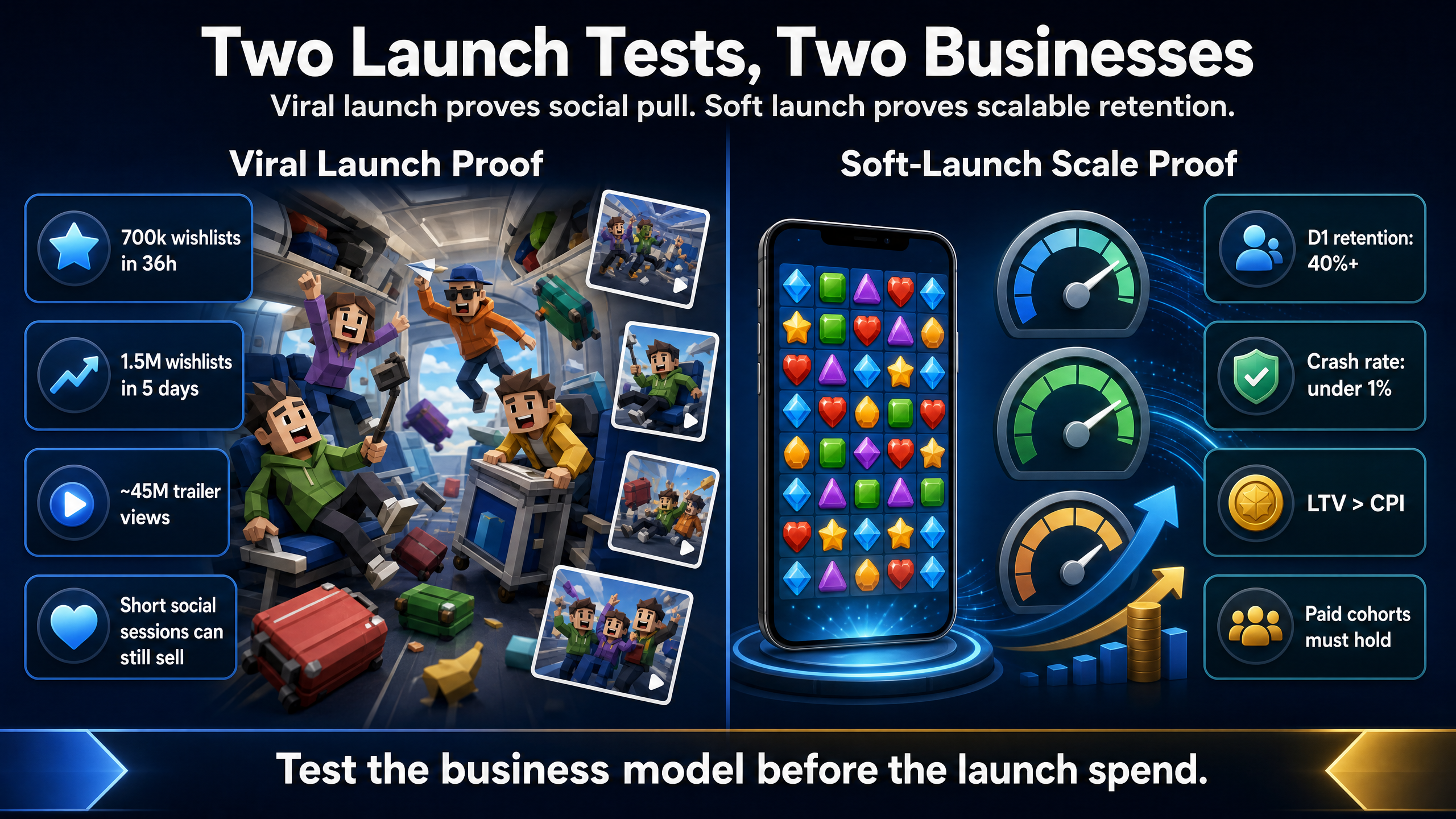
Naavik’s friendslop piece is useful because it does not treat cheap viral co-op games as a joke. The examples are concrete: Dear Passengers reportedly reached 700,000 Steam wishlists in 36 hours and 1.5 million in five days, while its trailer pulled roughly 45 million views.[1] Meccha Chameleon, cited in the same analysis, took two developers two months to make and sold 15M copies in 26 days.[1]
The pattern is not just low-poly art or sloppy execution. The product promise is social: funny physics, proximity voice, short sessions, a low buy-in, and clips that make a friend say “we should play this tonight.” Naavik also notes that these games can average roughly 3% D30 retention and still make sense because most revenue is captured around launch.[1]
For larger live-service teams, the lesson is direct. Some games are not trying to become a daily routine. They are trying to become a brief shared event. If the business depends on a short social spike, the launch test is shareability, price friction, group conversion, and clone risk. D30 retention still matters, but it is not the same pass-fail number it would be for a mobile game buying millions of installs.
Soft Launch Proof Filters Out Expensive Mistakes
AppAgent’s soft-launch guide makes the opposite case for the titles that do need scale. It frames soft launch as a staged test of whether the game can become a business: technical health first, retention next, monetization after that, then scaled spend.[2]
The guide gives useful decision rules. A title moving toward global launch should show clean tracking, crash rates under 1%, D1 retention around 40% or better for a healthy casual title, and projected LTV above CPI.[2] Those numbers are not decoration. They stop a team from turning an expensive worldwide launch into an expensive lesson.
This is where many teams blur two different kinds of confidence. Wishlists, comments, trailer views, and influencer clips can prove that people understand the promise. They do not prove that paid cohorts retain, spend, watch ads, or survive onboarding. For a F2P mobile game, the real launch question is not “can people get excited?” It is “can paid attention become profitable attention?”
The launch test should match the cost structure. A low-priced premium game can survive on social urgency. A paid-UA mobile game needs cohort economics before it deserves scale.
Creative Proof Has To Match The Game Feeling
The most useful bridge between those worlds is creative testing. Alexandra Pulinets’s AppAgent column on PocketGamer.biz argues that the best ads recreate the same emotional loop as the game: instant readability, visible progress, near-completion tension, and satisfying closure.[3] That is a cleaner way to think about marketability than asking whether an ad is polished.
For puzzle games, the article points to playables, gameplay videos, and ASMR-style creative because they let players feel the fixable mess before they install.[3] For friendslop, the equivalent proof is not a perfect tutorial video. It is a clip where the social joke lands in seconds. For a premium sports title, the proof may be whether the channel lets the design avoid monetization compromises. EA’s comments on Madden NFL 27 Arcade Edition and Apple Arcade make that channel-product fit explicit: the pitch was a no-ads, no-IAP home for a specific kind of mobile sports experience.[4]
That gives studios a practical test design rule: do not measure generic interest. Measure the emotion the game will actually sell. For a sorting puzzle, test the moment of relief. For a chaotic co-op game, test the clip that makes friends recruit each other. For a F2P economy, test whether the first sessions and monetization can carry paid traffic.
Business Model Comes Before Launch Ritual
PocketGamer.biz’s profile of Triband and Midjiwan is a useful reminder that not every durable game business has to become an aggressive F2P machine.[5] Triband has built comedy-led games around Apple Arcade and small teams. Midjiwan turned The Battle of Polytopia from a solo 2016 project into 25 million organic downloads with expansions and cosmetics rather than a mobile-standard currency grind.[5]
Those examples are not an argument that subscriptions, premium, or light monetization are easier. They are a reminder that launch planning should start with the business you are willing to run. A studio that wants a decade-long mobile strategy game needs one set of proof. A studio that wants a funny co-op launch window needs another. A publisher buying global hypercasual scale needs another again.
At the other end of the market, large publishers are buying the capabilities that small teams can often avoid. Tripledot’s $40 million acquisition of Supersonic was framed around closing the gap between faster game creation and the growing complexity of global scale.[6] That is not the same challenge as getting four friends to buy a funny Steam game for one evening. It is a publishing, data, creative, and capital problem.
Channel Access Is Another Launch Test
Distribution changes can also change what should be tested. Aptoide’s return to Google Play in the US through Google’s Play Catalogue Access programme is not only an app-store-policy story.[7] It is a reminder that channel access can change discovery friction, trust, install paths, and partner economics.
That does not mean every studio should chase every new store or platform opening. It means channel fit belongs in the launch plan. The test is whether the channel lowers install friction, improves trust, preserves measurement, or changes payer quality enough to justify the extra work. A game with strong organic pull may need a frictionless group-buy path. A F2P mobile game may need stores, geos, and paid channels that produce readable CPI and LTV. A subscription game may need a platform where the lack of ads and IAP is a feature, not a missing revenue line.
AC&A made a related argument in Great Mobile Games Are Managed as Habits, Not Hits: return behavior is designed, not hoped for. Channel access only matters if it helps the desired player behavior appear. Teams should decide what behavior they need to see, then build the smallest credible launch test that can show it.
What Game Launch Testing Should Prove First
The practical takeaway is not “skip soft launch” or “always soft launch.” It is to name the business model before naming the launch ritual. Good game launch testing makes that choice explicit before budgets, timelines, and sunk cost make it harder to change.
- For viral paid co-op games: test whether the premise spreads in seconds, whether friends recruit friends, whether price friction is low, and whether quality is good enough that rough edges feel funny rather than broken.
- For F2P mobile games: test clean data, crash rate, D1 to D7 retention, LTV versus CPI, payer conversion, ad engagement, and creative before global scale.
- For puzzle and casual titles: test whether ads recreate the core emotional loop, not just whether they look expensive.
- For subscription or premium games: test whether the channel reinforces the design promise and whether the audience understands what they are buying.
For teams making that call, AC&A’s games consulting services often turn the launch plan into a decision tree: scale, stop, change the product, change the channel, or change the business model.
Launch discipline is not one checklist. It is the ability to say, before the expensive part begins, what would make the team scale, stop, or change course. The best launch plan is the one that kills the wrong spend early and gives the right game enough evidence to move.
Sources
- Naavik: Friendslop: Disrupting the Live-ops Status Quo
- AppAgent: Soft Launch vs Global Launch for Mobile Games: What’s the Right Strategy?
- PocketGamer.biz: Why simple puzzle games keep players hooked and how to advertise them
- PocketGamer.biz: Why Apple Arcade offered a no-compromise home for EA’s Madden NFL 27 Arcade Edition
- PocketGamer.biz: A tale of two indies: How Triband and Midjiwan outlasted the boom-bust cycle
- PocketGamer.biz: Tripledot acquires Supersonic from Unity for $40m
- PocketGamer.biz: Aptoide returns to Google Play after more than a decade