
Mobile game teams have spent the last few years chasing direct-to-consumer revenue because the math looked obvious: move more purchases away from app-store fees, keep more margin, own more data, and build a closer relationship with players. For mobile game DTC strategy, that logic still matters. But the current evidence is sharper. The easy part is adding another place to pay. The hard part is giving players a reason to use it.
PocketGamer.biz’s Q2 2026 DTC review shows a market that has moved past novelty.1 Some publishers are now running meaningful shares of revenue or bookings through direct channels. Others are finding that migration can improve gross profit while hurting net revenue in the short term. A web shop cannot sit off to the side as a finance project.
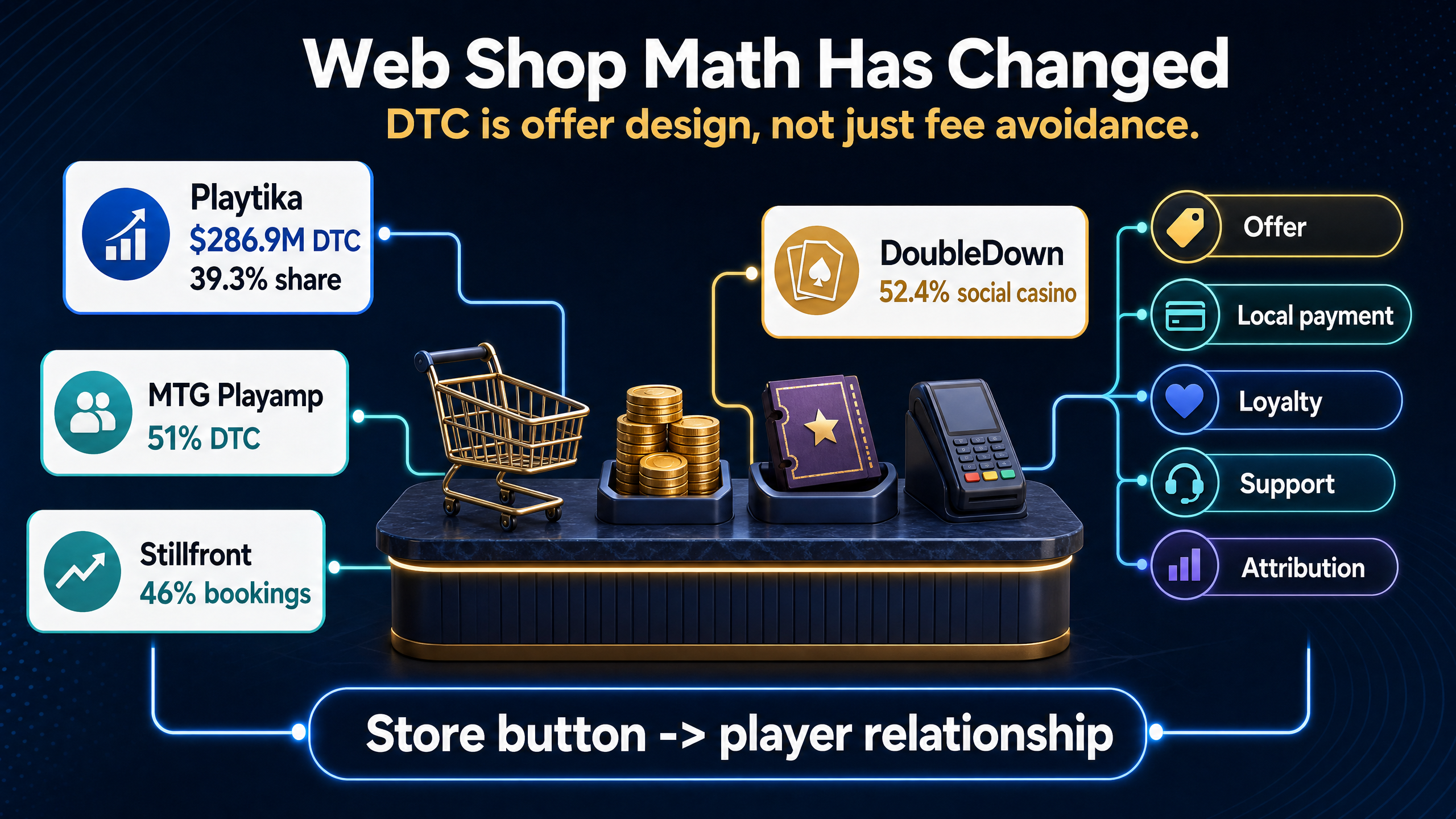
The next DTC advantage is not the store. It is the offer, payment path, and follow-up around the store. A player has to understand why leaving the default checkout is worth the extra step. That reason might be a better bundle, local payment fit, or loyalty progress. For some games, it might be account continuity, VIP service, gifting, creator support, regional pricing, or a cleaner subscription promise.
DTC Is Now Margin Work, Not Magic
The PocketGamer.biz numbers are useful because they do not tell one simple story. Playtika posted $286.9 million in Q2 DTC revenue, down 1.7% sequentially but up 63.1% year over year. Its DTC revenue share ticked up to 39.3%, only slightly above Q1, while payment processing on its internal platforms was described as roughly 3% to 4% versus outside DTC platforms that can charge around 5% to 15%.1
Modern Times Group showed a different shape: DTC accounted for 38% of group revenue, down from 39% in the prior quarter, while its midcore Playamp division reached 51%, up from 49% in Q1 and 31% a year earlier.1 Stillfront said DTC made up 46% of bookings, up from 39% a year earlier, but also said player migration to its own platform was negative for net revenue while improving gross profit and gross margin.1 DoubleDown reported $40.5 million in DTC revenue, or 52.4% of social casino revenue, which makes the channel material enough to demand product ownership, not just finance reporting.1
Product leaders should study the tension, not only the headline share. DTC can improve unit economics and still create near-term revenue pressure. It can grow in one portfolio division while flattening elsewhere. There is no universal DTC benchmark that replaces product judgment.
Outside The Store Still Has Tolls
The Apple/Epic dispute is a reminder that “outside the App Store” does not mean “free of platform economics.” PocketGamer.biz reported Apple’s proposed US link-out fee structure: 15% for standard apps, 10% for certain partner programs and subscription renewals, and 5% for Small Business Program apps.2 Epic rejected the proposal and argued that Apple’s filing was outside the bounds of the Ninth Circuit’s guidance.
Whatever the final legal outcome, the product lesson is clear. If a studio’s direct-payment plan only works when the platform fee goes to zero, the plan is fragile. The player offer has to survive real costs: payment processing, fraud, tax, refunds, support, attribution gaps, customer-service load, discounts, loyalty liability, and the app-store relationship itself.
AC&A read: direct commerce should be modeled as a product path with its own margin, conversion, trust, and retention assumptions. If the plan is only “save the fee,” it is not ready.
Checkout Is Part Of The Game Economy
Xsolla’s new product wave is more interesting than a normal vendor release because it treats checkout as only one piece of the work. PocketGamer.biz says Xsolla Web Shop already powers more than 800 mobile web shops, and the new release connects loyalty, subscriptions, chat commerce, no-code live ops, analytics, attribution, local payments, creator programs, and backend services around the transaction.3
The local-payment detail matters. Xsolla is adding more than 15 methods across three continents, including ShopeePay in the Philippines, Konbini 7/11 in Japan, Zip Co in Australia, Wero in Germany and Belgium, CliQ in Jordan, and Aeropay in the United States.3 Venmo’s arrival on Google Play points in the same direction from inside the platform: payment choice is becoming part of accessibility and conversion, not just back-office plumbing.4
Payment choice moves DTC decisions into the product plan. A payment method can affect conversion by country, but it can also affect bundle design, price points, offer timing, VIP messaging, refund risk, and support volume. A web shop can improve payer economics, but it can also fragment the player journey if the app, account, CRM, and live ops calendar do not recognize the same player.
The same test applies when a mobile game DTC strategy combines store payments, web-shop sales, ads, subscriptions, and convenience purchases inside one value ladder.
Hybrid Monetization Needs A Clear Player Promise
Digimon Up is a good caution because the title does not depend on one money path. PocketGamer.biz reports an estimated $10 million in first-month gross player spending across Google Play and the App Store, with total earnings likely higher after its web shop and rewarded ads are included.5 The same article describes gacha, battle passes, subscriptions, optional ads, ad removal, cosmetics, and idle-battle acceleration.
Players have to interpret all of those paths. The mix may be right for the product, but it can also create a noisy value ladder if each path is optimized in isolation. Launch decay is normal in mobile games; the caution is how quickly the offer mix has to prove a durable reason to pay. PocketGamer.biz reports that spending rose from $790,000 on launch day to $1.1 million on day two, then declined over the following weeks to $75,000 in daily spend by the end of the first month.5
Hybrid monetization can work, but it needs a hierarchy. Which purchase is for progress? Which is for identity? Which is for convenience? Which is for loyalty? Which is there because a specific country or audience pays that way? If players cannot tell what each purchase path is for, the team should not expect cleaner data from adding more paths.
The Mobile Game DTC Strategy Playbook Is Now Mainstream
PocketGamer.biz’s source article also points readers to several DTC video discussions, which is a useful signal by itself: direct commerce has moved from specialist payments work into the mainstream mobile games conversation.1

The mainstreaming creates a new risk. When a tactic becomes common language, teams start copying the visible part. In DTC, the visible part is the storefront. The durable part is the work around it: offer design, segmentation, payment fit, compliance, support, loyalty, player data, creator attribution, and live ops timing.
This is the next step after AC&A’s earlier point that more game channels do not automatically create more control. Control comes from knowing what each channel is allowed to change. In DTC, the answer cannot be “checkout location” alone.
A mature mobile game DTC strategy should start with player value, not store placement.
How To Audit A Web Shop Plan
Before a studio adds or scales a web shop, product leaders should be able to answer five questions:
- What player value changes? Better price, exclusive bundle, regional payment fit, loyalty reward, gifting, creator support, subscription clarity, or account continuity?
- What in-game behavior sends the player there? Event cadence, VIP milestone, replenishment need, collection goal, social gift, or reactivation offer?
- What cost remains after the app-store fee changes? Processing, tax, fraud, chargebacks, support, discounts, tooling, attribution, and player-service time.
- What retention proof matters? Do web-shop buyers return longer, churn faster, spend more sustainably, or only pull purchases forward?
- Who owns the decision after launch? Product, economy, UA, live ops, finance, support, platform, or one named cross-functional owner?
DTC is no longer a question of whether a game can put checkout on the web. The better question is whether the game has an offer strong enough, a payment path clean enough, and a follow-up loop useful enough to make the player relationship better after the purchase.
For teams working through that choice, AC&A’s games consulting services can help turn channel, economy, and live ops plans into concrete tests before a studio adds another store to maintain.
Sources
- PocketGamer.biz: How much direct-to-consumer revenue are publishers actually making?
- PocketGamer.biz: Apple proposes 15% US link-out fee as it seeks settlement talks with Epic Games
- PocketGamer.biz: Xsolla to launch its biggest product wave yet
- PocketGamer.biz: Venmo becomes payment option on Google Play
- PocketGamer.biz: Digimon Up player spending hits $10m in one month with hybrid monetisation model