
Game studios have more distribution options than they did a few years ago. That does not mean they have more control.
Direct-to-consumer stores, renewed App Store access, Roblox experiences, UGC platforms, AI character agents, creator communities, web shops, and context-aware creative testing all promise some version of the same thing: a better route to the player. The strategic mistake is treating each of those routes as a separate growth hack.
The practical question is more basic: which parts of the player relationship does the studio actually control?
That question sits behind several current games-industry signals. FastSpring argues that D2C has moved from an edge case to a core mobile games strategy as Epic-related rulings and platform-rule changes make web stores more viable.1 Fortnite’s global iOS return produced an estimated 3.4 million first-week App Store downloads, but App Store spending rose only to a six-week high.2 GDC trend coverage similarly frames D2C, mobile monetization, AI, and co-development as live operating concerns for studios.3 FIFA is moving from a single-partner model to a multi-partner digital football ecosystem spanning Roblox, Epic, Konami, SEGA/Sports Interactive, Gamefam, Mythical, Solace, Netflix, and Delphi.4
The common thread is not “add more channels.” It is that every new route to the player now creates product work: account identity, offers, payment paths, community, creator incentives, support, trust, and learning. The studios with an advantage will not be the ones that merely bolt on a web store, ship a Roblox experience, open a creator program, or generate more ads. They will be the ones that connect those channels into one plan for demand, retention, spend, trust, and learning.
AC&A read: a new channel only matters if it returns one of three things: player identity, repeat behavior, or product learning.
Platform Access Is Reach, Not Control
Platform access is reach inventory, not relationship ownership. Fortnite’s global iOS return is a useful warning against confusing access with ownership. The reach signal was enormous: PocketGamer.biz, citing AppMagic estimates, reported roughly 3.4 million App Store downloads in one week, a 1,408% daily install surge after the global return, and a daily peak of 674,000 downloads on May 23.2
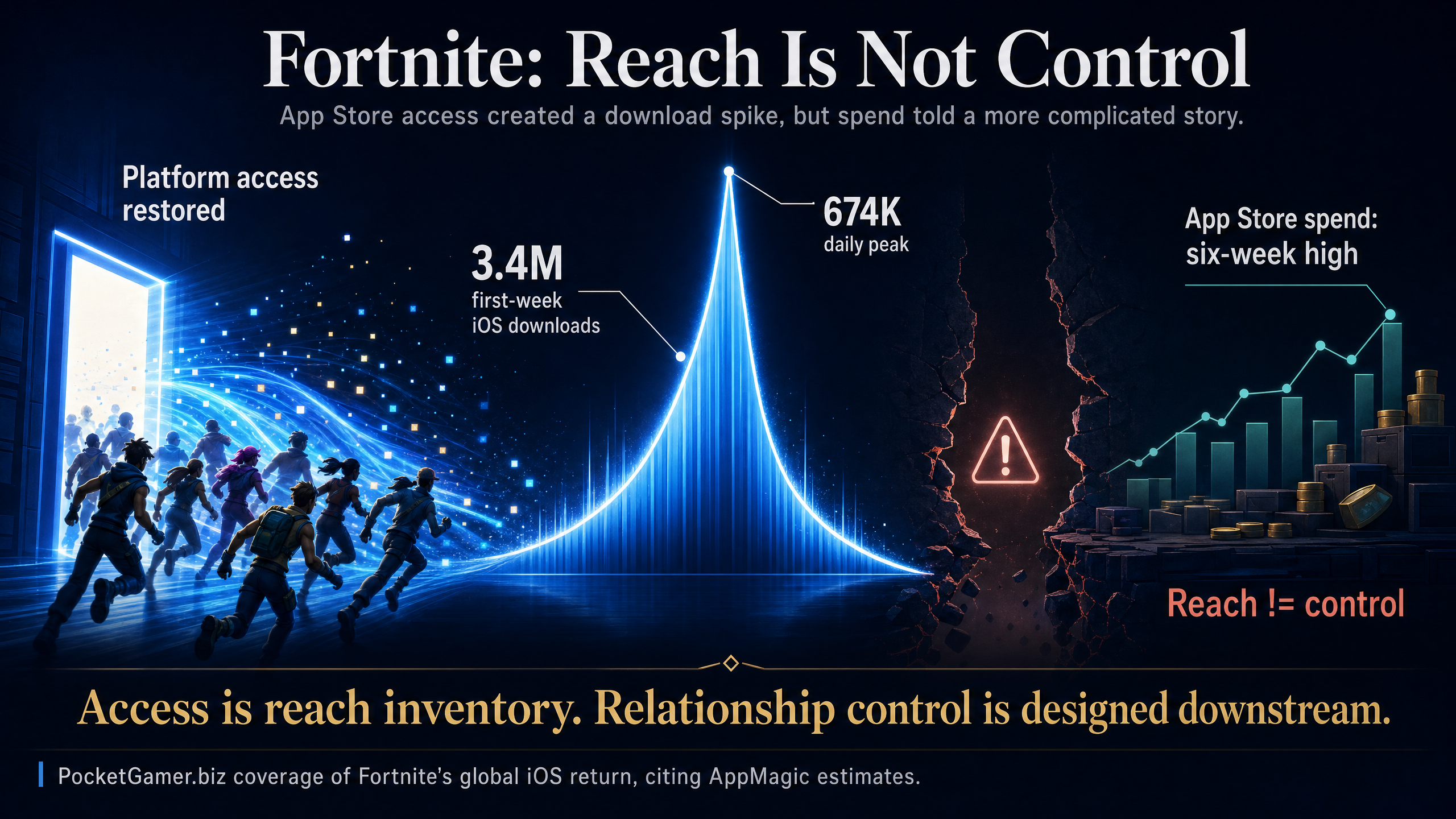
But the monetization signal was more ambiguous. The same article noted that player spending through the App Store reached only a six-week high, with possible spending through Epic’s web shop or delayed payer conversion. That gap is the point. Platform access can restore visibility and remove friction, but it does not automatically restore the studio’s preferred economics or relationship with the player.
For studios, the lesson is practical. Treat platform distribution as reach inventory. It can create a surge of installs, returning users, press coverage, and store visibility. It should not be mistaken for a durable player relationship unless the studio also controls account identity, offers, community, messaging, support, payment paths, and the data needed to act on those behaviors.
D2C Is A Repeat System, Not A Fee Hack
D2C is useful when it creates repeat behavior, not just when it avoids fees. Platform fees are visible and politically charged, so D2C gets discussed as a margin story. That is incomplete. Fee avoidance can improve economics, but it does not create demand by itself.
The most useful signal in PocketGamer.biz’s FastSpring interview is repeat behavior. FastSpring’s Chip Thurston said more than 90% of web-store purchases come from customers who made a D2C purchase in the prior 30 days.1 That makes D2C less like a cheaper checkout page and more like a relationship loop.
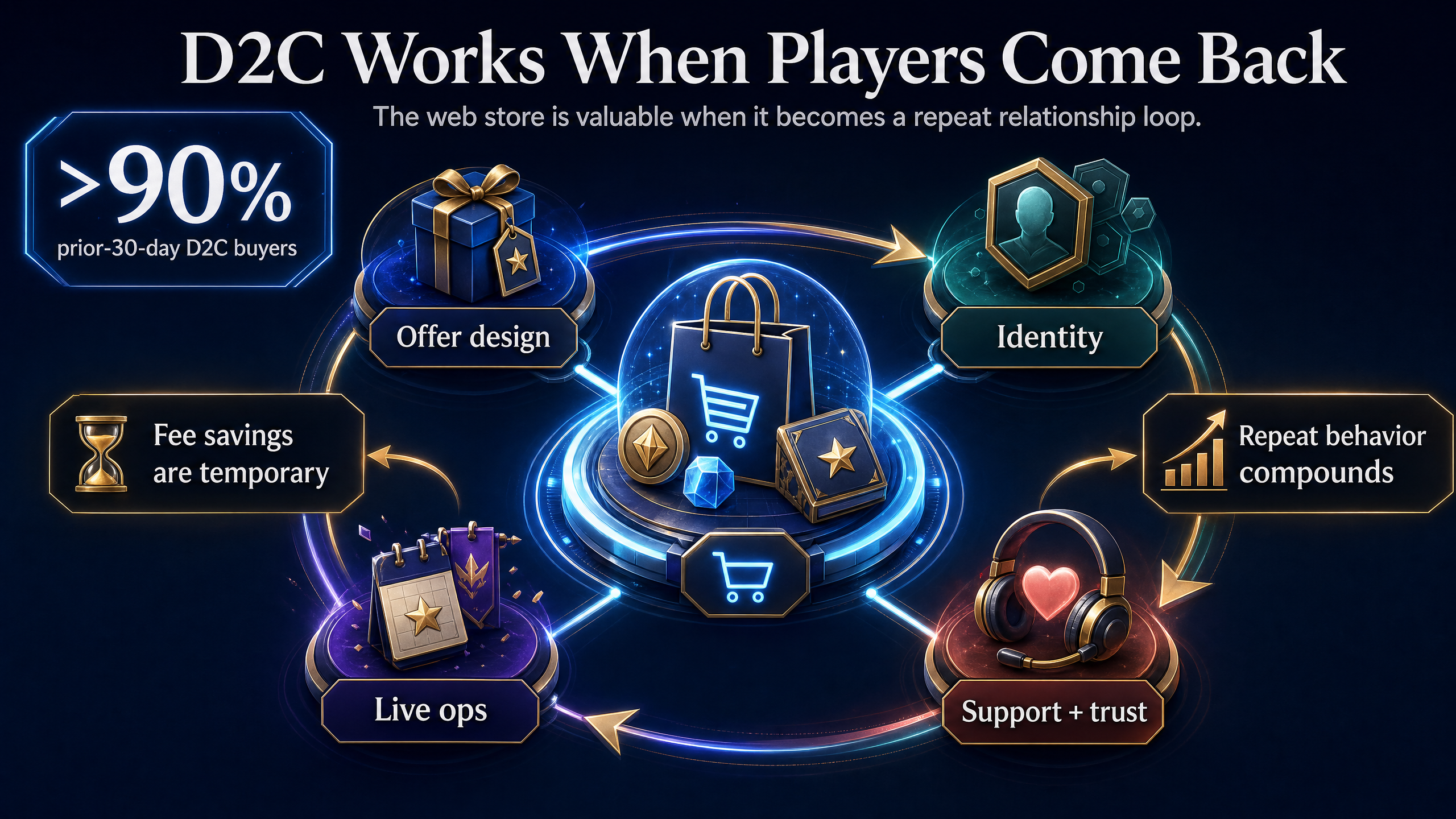
That distinction changes the work. A web store needs offers worth leaving the app for, a clear reason to return, identity that survives across channels, player-safe payment flows, customer support, live-ops timing, and product logic that does not punish the player for buying outside the storefront. The store is the visible part. The operating system around it is where the advantage comes from.
This is also why the “no-fee window” is the wrong mental model. Platform holders will keep changing fees, steering rules, service definitions, and billing mechanics. A studio that treats D2C as a temporary arbitrage will keep rebuilding around someone else’s policy. A studio that treats D2C as a owned-retention and owned-commerce capability has something that survives rule changes.
IP Strategy Needs Clear Channel Jobs
A channel mix only works if each channel has a job. FIFA’s digital football strategy shows the same shift from another direction. The move away from a single-partner model is not simply a licensing reset. It is a portfolio approach to audience channels: Roblox and Gamefam for participatory play, Konami for esports competition, Epic and Fortnite-adjacent reach, SEGA/Sports Interactive for simulation depth, Mythical and Solace for additional formats, and a Netflix/Delphi project for another branded football experience.4
The scale signals matter. FIFA Super Soccer on Roblox has passed one billion plays and attracts more than 10 million monthly active users. FIFA Rivals has passed 2.5 million downloads. FIFAe has involved more than 120 Member Associations and over 16 million players, with more than 1.1 billion views last year.4
That is not one funnel. It is a map of different jobs. Some channels create reach. Some create identity. Some create competition. Some build habit. Some are better for kids, families, creators, spectators, or high-intent spenders. The mistake is putting the same KPI on every channel and then declaring half the portfolio a failure.
For AC&A clients, the useful question is: what job does each channel perform, and what information returns to the core operating loop? A Roblox activation that creates social play but no cross-channel identity is only partly useful. A licensed mobile game that monetizes but does not inform future IP demand is leaving signal behind. An esports program that creates viewership but no product learning is brand spend, not strategy.
UGC And AI Agents Move Distribution Inside The Product
UGC turns distribution into product architecture. Tencent’s reported Delta Force UGC initiative is a good example. PocketGamer.biz reported that Tencent IEG recruitment signals point to player creation tools, an in-game editor, content distribution systems, and monetization features for Delta Force, which surpassed 50 million daily active users in China in March 2026.5
At that scale, UGC is not a content feature. It is a distribution system. The product has to decide what gets made, what gets surfaced, what gets monetized, what gets moderated, which creators receive leverage, which players see which content, and how the core game survives the incentives it creates.
Saga’s AI influencer-style character agent points at a similar boundary shift. Crystal Beaumont exists inside Diamond Jewels and on social platforms, while Saga’s Bonoxs Arena integration positions an AI character as a Discord community manager for a tournament platform serving 100,000 monthly users.6 If that work is measured only as “more content” or “cheaper community management,” it will underperform. If it is wired into retention, support, social participation, campaign timing, and trust, it can become part of the player relationship.
The risk is that AI agents and UGC tools create the illusion of owned distribution while actually increasing operating complexity. More content means more ranking decisions. More creators mean incentive design. More automated interaction means moderation and brand safety. More community channels mean more ways to disappoint players publicly.
Creative Needs Context, Not Just Volume
Creative testing needs context, not just more assets. Mobile Dev Memo’s DeCANT essay is useful because it does not treat AI creative as magic output volume. It starts from the opposite premise: automated ad platforms are increasingly opaque, advertiser-side levers are limited, and generative tools can inflate the number of creative assets without increasing the diversity of ideas being tested.8
DeCANT is described as a pre-testing gate that models expected ROAS from creative and deployment context. The underlying empirical setting used nearly 100,000 ad-level observations and more than 10,000 unique creatives. The broader lesson for game studios is not that every team needs that exact architecture. It is that creative should be evaluated in context:
- Where it runs: country, channel, and placement.
- How it appears: timing, format, and message.
- Who it interrupts: the player state at the moment of exposure.
That matters because channel control is not only about where the player can buy. It is also about which promise the player sees, how the studio learns from that exposure, and whether campaign outcomes improve product decisions. More assets without a structured testing gate can make the team feel faster while making the learning system worse.
Mobile Dev Memo’s audience-building podcast adds the adjacent caution: rented social distribution can distort demand signals, while weak audience portability leaves creators and businesses exposed to platform incentives they do not control.7 Games have the same problem. A viral clip, a paid ad spike, or a creator activation is not owned distribution unless the studio can carry the relationship into the next product, event, purchase, or community touchpoint.
What Teams Should Do
More channels only create control when they improve the studio’s relationship with the player. Every growth channel creates product consequences.
A studio building around this reality should answer six questions before it scales a new channel:
- What job does this channel perform: reach, monetization, retention, learning, trust, community, or creator supply?
- What player identity or behavioral signal comes back to the studio?
- What product, economy, live-ops, or creative decision changes because of that signal?
- What repeat behavior makes the channel durable after the first spike?
- Which platform-rule or algorithm change would break the plan?
- Who owns the operating loop across product, UA, economy, community, support, and analytics?
The answer is rarely “do less distribution.” Most studios need more ways to reach players, not fewer. But every new channel should either improve the player relationship or teach the team something it can use. Otherwise it is only another rented channel with a better launch headline.
Sources
- PocketGamer.biz: “The future couldn’t be brighter for D2C”: FastSpring’s Chip Thurston on gaming’s changing platform economy
- PocketGamer.biz: Fortnite’s global iOS comeback drives downloads to eight-year high
- PocketGamer.biz: D2C, co-development and “volume over viability”: GDC 2026 trends revealed
- PocketGamer.biz: FIFA outlines multi-partner digital football strategy ahead of 2026 World Cup
- PocketGamer.biz: Tencent reportedly preparing UGC initiative for Delta Force
- PocketGamer.biz: Saga introduces AI influencer agent to mobile game Diamond Jewels
- Mobile Dev Memo: Podcast: The New Economics of Building an Audience (with Danny Frankel)
- Mobile Dev Memo: Introducing DeCANT, a context-conditioned, attention-based multimodal architecture for creative pre-testing