
Every major games company can now say the same sentence: we need to reach players everywhere. Console games want PC. PC games want performance marketing. Mobile games want web stores. Western studios want China and India. Platform holders want mobile scale without admitting that mobile changes the operating model.
The problem is that “everywhere” is not a strategy. Scale does not come from adding more platforms; it comes from designing the local access layer that makes each platform usable, measurable, trusted, and worth returning to. That is the continuation of AC&A’s earlier point that more channels do not automatically mean more control. The new wrinkle is that the channel list is getting longer while the access problem is getting more local.
AC&A read: the next growth constraint is not awareness. It is whether the studio has the market-specific access model needed to turn attention into durable play, payment, and repeat behavior.
Hardware Is Pushing Players Away From The Box
Naavik’s July 12 hardware analysis is the clearest macro signal. Its argument is that AI data-center demand has repriced memory, which has pushed console economics into unfamiliar territory: mid-generation price increases, more expensive future boxes, and pressure on the old model where hardware costs fall while software monetization expands the installed base.[1]
That matters to mobile and F2P studios because fewer affordable boxes means more demand will be absorbed by devices and channels players already use: mobile, PC, browser, cloud, social platforms, and super-apps. Naavik’s article is about console economics, but the strategic implication is broader. If the next device cycle cannot cheaply expand the market, growth has to come from better access to existing player behavior.
A hardware price shock makes the access layer more important than the hardware layer. A studio that treats mobile, web, Steam, regional stores, D2C, and cloud as ports will miss the point. Those channels are not just distribution endpoints. They are different answers to “how can this player enter, pay, resume, share, and trust the game from where they already are?”
Xbox’s Billion-Player Target Is Really An Access Problem
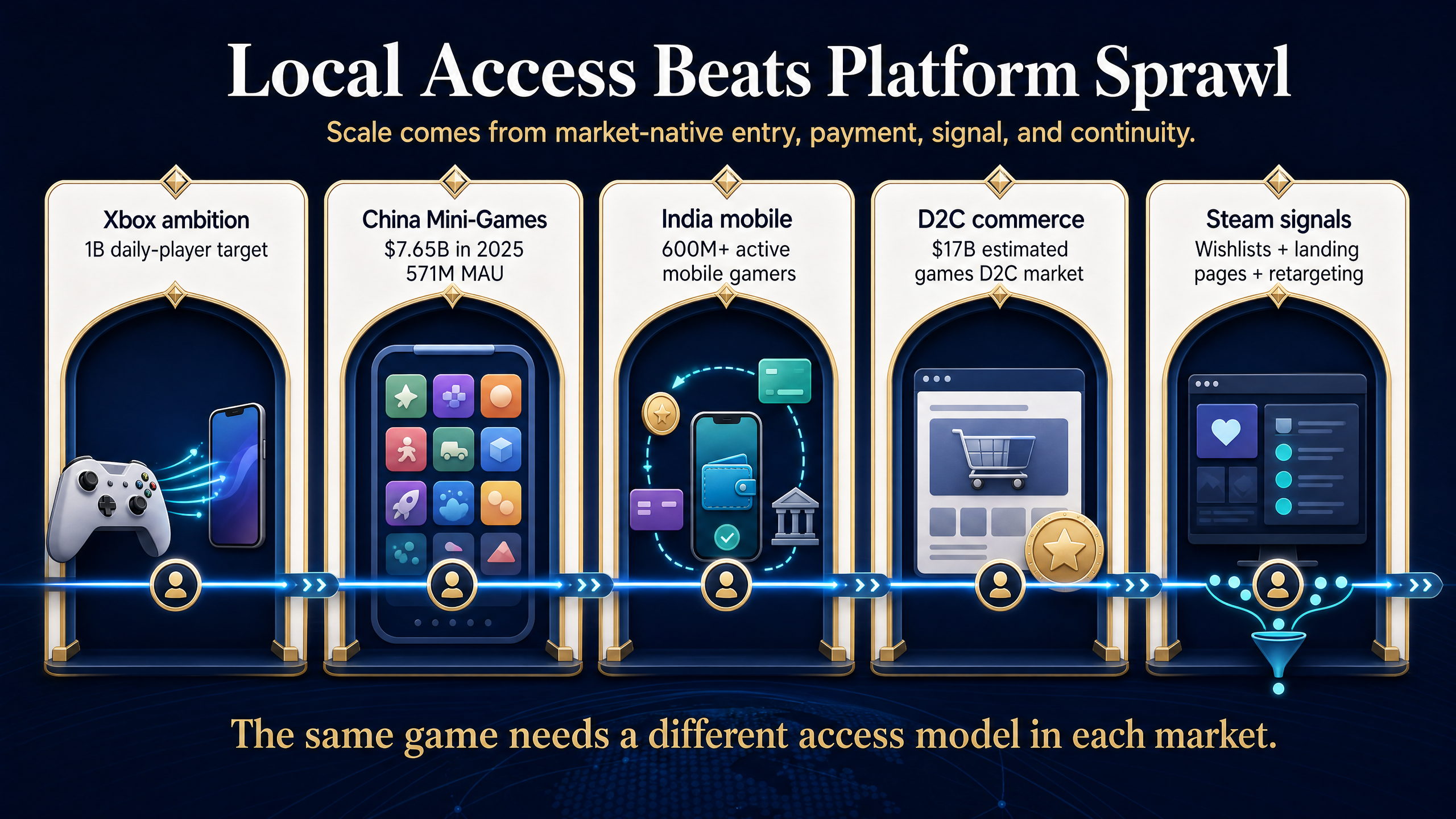
PocketGamer.biz’s analysis of Xbox’s reset turns that access problem into a strategic case study. Xbox is cutting thousands of roles, divesting studios, and aiming to entertain more than a billion people each day. PocketGamer’s read is blunt: to get anywhere near that ambition, Xbox needs mobile, F2P, live services, Minecraft, King, cross-platform distribution, and probably a more advertising-aware economic model.[2]
A companion PocketGamer report on Asha Sharma’s restructuring comments adds the operating pressure: Xbox’s console business still carries most of the company, but rising hardware component costs, lower revenue, overextended studio investment, and underinvestment in key franchises forced a reset. Sharma said the platform must also be available on mobile and PC.[3]
The mistake would be reading that as a simple platform expansion story. Xbox does not become a billion-player business by putting the same premium-console assumptions on more screens. It has to decide which parts of King and Mojang are actual access infrastructure: live ops cadence, UA testing, creator ecosystems, family-safe play, community identity, account continuity, ad monetization, and low-friction re-entry.
For any studio, scale ambitions expose operating gaps fast. If the business depends on a billion-player funnel, then platform presence is only the first row in the spreadsheet. The hard rows are payment fit, acquisition signal, content cadence, device constraints, compliance, community support, and retention loops by market.
Steam Needs Signal Engineering, Not Mobile UA Cosplay
Naavik’s Steam performance-marketing episode makes the same point from the other direction. Steam is not a country, but it behaves like a local access environment because discovery, intent, payment timing, and data visibility are all platform-specific. The episode argues that mobile has spent years building paid acquisition discipline, while many PC and console studios still rely on festivals, press, influencers, brand beats, and creator coverage. The interesting part is not “bring mobile UA to Steam.” It is that the Steam stack has different signals: wishlists, landing pages, long purchase windows, limited store data, cross-device attribution, retargeting, and incrementality testing.[4]
That is a useful corrective. Mobile growth knowledge travels, but it does not travel as a template. A mobile team can bring creative testing, funnel discipline, LTV thinking, cohort readouts, and experimentation cadence. But Steam does not give the same post-install event stream, transaction path, or platform levers. A campaign that performs well on mobile can still fail on PC if the access path does not understand how PC players discover, defer, wishlist, discuss, wait for sales, and eventually buy.
Performance marketing only works when the studio can observe the player’s next useful action. On mobile that may be install, tutorial completion, payer conversion, subscription trial, or D7 retention. On Steam it may be wishlist quality, landing-page intent, creator-assisted traffic, demo behavior, forum response, or sale-window conversion. The operating muscle is the same. The access data is not.
China And India Show Access Is Local
The clearest regional examples are China and India. PocketGamer.biz’s China Mini-Games data summary reports that China’s Mini-Games market generated about $7.65 billion in 2025, up 34.39% year over year, and is forecast to reach about $9.72 billion in 2026. WeChat Mini-Games alone recorded 571 million industry-wide MAU, and revenue was split between IAPs and ads rather than just one monetization path.[5]
That is not just a China-growth headline. It is an access lesson. Mini-Games work because they fit existing super-app behavior: no separate download, familiar payments, social sharing, ad and IAP monetization, and platform terms that publishers can model. A Western studio cannot treat that as “ship a web game in China.” The access layer is the game.
India shows the other side. PocketGamer.biz’s coverage of the India State of Play report says India has more than 600 million active mobile gamers and 7.95 billion annual installs, but monetization still trails usage. The same piece points to the fallout from real-money-gaming regulation, growing digital payment infrastructure, genre differences, government support, and an IAP/IAA forecast of $1.5 billion in 2026.[6]
The implication is simple: player count is not access. Downloads are not monetization. A large mobile audience only becomes a business when the game fits the market’s payment rails, device base, genre expectations, regulation, acquisition economics, and local community norms.
D2C Only Works When It Adds Incremental Behavior
Direct-to-consumer commerce is another access layer, not just a fee workaround. PocketGamer.biz’s interview around Appcharge and GDC’s D2C estimate frames the global games D2C market at roughly $17 billion, about 15% of the global IAP sector. In the Appcharge/GDC survey data discussed in the same article, 92% of publishers expect D2C revenue to grow, and leading adopters report stronger uplift than the median.[7]
The useful question is not whether a web store can save platform fees. That is table stakes. The better question is whether D2C changes behavior. Does it create better bundles, creator attribution, loyalty, local payment coverage, offer testing, player support, reactivation, or account continuity? Does the studio know which users should be sent there, when, and with what value proposition?
If the web store is only a cheaper checkout, it will be evaluated as a cheaper checkout. If it helps deepen the player relationship, it can improve measurement, retention, merchandising, creator programs, and cross-platform identity. That is why D2C belongs in the same access conversation as Steam, Mini-Games, India, and Xbox. It is another way to enter the player’s life on terms the app store does not fully control.
Partnerships Have To Translate Operations, Not Just Rights
The most grounded partnership signal came from PocketGamer.biz’s interview on Thatgamecompany and NetEase growing Sky: Children of the Light in China. SJ Xue describes the partnership as co-development, shared technical problem-solving, cultural context, live ops knowledge, community understanding, and trust built through daily work. Capital and market access started the relationship, but they did not make it durable.[8]
That is the part many expansion plans underweight. A local publisher, platform partner, D2C vendor, ad network, or regional monetization provider is not a magic door. The partner has to translate the game into local operating reality without stripping out the reason players care. In China, that might mean ad quality, SDK stability, privacy, compliance, payment habits, and local live ops. In India, it might mean payments, genre fit, RMG sensitivity, language, device mix, and youth-market behavior. On Steam, it may mean wishlist signals and creator-assisted consideration. On Xbox, it may mean changing the company around King and Mojang rather than just using them as audience pools.
The Local-Access Checklist
Before adding a platform, market, store, partner, or D2C path, force the team to answer the access questions that sit below the growth headline:
- Entry: What is the player’s native way into the game in this market or channel: store search, super-app, creator link, wishlist, web checkout, cloud, partner launcher, or social invitation?
- Signal: What is the next observable action that proves intent before purchase or long-term retention?
- Payment: Which payment rails, price points, taxes, platform fees, refunds, and local habits shape the offer?
- Continuity: What progress, identity, inventory, creator attribution, rewards, or support expectation must travel with the player?
- Rules: Which regulations, platform policies, age gates, privacy constraints, or content requirements can block access after launch?
- Partner role: What local operating capability is the partner actually providing beyond a logo, license, or market-entry promise?
The answer will not be the same for a premium PC launch, a casual puzzle game in India, a WeChat Mini-Game, a D2C-heavy casino-adjacent mobile portfolio, or a family-safe UGC world. The more global the ambition, the less generic the access model can be.
For teams already trying to connect audience signal to product and monetization decisions, AC&A’s player-signal framework is the natural next step. The strategic work is no longer choosing the next platform. It is designing the player access layer that makes each platform earn its place.
Sources
- Naavik: “The AI Boom Is Repricing Gaming Hardware and Rewiring the Console Business”, July 12, 2026.
- PocketGamer.biz: “The future of Xbox: What chasing one billion players means for the console giant”, July 9, 2026.
- PocketGamer.biz: “Xbox CEO says mobile to play key role as Microsoft restructures gaming business”, July 8, 2026.
- Naavik Gaming Podcast: “Can Performance Marketing Finally Work On Steam?”, July 7, 2026.
- PocketGamer.biz: “The key numbers on China’s booming Mini-Games market”, July 7, 2026.
- PocketGamer.biz: “India’s mobile games market set to reach $2.4bn by 2029”, July 10, 2026.
- PocketGamer.biz: “The truth behind mobile gaming’s $17bn D2C market”, July 9, 2026.
- PocketGamer.biz: “How Thatgamecompany and NetEase grew Sky’s community in China”, July 9, 2026.