
Designing games for kids means serving at least two customers. The child decides whether play feels fun enough to continue. The parent decides whether the game gets installed, paid for, and trusted with another session.
That split changes almost every familiar product decision. A mechanic that lifts minutes played can still lose the parent. A store that converts well can still make the game feel unsafe. A trusted character can lower the cost of discovery, while a surprise purchase prompt can undo that confidence in seconds.
Kids’ games do not win by maximizing the child’s engagement alone. They win by giving the child a reason to return and the parent a reason to keep saying yes.
AC&A read: treat parent confidence as a product outcome. Measure whether adults understand the offer, recognize the safeguards, and feel comfortable handing the device back.
Designing Games For Kids Means Serving Two Decision-Makers
Naavik’s analysis of the children’s games market makes the buyer-player split explicit. For younger children, parents largely choose and pay for games; peer influence grows after school starts, and children increasingly make their own choices as they approach nine to twelve.[1]
That creates a short, unusual market window. The person using the product may not understand the subscription, privacy model, content rating, or brand promise. The person judging those things may only watch a few minutes of play. Product leads have to make value clear to both of them without turning the experience into two disconnected apps.
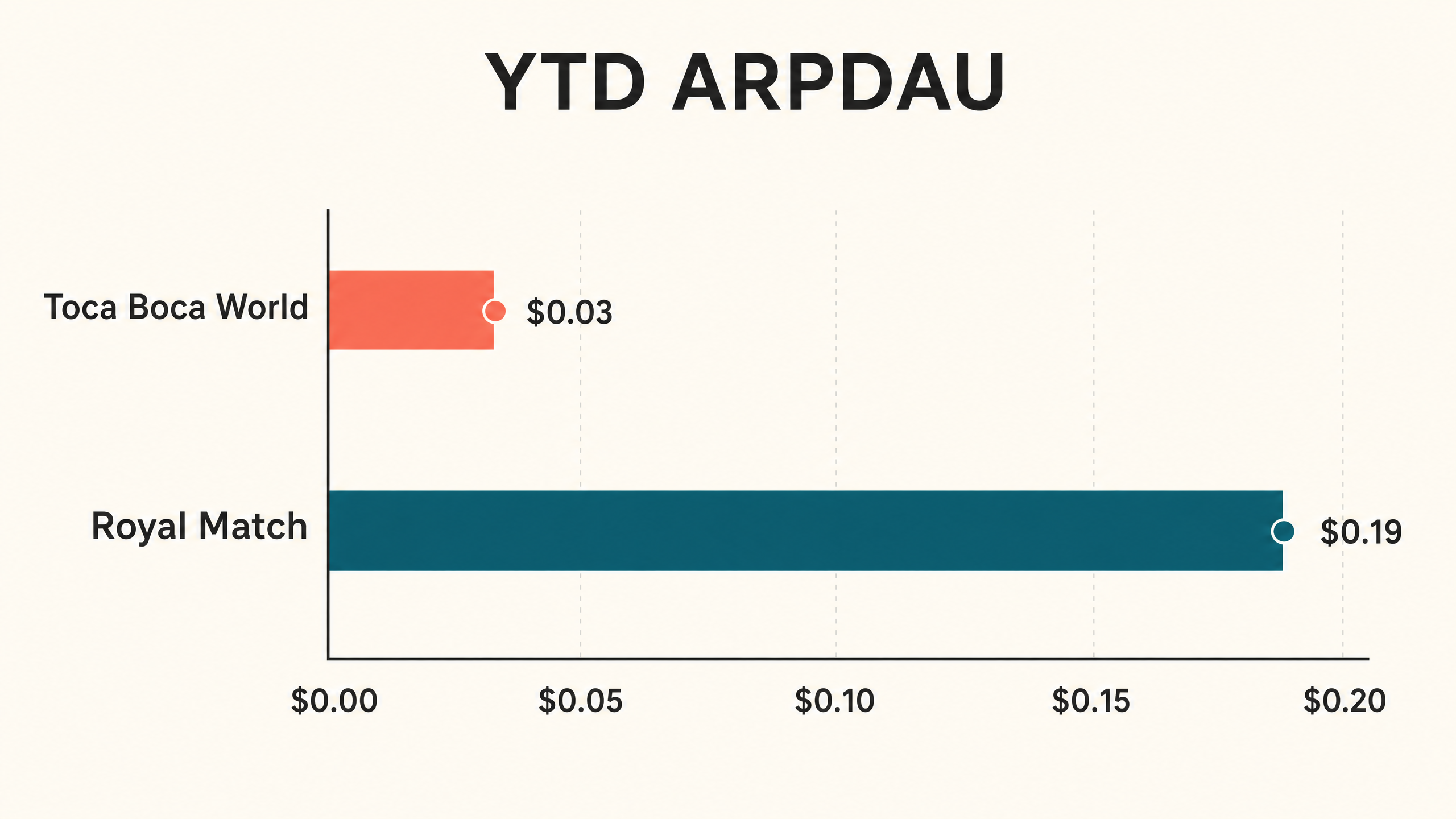
Naavik also reports that Toca Boca World reaches 50 million monthly active users, while Sensor Tower estimates put its year-to-date average revenue per daily active user at $0.03, compared with $0.19 for Royal Match.[1] The point is not that children are a weak audience. It is that adult free-to-play economics cannot simply be shrunk to fit them.
Trust Has To Be Visible Before Play Begins
In many game categories, trust accumulates after the first session. In games for young children, it often has to arrive first. A familiar property helps because the parent already understands its tone. A clear age range, an ad-free promise, and a purchase model without surprises do the same job.
Netflix describes Playground as an app for children eight and under that is included with every membership, works offline, and has no ads, in-app purchases, or extra fees.[2] Those are not footnotes to the game catalog. They are the reason a busy parent can make a fast decision.
Naavik argues that licensed characters work as trust signals and that subscriptions suit the category because they bundle recognizable, parent-approved content into one payment.[1] The strongest offer is therefore larger than access to a list of games. It is relief from having to evaluate every ad, locked room, currency pack, and download separately.
Parents apply the same logic to games that they apply to any platform: they stay when the rules are legible. AC&A has argued more broadly that game platforms grow when people trust those rules. For parents, they must be clear before the child forms an attachment that makes “no” harder to enforce.
Natural Stopping Points Are A Product Feature
Roblox recently turned that principle into a mechanic-level rule. Games in Roblox Kids and Select can no longer combine continuous media feeds, autoplay or automatic scrolling, and rewards for continued watching.[3] PocketGamer.biz’s report on the change notes that even an implied reward can trigger the rule if a typical player would believe continued watching is required.[4]
The important design detail is the lack of a natural stop. A sequence with a clear ending gives a child a moment to choose again and a parent a clean moment to intervene. An infinite feed tied to rewards removes both choices.
For young players, stopping well can be as valuable as starting quickly. A short activity that closes cleanly may produce fewer uninterrupted minutes, but it can earn more approved sessions over time. That is a healthier return reason than making a child feel that the next reward is always one swipe away.
This does not mean every reward, streak, or video is wrong. Roblox’s policy exempts player-initiated, rate-limited rewarded video ads.[3] The practical distinction is control: the player chooses a bounded exchange instead of being carried through an endless loop.
Safety Work Has To Reach The Interface
Trust cannot live only in a policy document. Roblox Kids and Select accounts combine age-based access, additional game reviews, chat defaults, and parental controls.[5] The product tells a family that a younger account is meaningfully different from the standard experience.
There is deeper technical work behind that interface. Roblox says its Sentinel model detects early signs of potential child endangerment. The company reports that nearly 70% of the cases it detected in the twelve months ending August 7, 2026 came from Sentinel’s early detection.[6] Roblox has also open-sourced Sentinel, its PII Classifier for personal information, and a voice-safety classifier through ROOST.
But parents do not experience a classifier directly. They experience whether chat is available, whether a warning appears, whether a report is handled, and whether an age setting actually changes what the child can see. Backstage safety work creates value only when the family can feel the difference in the product.
The pressure is also external. PocketGamer.biz reported that Meta and Roblox agreed to stronger child-safety measures in the Philippines, including age verification, parental controls, faster takedowns, and closer law-enforcement cooperation.[7] Teams should expect the standard to keep moving from general promises toward demonstrable product behaviour.
Score Both Customer Journeys
A useful children’s-game review should score the child journey and the parent journey separately:
- First yes: can the parent understand the age fit, price, ads, purchases, data use, and controls before handing over the device?
- First fun: can the child begin meaningful play without reading-heavy setup, a confusing store, or an adult’s constant help?
- Clean stop: does each activity have a natural ending, and can progress survive a parent ending the session?
- Return confidence: does the child know what to do next while the parent knows what may have changed?
- Payment clarity: can an adult explain what the subscription or purchase unlocks without negotiating around artificial frustration?
- Visible protection: do age settings, chat limits, reporting, and moderation produce differences a family can recognize?
A high child-engagement score cannot cancel a low parent-confidence score. The reverse is also true: a perfectly controlled library that children never ask for has no durable business. The work is to improve both journeys without letting one exploit the other.
Build For The Next Yes
For a team designing or reviewing a children’s game, the best retention question is not “How do we keep the child playing longer?” It is “What makes the next session easy for both people to approve?”
That may lead to a calmer store, a family subscription, a clearer activity ending, stronger age defaults, or a trusted catalog instead of another currency layer. AC&A’s guide to mobile game subscriptions can help teams test whether recurring value is broad and dependable enough to support that choice.
In children’s games, the parent’s repeated yes is part of retention. Design for it as deliberately as the child’s next tap.
Sources
- Naavik: The Future of Kids Gaming
- Netflix: Netflix Expands Kids Entertainment Lineup With Playground App for Games
- Roblox Developer Forum: New Restrictions on Reward-Driven Media Feeds
- PocketGamer.biz: Roblox Restricts Reward-Driven Media Feeds in Kids and Select
- Roblox: Age-Based Roblox Kids and Select Accounts Now Globally Available
- Roblox: Open-Source Safety Models for the ROOST Model Community
- PocketGamer.biz: Meta and Roblox Agree to Strengthen Child Safety Measures in the Philippines