
Understanding whale behavior in mobile games is crucial because these top spenders – just 1-2% of players – generate the majority of revenue. Here’s the key takeaway: whales account for up to 86.6% of total game revenue, often through consistent, smaller purchases averaging $20 each. They typically take longer to convert (about 18 days) but show higher retention rates and lifetime value (LTV). By analyzing their actions, you can improve monetization strategies, predict churn, and refine your in-game economy to solve common balance issues.
Key Insights:
- Who are whales? The top 1-2% of spenders, often contributing over half of a game’s revenue.
- Spending habits: Median ARPPU is $335, with an average of 7.4 purchases per month.
- Data to track: Purchase logs, engagement metrics, and conversion timelines.
- Tools to use: Analytics platforms like GameAnalytics, Amplitude, and deltaDNA help track spending and engagement.
- Retention strategies: Use personalized offers, exclusive content, and VIP perks to keep whales engaged.
Analyzing whale behavior isn’t just about tracking high spenders – it’s about creating tailored experiences, improving long-term retention, and ensuring your game’s economy supports ongoing investment. This approach turns whales into a reliable revenue source while maintaining a balanced player ecosystem.
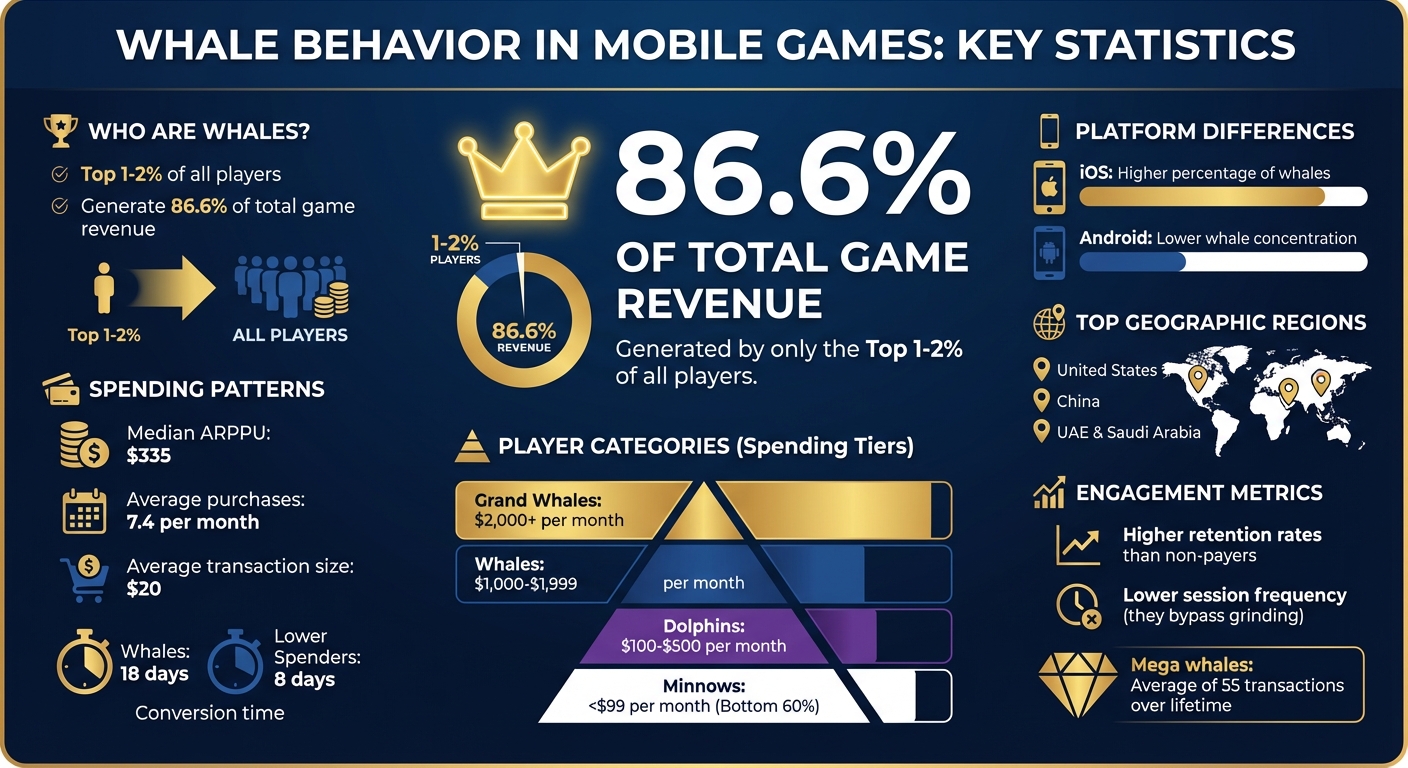
Whale Player Statistics and Revenue Impact in Mobile Games
Inside the Mind of a Free-to-Play Whale

sbb-itb-fd4a1f6
Collecting Data on Whale Users
To understand your whale users, it’s essential to establish reliable systems that capture detailed insights into player behavior, spending patterns, and conversion timelines.
Key Data Sources for Whale Analysis
In-game purchase logs are the cornerstone of whale identification. By tracking transaction size, frequency, and timing, you can calculate each player’s lifetime spend. Since whales typically represent the top 1% of spenders [1][2], maintaining detailed transaction records is critical.
User engagement metrics provide insight into how whales interact with your game. Whales often exhibit higher retention rates but lower session frequency compared to non-paying players [1][3]. This is because they use their purchases to bypass grinding for virtual currency, allowing them to progress more quickly. Pay attention to session duration, feature usage, and the time between sessions to understand their unique playstyle.
Conversion timing data is another key metric. Whales generally take up to 18 days to make their first purchase, compared to 8 days for lower spenders [3]. Tracking "days to first purchase" can help avoid prematurely dismissing new users who may have whale potential.
Platform and geographic data also play a role. For example, iOS users tend to have a higher percentage of whales compared to Android users [1][3]. Additionally, high-value players are often concentrated in regions like the US, China, and Arab countries such as the UAE and Saudi Arabia [1][3].
Using Analytics Tools and Platforms
Managing whale data is easier with specialized analytics tools. Platforms like GameAnalytics (IQ Suite), deltaDNA, devtodev, SuperPlatform, Amplitude, and Mixpanel allow you to track metrics like ARPPU, item-level revenue, virtual currency flows, and even technical indicators like FPS and error rates [9][1][2][4][11][7].
Integrating these tools early in development ensures clean data collection from the start. Real-time log-based systems are particularly useful for capturing user interactions as they occur. This enables you to spot sharp drops in conversion funnels and identify potential whales through early purchase patterns or high session activity [7].
Ensuring Data Accuracy and Privacy
To maintain data integrity, apply techniques like Winsorization, which caps extreme lifetime value (LTV) figures at a specific percentile, such as the 95th percentile. This prevents outliers, like mega-whales, from distorting cohort averages [10]. When setting bid prices for marketing campaigns, use median LTV instead of mean LTV to avoid overspending based on a few high-value users [10].
Privacy is equally important. Modern analytics tools must comply with GDPR and CCPA regulations, offering granular cookie consent options categorized as Necessary, Functional, or Analytical [9][4]. Ensure your data pipelines respect user consent and remain transparent about what data you collect and how it’s used.
Segmenting and Identifying Whale Users
When you have solid data, segmentation can pinpoint players likely to become your biggest spenders. This process not only highlights current whales but also identifies rising high-value users, paving the way for targeted monetization efforts.
Behavioral Segmentation Strategies
Spending patterns are an obvious place to start. Instead of using arbitrary dollar thresholds, consider percentile segmentation to group players based on your game’s specific economy. For example, the top 1% of spenders are often classified as "Grand Whales", while the next 2–10% fall into the "Whales" category [13]. This method adjusts to your revenue distribution, reducing the risk of misclassifying players across different monetization models.
However, spending isn’t the only indicator. Engagement behaviors can help you spot potential whales even before they make significant purchases. These players tend to stick around longer, progress faster, and show interest in competitive or premium features. Key metrics to monitor include session duration, feature usage, and the speed at which users advance in the first 10–14 days. These patterns often hint at future high spenders [3].
Spending Thresholds and Predictive Models
To refine your segmentation further, you can also use spending thresholds. A common framework organizes players into categories like:
- Minnows: Bottom 60% of spenders, typically spending less than $99 per month.
- Dolphins: Spending $100–$500 per month.
- Whales: Spending $1,000–$1,999 per month.
- Grand Whales: Spending $2,000 or more per month [13].
For a more advanced approach, predictive modeling can identify potential whales before they hit these spending levels. Machine learning methods like RFM analysis (Recency, Frequency, Monetary) evaluate how recently a user spent, how often they make purchases, and their total spending [7]. More sophisticated tools, such as Convolutional Neural Networks (CNNs), can analyze raw game logs to detect spending trends without manual input [12]. Additionally, association rule algorithms like Apriori can uncover patterns in early-game purchases that align with behaviors of established whales [8].
It’s crucial not to dismiss whales as statistical outliers. These players often account for 86.6% of total game revenue in many titles [3], making them vital to your revenue forecasts and user acquisition strategies.
Analyzing Whale Behavior Trends
Once you’ve pinpointed your whale segments, the next step is keeping a close eye on how their behavior changes over time. This helps you figure out which players will keep generating revenue, when they’re at risk of leaving, and which acquisition strategies consistently bring in high-value users. Tracking these patterns not only sharpens your revenue forecasts but also helps you fine-tune your monetization approach. Let’s break it down with examples of cohort analysis, churn prediction, and cross-channel benchmarking.
Cohort Analysis for Lifetime Value (LTV)
Cohort analysis groups users based on shared traits – like when they installed your game or made their first purchase – so you can compare how spending habits evolve over time [14]. To calculate LTV, divide the total spending of a cohort by the number of users in that group. For instance, if 10,000 players installed your game on February 1, 2026, and spent $50,000 collectively by Day 30, the Day 30 LTV would be $5.00 per user.
Don’t leave whales out of these calculations. High-value players are crucial for accurate LTV predictions. Excluding them could lead to dangerously off-base revenue estimates. In games with hyper-concentrated spending, the top 1% of players often generate 38% of total revenue [6]. Ignoring these players underestimates your Return on Ad Spend (ROAS).
To reduce volatility in LTV predictions, use data from Day 30 onward [16]. Also, ensure your cohort is large enough – at least a few hundred paying users – to avoid skewed results from a single whale’s activity [4][16]. For more precise forecasting, a three-parameter logarithmic model can deliver reliable predictions with just a few days of data [16]. And don’t forget to segment by platform (iOS vs. Android), as spending behaviors often differ significantly between the two [15].
Interestingly, whales tend to achieve high LTV through frequent, smaller purchases. A study of 1 million whales revealed that the average transaction size is $20 [2]. Even "mega whales", who spend $1,000 or more over their lifetime, make an average of 55 transactions [2]. This shows that high LTV is often built on consistent spending rather than one-off splurges.
Churn Prediction and Retention Analysis
While LTV trends help you understand revenue, churn analysis focuses on retention. Predicting when a whale might leave – and stepping in before they do – is far more effective than trying to win them back later. Machine learning models like Support Vector Machines (SVM) and neural networks can analyze factors such as login frequency, days since the last purchase, rounds played, and in-game currency balances to estimate churn risk [17]. Convolutional Neural Networks (CNNs) are particularly effective at processing sequential data to identify potential whales early on [12].
A notable example comes from October 2014, when Wooga collaborated with the Artificial Intelligence Lab at École Polytechnique Fédérale de Lausanne. They tested predictive churn management on "Diamond Dash" and "Monster World", targeting the top 10% of spenders using SVM and logistic regression models. By sending Facebook notifications and emails with free in-game currency to players predicted to churn, they achieved a 30% relative reduction in new churn compared to a control group [17]. Over 10,000 high-value players from "Diamond Dash" and 7,700 from "Monster World" participated. Email click rates for these interventions reached 10.95%, far higher than the 2.16% seen in win-back campaigns after 14 days of inactivity [17].
When designing retention offers, avoid generic gifts. High spenders are more likely to respond to rare or context-specific items that align with their current progress in the game [17]. Since whales have already invested heavily in your game, they typically show stronger retention than non-payers, even if they play less frequently because their purchases allow faster progression [1].
Cross-Channel Benchmarking
Building on earlier segmentation, cross-channel benchmarking compares long-term metrics like LTV and ROAS across platforms such as Google Ads, Meta Ads, and TikTok Ads. This helps you identify which channels bring in users who frequently make repeat purchases and engage with new content [7][14]. The focus shifts from Cost Per Install (CPI) to sustainable profitability. For example, a channel with a $5.00 CPI but a Day 90 LTV of $15.00 is far more worthwhile than one with a $2.00 CPI but only $4.00 in LTV [14].
When setting bid prices for campaigns, rely on median LTV instead of the mean to avoid being misled by extreme spenders [10]. For more accurate cohort analysis, consider Winsorization, which caps LTV values at a specific percentile (like the 95th) to reduce the impact of outliers [10]. Also, ensure your cohorts are large enough to provide reliable data, as small groups can produce erratic results [4].
Benchmarking can also uncover ways to improve your ad creative. If high-LTV cohorts from a particular channel show interest in a specific in-game item, emphasize that item in your ads to boost conversions [7]. Regularly test new channels to diversify your acquisition strategy and avoid over-reliance on a single platform [7]. Redirect your marketing budget toward channels that show strong long-term ROAS, even if their initial costs are higher [7].
Using Whale Insights to Drive Monetization
Once you’ve got a handle on how your whales behave, the next step is turning that knowledge into revenue. This involves creating tailored experiences, refining your in-game economy design, and running engaging live operations to keep these high-value players hooked. Why does this work? Because whales aren’t impulsive spenders. As Mike Lu, VP of Product at GREE, explained:
"Whales never spend frivolously… Each purchase I made was calculated, and it had to make sense to the game" [5].
The goal is to use these insights to craft experiences that resonate with your whales and maximize your revenue streams.
Personalization for VIP Players
Whales aren’t all the same. Their motivations vary widely – Power Whales aim to dominate PvP rankings, Collection Whales want every rare item, Status Whales seek recognition and leadership, while Narrative Whales connect deeply with a game’s storyline and characters [19]. To boost revenue, tailor your offers to these distinct segments.
Here’s a real-world example: In February 2025, Crazy Panda, led by Ivan Kozyev, introduced personalized offers in games like World Poker Club and Stellar Age. By tweaking the content, cost, bonuses, and duration of offers based on individual player behavior, they generated 50% to 80% of their total revenue [20].
Machine learning can also help. For instance, trigger offers when a player’s currency levels dip [20]. Adjusting store layouts is another smart move – placing high-value items in prominent spots, like the left side of the screen, can significantly increase revenue per payment [20]. Another effective tactic is offering two options side by side: a smaller, low-cost offer alongside a higher-priced one. This strategy captures the high conversion rates of smaller offers while maintaining a strong average revenue per paying user (ARPPU) [20].
Even "bad" offers can work in your favor. As Ivan Kozyev noted:
"Bad offers make your good offers look better. They show users the value of better offers, making them more attractive" [20].
Scarcity and prestige also appeal to whales. Limited-edition items, VIP-only zones, and exclusive premium stages cater to their desire for dominance [19]. For your top spenders, consider offering perks like dedicated account managers or priority customer support to make them feel essential to your game’s community [18][19].
But personalization alone isn’t enough – your in-game economy needs to complement whale spending habits.
Adjusting In-Game Economy
Your game’s economy should encourage ongoing investment. Many successful games provide 300 to 1,500 hours of progression content, ensuring whales feel their purchases remain valuable over time [22]. Interestingly, whales often prefer making multiple smaller purchases rather than one big one. In fact, the average transaction size for a whale is $20, and over half have never spent more than $50 in a single transaction [2].
Dynamic pricing can be a game-changer. Adjust prices based on player behavior or market trends, and use time-gating to let players spend premium currency to skip wait times [21][1]. Keep an eye on the balance between hard and soft currencies, and consider offering direct soft currency packages for instant gratification [20].
A fascinating example comes from January 2014, when a bug in one of GREE’s games allowed players to buy multiple limited-edition packs instead of just one. This led to a staggering 1,000% increase in purchases. Whales saw the value as too good to pass up, snapping up hundreds of packs before the issue was fixed [5]. The takeaway? Ensure your offers have a clear value proposition. If an item priced at $100 feels like it’s worth $200, players are far more likely to buy [5].
To complement personalized offers and a balanced economy, live operations play a crucial role in keeping whales engaged.
Retention-Focused Live Operations
Live operations are key to maintaining long-term engagement with whales. VIP loyalty programs with tiered rewards, invitations to exclusive offline events, and unique cosmetic titles create a sense of progression and recognition [19]. Features like guild-based missions and leaderboard-driven competitions also strengthen emotional ties, as whales often derive value from their status within the community [19].
In April 2025, Playio, a Korean platform, used features like "Time Quests" and "Hidden Quests" to incentivize extended play and milestone achievements. This approach increased whale participation in major live events and drove additional revenue [19].
Personalized communication is just as important. Use behavioral data to send targeted push notifications or in-app messages. For your top spenders, offer 24/7 support with dedicated agents [19][18]. Avoid aggressive monetization prompts, as whales value a seamless and enjoyable experience. Opt-in rewards and subtle monetization models tend to work better [18].
Keep in mind that whales often take longer to convert than smaller spenders – up to 18 days of gameplay before making their first purchase [22]. Early-stage engagement is critical. Immersive quests and storylines can help build habits that lead to high-value conversions.
Finally, don’t underestimate the importance of a thriving community of non-paying users. They provide the social interactions and competition that whales crave [3]. By combining personalized offers, a well-structured economy, and engaging live operations, you can turn whale insights into a reliable source of revenue.
Working with Adrian Crook & Associates for Expert Consulting
If you’re ready to take the insights from whale players and turn them into steady revenue, working with experts can make all the difference. Adrian Crook & Associates offers solutions designed to help you build monetization strategies that deliver results.
Tailored Solutions for Whale Monetization
We at Adrian Crook & Associates bring expertise in game economy modeling, KPI analysis, and live operations optimization. We go beyond basic monetization metrics, focusing on spend depth – offering purchases that appeal to players’ desires for competitive advantages, collection achievements, and social recognition. This ensures that your most engaged players always have meaningful ways to invest in your gam.
Our team excels at creating new economies or refining existing ones, using simulations to spot potential issues before you commit resources. For instance, in January 2024, Hot Siberians – a game studio – boosted its Average Revenue Per Paying User (ARPPU) by 50%. This was achieved by adopting a personalized approach to in-app purchase packages, a strategy our founder Adrian Crook champions for smaller studios [21].
We also specialize in optimizing live operations through well-timed events, seasonal updates, and competitive challenges that encourage spending. As our founder, Adrian Crook, emphasizes:
"The key to sustainable success lies in creating systems that players want to engage with, not feel forced into" [23].
This approach ensures that your monetization strategies feel natural and enjoyable, rather than exploitative – an essential factor for maintaining long-term relationships with whale players.
17+ Years of Industry Experience
Since 2008, we’ve worked with over 300 mobile gaming clients, delivering profitable results and helping studios bring their visions to life. One standout example is Hempire. Dennis Molloy, President of Hempire, shared:
"AC&A were instrumental in bringing Hempire to reality. They provide the expertise that turns visionary ideas into profitable, engaging games… we have the highest-rated weed-growing game anywhere" [24].
With 17 years of experience, we’ve seen the mobile gaming industry evolve – from ad-heavy models to hybrid-casual games with intricate progression systems. We’re well-versed in balancing the UA-Retention-Monetization Triangle, ensuring user acquisition costs align with deep mid- and late-game engagement systems. Our team includes seasoned product managers, monetization specialists, and economists who deliver tailored insights for your game’s unique needs [26].
We can help you transform whale insights into dependable revenue. Explore our services at adriancrook.com.
Conclusion
Recap of Whale Analysis Process
Analyzing whale behavior begins with gathering precise data from analytics platforms. This involves tracking metrics like spending patterns, session lengths, and engagement levels. Using this data, you can segment users based on their behaviors and spending thresholds, pinpointing the top 1-2% of players who generate the bulk of your revenue.
From there, cohort analysis plays a key role in calculating Lifetime Value (LTV) and predicting churn rates. One common mistake is dismissing whales as "outliers", which can severely undervalue your Return on Ad Spend (ROAS). Once you’ve identified your whales and their habits, these insights can drive actions like creating tailored VIP experiences, fine-tuning the in-game economy to sustain spending, and running live operations that encourage both urgency and long-term engagement. This understanding forms the backbone of a strong monetization strategy.
Final Thoughts on Monetization Strategies
Using this analysis as a foundation, thoughtful monetization can boost your game’s profitability while maintaining player satisfaction. Whales are not impulsive spenders; they make deliberate, calculated purchases that often focus on long-term benefits, such as permanent resource upgrades or expanded research slots [5].
The evidence supports this approach. However, successful monetization isn’t just about revenue – it’s about crafting systems that players enjoy interacting with. A thriving game maintains a balance between paid and unpaid users, with the unpaid base creating the environment that makes whale contributions feel even more rewarding [3].
Understanding whale behavior is a defining factor for successful games. By leveraging data, segmentation, and targeted monetization strategies, you can transform your top players into enduring partners in your game’s growth and success.
FAQs
How do I spot future whales early?
To spot future high-value players (or "whales") in your mobile game, keep an eye on users who show strong engagement and exhibit spending potential – even if they haven’t made large purchases yet. Dive into their behavior patterns, analyze cohort data, and watch for spikes in the lifetime value (LTV) curve to identify emerging big spenders. Leveraging tools like behavior prediction models and real-time feedback systems can also help you forecast which players might become whales. This way, you can fine-tune your marketing and engagement strategies to encourage their growth.
What whale metrics matter most?
Whale behavior in mobile games can be measured using several key metrics. Spend depth tracks the total amount users spend, while lifetime value (LTV) predicts their long-term contribution. Another critical factor is assessing engagement patterns to understand how these players interact over time.
To identify high-value users, behavior modeling plays a significant role, alongside analyzing revenue based on acquisition channels. Additionally, studying spending distribution offers insights that help developers fine-tune both retention and monetization strategies. Since whales are pivotal to the financial success of freemium games, understanding their habits is essential.
How do I retain whales without pay-to-win?
To keep dedicated players engaged without relying on pay-to-win strategies, focus on delivering a fair and enjoyable experience with lasting appeal. Consider using non-intrusive monetization methods like reward-based ads or special event-driven offers. Offering exclusive content, VIP programs, and fostering a sense of community can build loyalty among your player base.
Immersive storytelling and premium customer support can help create stronger emotional ties with players. By prioritizing personalized and meaningful interactions, you can maintain the interest of high-value players while steering clear of pay-to-win mechanics.