
Retention is the backbone of success in freemium mobile games. The longer players stay engaged, the more opportunities you have to generate revenue through monetization techniques like ads, in-app purchases, and subscriptions. Strong retention transforms small daily earnings into significant lifetime value (LTV), which must exceed your customer acquisition cost (CAC) for profitability. However, over 75% of players stop engaging within 30 days, making retention a critical focus area for game developers.
Key Takeaways:
- Retention drives LTV: Players who return often create more chances for monetization.
- Industry benchmarks: Average Day 30 retention is just 3.21%, but top games achieve 6.5%.
- Retention strategies: Improve gameplay loops, personalize experiences, and build social features to keep players engaged.
Retention isn’t optional – it’s essential for turning downloads into long-term success. Keep players coming back, and you’ll not only increase revenue but also build a sustainable game business.
WildCard Games’ Josh Chandley on Scaling Retention into Profit

What is Lifetime Value in Freemium Games
Lifetime Value (LTV) is the total revenue you can expect a single user to generate from the moment they install your game until they stop playing. It’s a key metric for assessing whether your game is financially sustainable. If your LTV is higher than your Customer Acquisition Cost (CAC), your game is profitable. If not, you’re losing money on every player you acquire [2].
The LTV Formula
The formula for calculating LTV is simple: LTV = ARPU × Lifetime [6][7].
- ARPU (Average Revenue Per User) is the income generated per active user through in-app purchases, ads, and subscriptions over a specific time.
- Lifetime refers to how long a user stays engaged with your game before they churn.
Together, these figures provide the expected revenue per player.
For a game to thrive, industry experts recommend that your LTV should be at least three times your CAC [5]. If it falls short, you’ll need to work on one or more of the following:
- Improving retention to keep players engaged longer.
- Increasing ARPU by enhancing monetization strategies.
- Reducing acquisition costs to make your marketing efforts more efficient.
"As long as the average customer lifetime value (LTV) exceeds the cost of customer acquisition (CAC), we will have a positive return on investment." – Igor Matrofailo, Blogger, Game Developer [2]
How Retention Drives LTV Growth
Retention plays a crucial role in increasing LTV by extending the "lifetime" component of the formula. When players stick around longer, they create more opportunities for monetization – whether through repeated ad views, participation in seasonal events, or making in-app purchases later in the game [5].
This creates a compounding effect: even small gains in retention can significantly boost the total revenue each player generates. By turning occasional players into long-term users, you not only maximize their contribution to your game’s profitability but also build a more sustainable business model.
How Better Retention Increases Profit
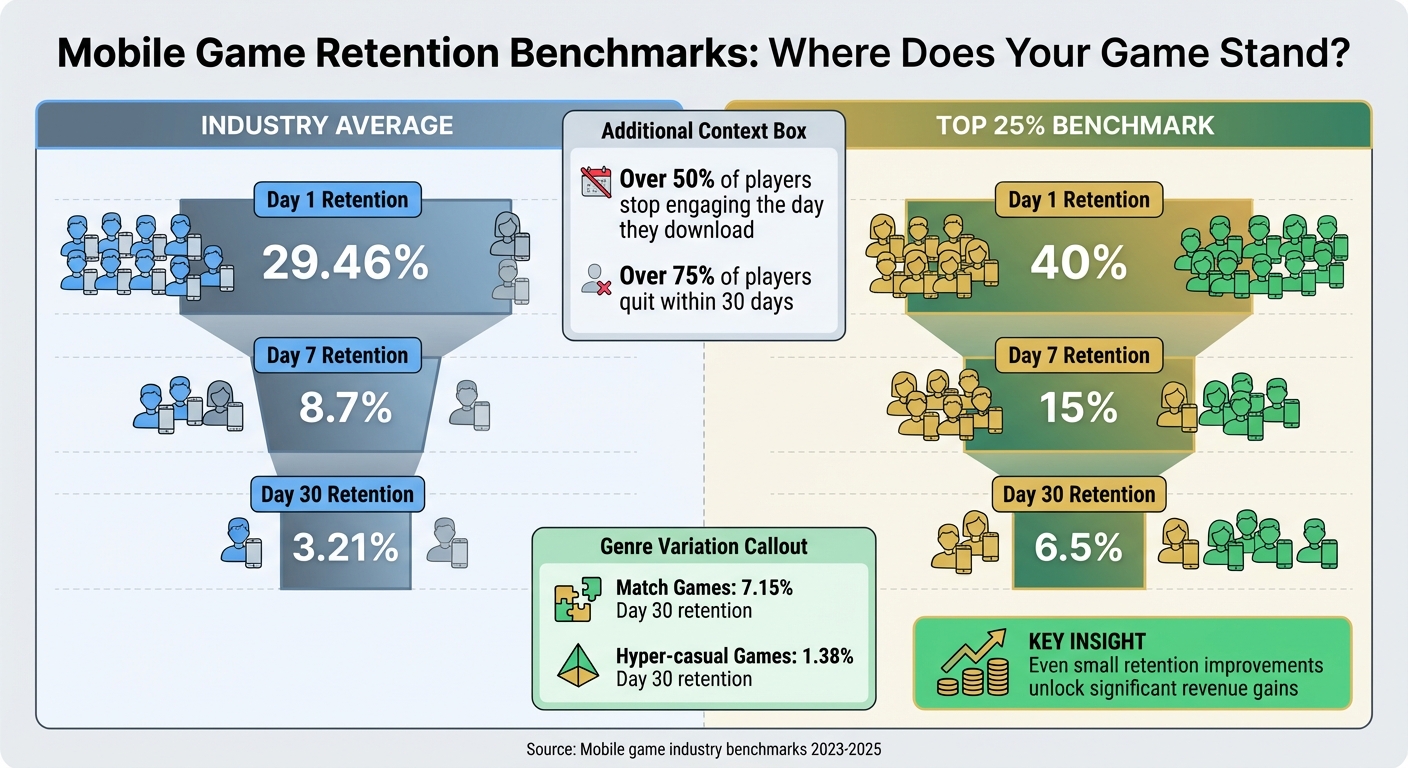
Mobile Game Retention Benchmarks: Industry Average vs Top 25% Performance
Boosting player retention isn’t just a nice-to-have – it directly impacts your bottom line. Why? Because better retention means you’re maximizing revenue from existing players without spending more on acquiring new ones. By keeping players engaged longer, you increase their lifetime value (LTV), which translates to higher overall profitability. Let’s dive into some industry benchmarks to see how retention makes this happen.
Mobile Game Retention Benchmarks
Retention benchmarks give you a clear picture of where your game stands and where it can improve. On average, 29.46% of mobile game players return on Day 1, but that number plummets to 8.7% by Day 7 and just 3.21% by Day 30 [8][9]. That’s a sobering reality: over half of your players stop engaging with the game the very day they download it [4].
But it’s not all bad news. The top 25% of mobile games show what’s possible, achieving 40% Day 1 retention, 15% Day 7 retention, and 6.5% Day 30 retention [10]. Retention also varies widely by genre. For example, Match games tend to perform better, with 7.15% Day 30 retention, while Hyper-casual games often struggle, managing just 1.38% [8].
| Retention Metric | Industry Average | Top 25% Benchmark |
|---|---|---|
| Day 1 | 29.46% | 40% |
| Day 7 | 8.7% | 15% |
| Day 30 | 3.21% | 6.5% |
These numbers show the massive potential for growth. Even small improvements in retention can unlock significant revenue gains.
Retention Improvements and Revenue Gains
So, why does retention matter so much? Because even minor gains can lead to major profits. Let’s break it down: if it costs $1.00 to acquire a player and your game earns $0.10 per session, a single play results in a net loss. But if that same player returns for 11 sessions, the game breaks even. Push that to 25 sessions, and you’ve more than doubled your return on acquisition costs [1].
"If you can improve the game so an average player comes back 11 times, the game is now profitable at that $0.10 ARPDAU. If you get the player to have 25 play sessions, you are more than doubling your advertising investment." – Lloyd Melnick, GM of Chumba, VGW [1]
Retention often outweighs monetization when it comes to building a sustainable game. A game with high revenue per user but poor retention won’t recoup acquisition costs. On the flip side, a game with modest monetization but strong retention can thrive over time [1]. It’s clear: keeping players engaged isn’t just good for business – it’s essential.
sbb-itb-fd4a1f6
Methods to Improve Retention and Increase LTV
Boosting retention and lifetime value (LTV) revolves around three key areas: improving gameplay fundamentals, tailoring experiences to individual players, and fostering meaningful social connections.
Improving Core Gameplay and Progression
Your game’s core gameplay loop is the heartbeat of retention. Successful games engage players through a layered structure: immediate actions, short-term goals, mid-session tasks, and daily objectives [11]. This approach keeps players hooked, from their first interaction to long-term commitment.
Progression systems should strike a balance between depth and variety. Vertical progression enhances a player’s power – think stats and levels – while horizontal progression adds diversity with new characters, abilities, or skills [11]. Combining these two avoids the monotony of pure number grinding. For example, in 2023, Marvel Snap simplified the complexity of collectible card games into a quick, four-minute tutorial, making its core loop accessible without overwhelming players [9]. Similarly, Genshin Impact incorporates onboarding into its opening cutscene, allowing players to shape their experience through interactive questions that influence the story [13]. A solid gameplay foundation like this, supported by strategic game economy design, not only keeps players engaged but also boosts their long-term value.
Ongoing updates through LiveOps are another crucial element. By delivering fresh content regularly, games avoid becoming stale. Notably, 91% of the top 500 mobile games rely on LiveOps to maintain player interest [13][9].
Using Gamification and Personalization
Gamification is a powerful tool to encourage daily engagement. Features like daily login bonuses and streak rewards work well – especially when they’re flexible. In 2023, Mistplay revamped its "Daily Play" feature to reward players for just two minutes of activity rather than requiring a rigid seven-day streak, which led to higher overall satisfaction [9].
Personalization goes beyond basic demographics. In July 2025, an indie studio saw a 230% increase in Day 7 retention for a new merge game by using Solsten‘s Elaris AI. The AI identified that high-LTV players valued exploration and discovery, prompting the studio to shift its mechanics to emphasize learning-based discovery rather than traditional progression [3]. Understanding whether players prefer competition or collaboration allows developers to craft progression paths that resonate with specific audience segments [3].
"By rewarding players for their continued participation and achievements, game studios can create a more competitive yet rewarding environment that enhances the overall user experience." – Nicholas Kerr, VP of Loyalty and Lifecycle, Mistplay [13]
Automated notifications also play a role in boosting engagement. Alerts tailored to in-game behavior remind players of bonuses and events [9]. Owned media channels like SMS and email are particularly effective, with retention rates rising by 212.3%, compared to 123.4% for paid media campaigns [9]. These personalized touches encourage players to stay engaged and deepen their connection to the game.
Building Social and Community Features
Social connections are a major driver of retention. As Raph Koster puts it, social groups act as the "primary glue" in games, fostering mutual obligation, group identity, and shared goals [12]. When players feel a sense of responsibility to their friends or their community, they’re more likely to keep coming back.
"If you add meaningful social engagement, players will come back because they feel an obligation to help their friends or are actually interacting (or competing) with friends." – Lloyd Melnick, GM of Chumba, VGW [1]
Go beyond shallow social features and aim for deeper interactions. Cooperative guild play, for instance, encourages teamwork by requiring genuine collaboration to complete quests. This is why 60% of top-grossing mobile games include social clan features [13]. Additionally, player-versus-player (PvP) modes offer unpredictable challenges that keep the gameplay fresh [12].
To prevent guild migration, where entire groups leave the game together, create multiple touchpoints to anchor players to their community. Use in-game notifications, Discord channels, and SMS to build a well-rounded social experience [4][14]. Data shows that players who engage with offerwalls achieve a Day 90 retention rate of 14%, compared to less than 3% for those who don’t [13]. By strengthening social features, you not only keep players engaged but also enhance their overall lifetime value.
Designing Game Economies for Better Retention
How Economy Design Affects Player Retention
When it comes to keeping players engaged, a well-thought-out game economy can make all the difference. A balanced economy doesn’t just manage in-game currencies – it also shapes how players spend their time. As Stanislav Stankovic, Senior Game Design Director at EA, puts it:
"Our job is to actually model the player’s time! Time and not the points, the trophy count, is the key to understanding the balancing of such features" [15].
An effective approach is to use an S-shaped progression curve. This method ensures players are rewarded quickly at the start, helping them stay engaged without feeling overwhelmed. To fine-tune your economy, focus on a typical player’s experience – someone with a 50–75% win rate. Use their average daily points to set achievable reward thresholds. For example, placing premium rewards like new characters every fourth or fifth tier creates mid-term goals that keep players motivated [15].
Fairness is another key factor. Progression systems should reward persistence, ensuring that even less-skilled players can make progress. Stankovic highlights this point:
"The player should be able to advance along his progression vectors even if he is not particularly good at the game. The player should not get stuck" [15].
To maintain transparency, limit pay-to-win elements and provide clear paths for non-paying players to succeed [17].
Balancing the flow of resources is also critical. As Sarvaiya from Sonamine explains:
"In an ideal world, the deficit between sources and sinks per player would be zero, indicating a balanced supply and demand" [16].
Bottlenecks, when thoughtfully placed, can offer rewarding challenges, while surpluses provide moments of satisfaction. Regularly monitoring these dynamics is crucial to avoid common game economy problems that could devalue rewards or frustrate players [16] [17]. Limited-time events are especially effective as resource sinks, encouraging players to spend stored resources like stamina in exchange for fresh content [16] [17]. When done right, these strategies not only keep players engaged but also extend their lifetime value while supporting steady revenue growth.
A well-designed game economy doesn’t just retain players – it also creates opportunities for strategic improvements.
Adrian Crook & Associates: Custom Retention Solutions
We bring over 17 years of expertise in game economy design and retention strategies for freemium games. With a portfolio of more than 300 clients, we specialize in KPI analysis, player persona development, and live operations optimization. Our tailored consulting services help developers build games that are both engaging and profitable, maximizing lifetime value across all genres. By tackling economic challenges head-on, our custom solutions can significantly enhance player retention and drive revenue. Learn more at adriancrook.com.
Conclusion
Retention is the backbone of profitability in freemium games. Without players coming back regularly, even the most well-thought-out monetization strategies and revenue models won’t hold up. At its core, success boils down to this: your Lifetime Value (LTV) must surpass your Customer Acquisition Cost (CAC) if your game is going to thrive [1]. Strong retention ensures players stick around long enough to justify the money spent bringing them in.
The numbers paint a stark picture. More than 75% of players quit within the first 30 days [4][9]. Ignoring retention isn’t just risky – it’s a surefire way to fail. Lloyd Melnick, GM of Chumba at VGW, captures it perfectly:
"If retention is low or non-existent, there is no profitable way to maintain your game" [1].
This reality is pushing developers to rethink their strategies. Instead of pouring resources into costly user acquisition campaigns, they’re doubling down on keeping the players they already have. It’s a shift that’s as necessary as it is logical.
The message is clear: retention needs to be part of your design from the very beginning. Every step you take to improve retention boosts revenue, creating a snowball effect over time. Players who stay engaged not only spend more but also recommend your game to others and become part of its community. They turn your game from a one-time experience into a daily ritual. To make this happen, focus on what matters – engaging core gameplay, balanced in-game economies, social interactions, and personalized experiences. These elements transform a simple download into meaningful, lasting engagement.
Building long-term player loyalty isn’t just a tactic – it’s the foundation of the freemium business model. Start designing for retention on day one, and you’ll create a game players keep coming back to. Every day they return strengthens your game’s future.
FAQs
How can game developers effectively increase player retention?
To keep players coming back, treat player retention as a primary goal, not just a side effect of monetization. Keep a close eye on key retention metrics like Day 1, Day 7, and Day 30 rates, alongside average revenue per user (ARPU). When retention improves, players stick around longer, which naturally boosts their lifetime value (LTV) and overall profitability.
Start by diving into player behavior to uncover what keeps them loyal. Look for patterns – maybe players who complete daily tasks, join guilds, or hit specific milestones are more likely to stay. Add social features like leaderboards, cooperative events, or clans to build a sense of community and encourage players to return. On top of that, design feedback loops that reward consistent activity, such as daily login bonuses. Use live-ops data to tweak these systems over time, ensuring the game stays fresh and balanced.
By blending behavioral insights, social features, and smart engagement incentives, developers can craft experiences that players love coming back to. This approach not only strengthens player retention but also drives higher LTV and sets the stage for long-term success.
How can improving retention increase a game’s Lifetime Value (LTV)?
Improving player retention has a direct impact on a game’s Lifetime Value (LTV) by keeping players engaged for longer periods and encouraging consistent spending. A seamless onboarding process is key – it quickly introduces players to the core gameplay loop, laying a solid foundation for their experience. Beyond that, regular updates, new content, and thoughtfully designed progression systems – like rewarding milestones with cosmetics, power-ups, or story expansions – help keep the game engaging and encourage players to return.
Adding social elements, such as clans, leaderboards, or in-game chat, transforms gaming into a shared experience, boosting both retention and word-of-mouth growth. Monetization models also play a big role. Transparent and fair pricing for in-app purchases or value-packed bundles can sustain spending without pushing players away. Personalization, like tailoring quests or special offers to match individual preferences, adds an extra layer of satisfaction that deepens player loyalty.
Keeping an eye on key metrics – like Day 1, 7, and 30 retention rates – and understanding different player segments (e.g., whales, dolphins, minnows) helps studios fine-tune their strategies to maximize LTV. Ongoing live-ops efforts, including special events and balance updates, are critical to maintaining long-term engagement. We at Adrian Crook & Associates can help you implement these strategies, crafting games that players love to return to while driving profitability.
Why does player lifetime value (LTV) need to be higher than customer acquisition cost (CAC) in freemium games?
For freemium games to succeed financially, the lifetime value (LTV) of each player needs to be higher than the customer acquisition cost (CAC). In simple terms, the money a player spends over time should not only cover what it cost to bring them into the game but also support the game’s overall profitability.
When a player’s LTV is greater than the CAC, the game achieves a positive return on investment. This is crucial for maintaining growth, as it allows developers to reinvest in attracting new players, enhance game features, and expand their operations. Without this balance, even a large player base could ultimately result in financial losses.