
Playable ads used to be expensive enough that a studio had to choose which games and campaign ideas deserved one. That constraint is changing. New tools can turn a prompt, a brief, screenshots, or gameplay footage into a working HTML5 ad in hours.
Cheaper production sounds like a straightforward advantage. It is also a new failure mode. When a team can produce more playable ads than it can seriously review, polished creative can drift away from the game, the audience, or the promise that should survive after install.
AI game ads do not remove the need for creative judgment. They make weak judgment easier to scale. Studios need a test that connects every ad concept to the real game experience, not only to click-through rate.
AC&A read: the scarce resource in automated ad production is not another variant. It is a clear hypothesis, an honest player promise, and the authority to stop a high-performing creative when the game cannot keep that promise.
AI Game Ads Remove the Production Excuse
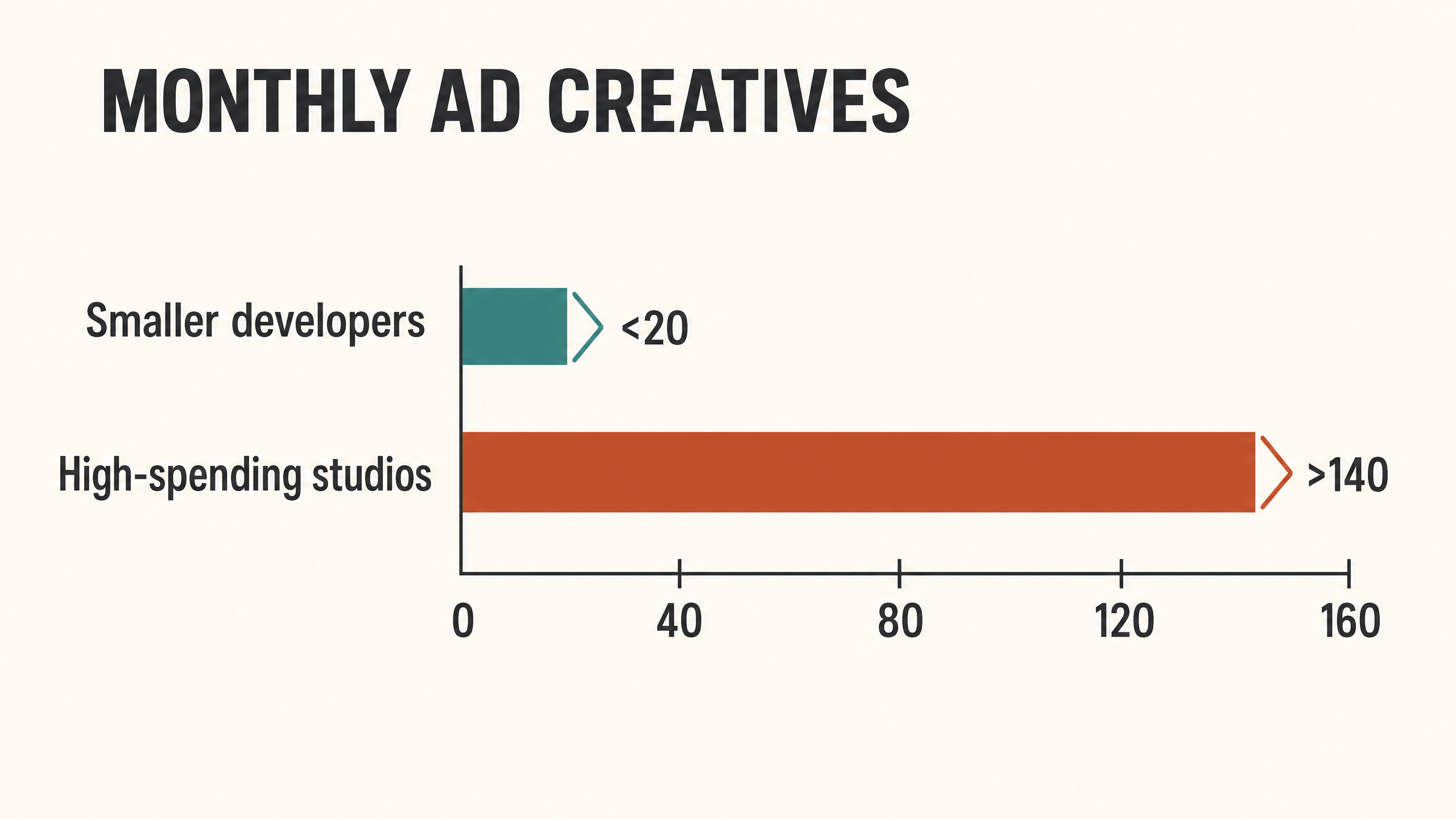
A PocketGamer.biz sponsored article about Layer’s playable-ad generator describes a large gap in creative output: high-spending studios deploy more than 140 distinct ads per month, compared with fewer than 20 for smaller developers. It also says a custom playable traditionally takes one to three weeks and thousands of dollars per iteration, while Layer promises first drafts in minutes and campaign-ready files in hours.[1]
That changes who can test interactive creative. A small studio no longer needs dedicated playable-ad engineers for every experiment. Marketers and artists can change mechanics, skins, and difficulty through prompts, then export network-ready files for major ad platforms.[1]
The production gain is real. But “the brief is the only thing standing between a game and its playable,” as Layer co-founder Burcu Hakguder puts it, should make teams look harder at the brief. If the brief is vague, the tool does not remove the ambiguity. It turns the ambiguity into a playable.
A Polished Ad Can Still Be Wrong
SecretSauce Labs CEO Simon Davis describes the harder part of generative production as memory and judgment. His team’s work began with a game that needed roughly 25 million distinct, on-brand avatars. Early tools could make variations quickly, but the same character might return with a different face, outfit, or anatomy.[2]
The lesson applies directly to ads. A creative can be attractive, technically compliant, and still wrong for the game. Davis argues that generating ten assets and using only two is not automatically faster once editing and brand fixes are counted. He also distinguishes looking good from staying on-brand: uploading a style guide is easier than checking every output against it.[2]
For a game team, brand drift is only one version of the problem. A playable can also drift from the actual mechanic, progression pace, difficulty, reward structure, or fantasy. The ad may win the auction and lose the first session. That loss will not appear in the creative-production dashboard. It appears later in install quality, early churn, weak payer intent, support complaints, and player distrust.
Campaign Agents Raise the Cost of a Bad Rule
The automation is moving beyond asset creation. Mobile Dev Memo reported that Meta introduced agentic campaign-optimization capabilities to Muse for Small Business.[3] The public announcement is one more sign that creation, targeting, allocation, and iteration are beginning to sit inside the same automated loop.
At the same time, the store itself is putting more pressure on paid visibility. Mobile Dev Memo’s public article preview noted that an iOS 27.2 beta removed the contrasting background that had helped distinguish ads in App Store search results, while retaining the Ad badge.[4] When paid placements blend more closely with discovery, the quality of the promise inside the ad matters even more.
An automated campaign will follow the objective it is given. If that objective rewards cheap clicks or short-window conversion without checking what happens after install, the system can become very good at finding people who respond to a promise the game does not sustain. More variants make that optimization faster.
This is not an argument against campaign automation. It is an argument for better constraints. The team has to decide which downstream signals are allowed to overrule an attractive acquisition result.
Test the Promise, Not Only the Ad
Mark Pincus told Deconstructor of Fun that instincts may be right while ideas are usually wrong. In his framing, an instinct is a read on what people want; the idea is the product, business model, timing, or technology built on top of it. He puts the hit rate for ideas at 25% at best and argues for killing weak ones quickly.[5]
That distinction is useful for creative testing. “Players want a relaxing transformation fantasy” is an instinct. “A thirty-second sorting playable will attract the right players for our mid-core collection game” is an idea. The playable can test that idea, but a high click-through rate does not prove the whole chain.
Before scaling a generated creative, teams should review five links:
- Player tension: What desire, frustration, or fantasy is the concept responding to?
- Ad mechanic: What does the player actually do in the playable, rather than merely watch?
- Game match: Where does that action, choice, or reward appear in the installed product?
- First-session handoff: Does onboarding confirm the ad’s promise quickly enough?
- Quality signal: Which retention, engagement, payer conversion, or sentiment measure can veto a cheap install?
This extends AC&A’s earlier argument that player signal should guide UA before spend amplifies the product. Once that signal exists, every generated ad should trace back to it. Otherwise the team has built a faster variation engine with no shared definition of a good variation.
Layer’s product demo shows how quickly a brief can become a playable build:
Make Creative QA Part of Growth
Traditional creative review often checks brand, legal requirements, network specifications, and whether the build works. Automated playable production needs one more layer: product truth.
Give one person clear authority to compare every proposed playable with the current game. Keep a short promise register that names the mechanic, fantasy, reward, difficulty, and audience expectation each concept relies on. Review creative results beside first-session and early-retention data, not in a separate meeting. When a concept wins on acquisition but loses on player quality, treat the mismatch as a product question, not simply a targeting problem.
This does not mean every ad must reproduce the game literally. Good creative can exaggerate, simplify, or isolate a fantasy. The line is whether the installed product gives the player a recognizable version of what made the ad appealing. AC&A’s launch-testing framework starts with the business model for the same reason: the test must resemble the conditions the real game will face.
The advantage will not go to the studio that generates the most playable ads. It will go to the studio that can reject the wrong promise before automation spends money proving that people will click it.
Sources
- PocketGamer.biz: Layer launches AI Playable ad generator to tackle production bottlenecks for mobile game studios (sponsored)
- PocketGamer.biz: SecretSauce Labs’ Simon Davis on solving AI’s brand consistency problem
- Mobile Dev Memo: Meta brings agentic ad campaign optimization to Muse
- Mobile Dev Memo: The App Store discoverability squeeze (part 2)
- Deconstructor of Fun: Zynga Founder Mark Pincus — Why Your Favourite Ideas Are Almost Always Wrong