
When live game retention slips, teams often reach for the same answer: add an event, add a reward track, add another reason to log in. The logic feels safe because shipping more is visible work. It can also make the core game harder to find—and the whole experience harder to love.
The stronger lesson from recent live-ops and player research is that a retention problem is not automatically a content shortage. Players may already have too many competing tasks. A weak onboarding step may be hiding under a busy calendar. One audience segment may be thriving while another quietly leaves. More content can spread the same attention across more places without improving the experience.
AC&A read: before adding another live event, identify whose behaviour needs to change, what is getting in their way, and which existing feature can be removed or clarified first.
Live Game Retention Needs A Precise Diagnosis
Outfit7 senior lead product manager Urška Leskovar described the attention problem in PocketGamer.biz with an unusually useful admission: her team once invested in more content to fix an engagement dip and did not see meaningful improvement in the metrics it wanted to move.[1]
The failed fix matters because it separates a symptom from a cause. Declining engagement among long-time players can mean the core loop has become stale. Early churn can point to onboarding, progression, economy pressure, or basic friction. Both appear as lower engagement in a dashboard, but they call for different work.
Leskovar also warns that a large audience can conceal a smaller segment in trouble. Aggregate retention may look stable while a new cohort, payer group, country, or returning-player segment is deteriorating.[1] Scale creates more data, but it does not remove the need to ask a precise product question.
Focused Games Do Not Try To Please Everyone
The audience evidence points in the same direction. PocketGamer.biz’s summary of Bain & Company’s gaming report says no single gaming experience appealed to more than 26% of players in a June 2026 survey of more than 5,300 gamers. Demand is split across narrower preferences, while playtime and spending remain concentrated among smaller groups.[2]
Bain’s review of 100 games released since 2023 makes the product consequence sharper: 83% of focused games achieved commercial success, compared with 50% of unfocused games.[2] The definitions and sample belong to Bain’s analysis, not a universal law, but the gap shows the cost of broad product promises. A game that makes a clear promise to a defined audience has a better chance than one that keeps adding features to avoid disappointing anyone.
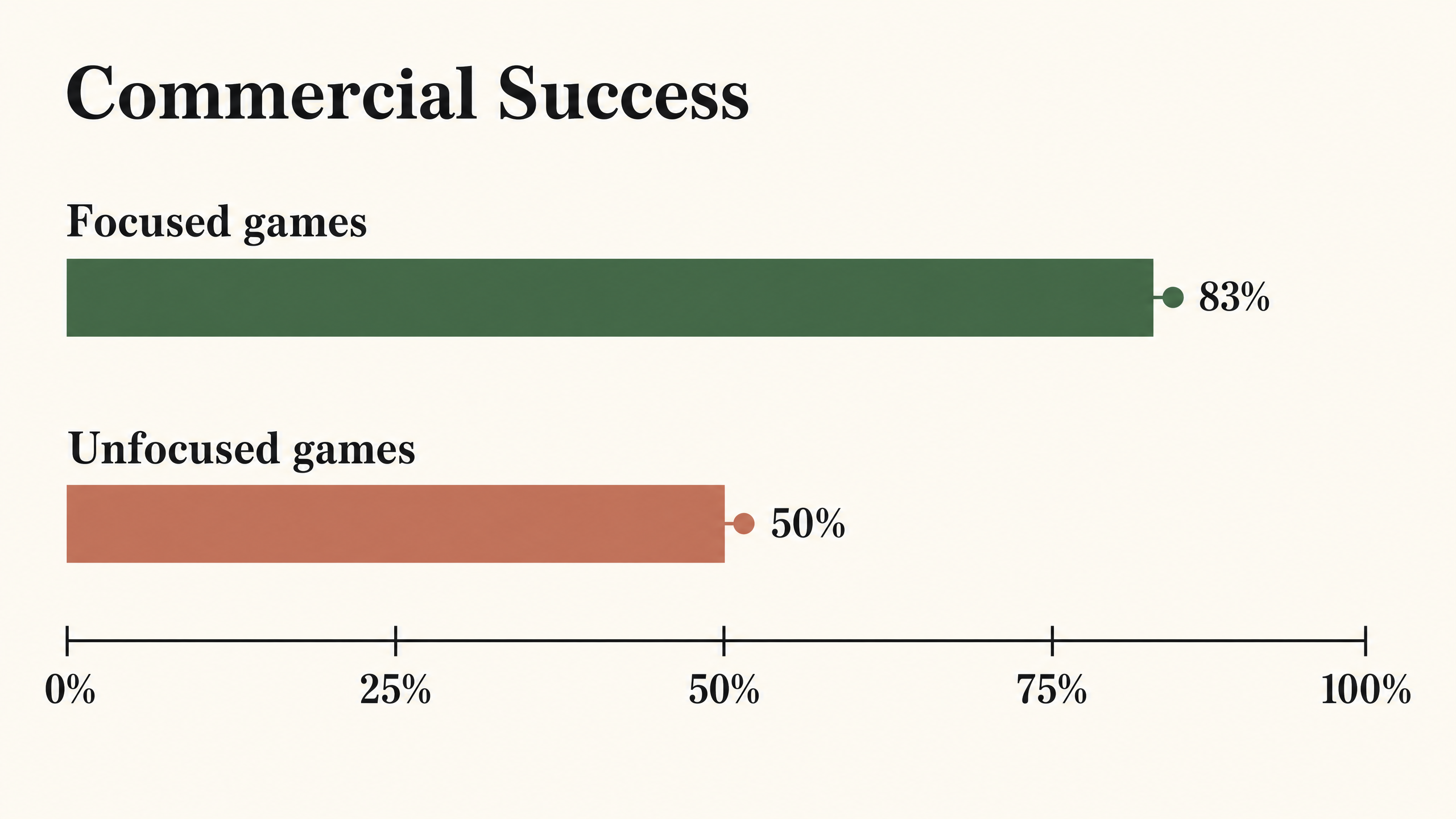
For live game retention, that means segmentation should narrow the decision, not multiply the roadmap. If a high-value cohort wants a deeper competitive goal while new players cannot understand the first upgrade, the answer is not one event that tries to serve both. It is two clear diagnoses, followed by a decision about which problem matters most now.
Audience Definition Is A Product Choice
Magic Potion Games’ approach to Imagine Island shows what focus looks like before a roadmap becomes overloaded. The founders have deep ties to Club Penguin, but CEO Stephen MacDonald said the team is not reshaping the new game to chase the older Gen Z audience. Imagine Island is built for Gen Alpha: easy browser access, creativity, customisation, sharing, a changing world, age-appropriate social features, and safety work behind the scenes.[3]
PocketGamer.biz reports that the beta attracted more than one million players organically.[3] That number does not prove long-term retention or a finished business. It does show the value of a legible product promise. The team knows who the first experience is for, why browser access matters for a child on a parent’s computer, and which behaviours distinguish this audience from the one that played Club Penguin years ago.
Audience focus is not a marketing filter applied after development. It changes access, social design, moderation, creator tools, content cadence, and monetisation choices. When those decisions align, the game needs fewer generic features to explain its value.
Sometimes A Break Restores Value
The same focus test applies to the industry’s instinct to maximise daily activity. Clash Royale commissioned a survey of 9,000 gamers across seven markets and found that 85.1% of respondents who rage quit said they enjoyed gaming more when they returned.[4]
This was campaign research tied to a rage-emote promotion, so it should not be treated as a neutral benchmark for every game.[4] The useful product signal is narrower: a break does not always mean the relationship is lost. Frustration can come from caring about performance, protecting a streak, or wanting to do well. A player who steps away may return with more appetite than one who is pushed through another mandatory event.
That is why managing a game as a habit should not mean demanding perfect attendance. Strong habits have rhythm. They leave room for fatigue, recovery, and re-entry. The live-ops question is not just how to prevent every absence; it is whether the returning player can quickly understand what matters now.
One Good Event Can Do More Than Five Average Ones
Pokémon Go’s 2026 regional campaign work offers a constructive example of concentrated attention. The National Trust partnership connected more than 140 UK locations to location-specific Raids and research. A separate Shoreditch activation linked timed quests to a local coffee reward, creator meetings, and a photo contest. These were not generic calendar fillers; each used the game’s real-world exploration promise.[5]
The global Go Fest made a different choice. The 10th-anniversary edition was free, widening access to the core event while leaving optional bundles, storage, Poké Balls, and Raid Passes inside the economy. PocketGamer.biz cites AppMagic estimates that the month became the game’s highest-revenue month in at least four years.[5]
The lesson is not that every event should be free or local. It is that an event earns attention when its product role is obvious. One can deepen local community, another can welcome the whole audience back, and both can reinforce the same core promise. Five interchangeable event tabs would not do that work better.
Run A Live-Ops Subtraction Audit
For live game retention, the next event or feature should clear a subtraction audit before it reaches the roadmap:
- Name the segment. Which players are leaving or disengaging, and what do they have in common?
- Name the moment. Where does their behaviour change: onboarding, first loss, first purchase, event choice, progression wall, or return session?
- Compare cohorts before adding work. Test long-time player fatigue separately from first-session friction.
- Remove one demand. Pause or simplify a low-use event, offer, notification, or progression branch and measure whether anyone misses it.
- Set a falsifiable result. Decide which behaviour should change and when the team will stop if it does not.
This audit is deliberately smaller than a content roadmap. It forces the team to prove that the proposed work addresses the diagnosed problem. It also creates a useful stopping rule: if the change does not improve the intended player behaviour, do not hide the result under another event.
For teams working through early churn, AC&A’s guide to mobile game churn prevention provides the next layer of cohort and journey analysis. But the first move is simpler: stop assuming that player attention expands every time the roadmap does.
A live game becomes easier to love when the team is willing to decide what does not belong.
Sources
- PocketGamer.biz: The attention problem: Outfit7’s Urška Leskovar on rethinking live ops
- PocketGamer.biz: Report: No gaming experience appeals to more than 26% of players globally
- PocketGamer.biz: “Gen Alpha plays very differently”: Club Penguin and Fortnite veterans build Imagine Island
- PocketGamer.biz: Clash Royale research on rage quitters returning to play
- PocketGamer.biz: Pokémon Go Fest, the National Trust and the value of exclusive regional campaigns