
Energy systems in freemium games are designed to manage player engagement and drive monetization. They limit gameplay through renewable resources like energy bars, timers, or lives, encouraging players to return regularly or spend money to continue. These systems balance pacing, retention, and revenue generation.
Key takeaways from the article:
- Hard vs. Soft Energy Systems: Games like Candy Crush Saga use “hard” systems (e.g., lives), while Clash Royale employs “soft” systems that allow unlimited play but restrict rewards.
- Monetization Strategies: Games often offer premium currencies (e.g., Gems in Clash of Clans) to skip wait times or refill energy, nudging players toward spending.
- Psychological Triggers: Features like loss aversion (logging in to avoid wasting full energy) and pinch points (early free resources that run out) encourage engagement and purchases.
- Examples of Energy Systems:
- Clash of Clans: Timers for upgrades and troop training.
- Candy Crush Saga: Lives that regenerate over time or can be refilled for $0.99.
- Hay Day: Crop growth timers and production queues.
- Puzzle & Dragons: Stamina points for dungeon entry with premium currency options.
Developers can improve energy systems by balancing progression and monetization strategies, using data to optimize retention, and seeking expert guidance for design and implementation. Professional game optimization services can help refine these mechanics for long-term success.
Case Studies of Successful Energy Systems
Clash of Clans: Timers Instead of Stamina Bars
In Clash of Clans, energy systems take a different form. Instead of traditional stamina bars, the game uses timers for building upgrades and troop training as a way to manage player progression. These timers can stretch from a few minutes to several days, depending on the level of the upgrade. This design naturally creates pauses in gameplay, encouraging players to check back periodically for resource collection or to start new upgrades.
The game’s monetization revolves around Gems, a premium currency that lets players skip these wait times. As Pete Koistila explained:
Monetization method is based on the need of speeding-up your game progress. More you play, more time you spend to get achievements done. Or you could cut the paths and spend real money instead to fasten your progress in the game [6].
With daily revenues estimated between $750,000 and $5.15 million and an ARPU of around $4.60 [6], Clash of Clans demonstrates the effectiveness of this approach. Supercell also employs a “pinch point” strategy to encourage first-time purchases. Early in the game, players receive free Gems, which they can use to skip timers. Once this supply runs out, the frustration of waiting often nudges players toward buying more Gems.
Next, let’s look at how Candy Crush Saga uses a contrasting energy system to manage player sessions.
Candy Crush Saga: Lives as an Energy System
Candy Crush Saga popularized the lives system, a hard energy mechanic that limits gameplay sessions. Players start with a set number of lives, and once they’re all used up, they must wait for lives to regenerate (one every 30 minutes) or pay $0.99 for an instant refill [2][9].
This system creates short, engaging sessions lasting between 30 seconds and 2 minutes. Sheldon Laframboise highlighted the benefits of this approach:
The life model… is a system that works and keeps the game fresh by restricting/limiting gameplay sessions. This system helps increase engagement, reduces burn-out and gameplay fatigue [9].
The game’s monetization strategy extends beyond life refills. Players can also purchase extra moves ($0.99) when they’re close to completing a level or invest in premium items like the “Charm of Life” ($16.99), which increases the life pool from five to eight [9]. By June 2013, Candy Crush Saga was generating over $62 million per month. Social features, such as requesting help from friends to unlock new episodes, further boost engagement and encourage spending without directly forcing purchases.
Hay Day: Timers for Crops and Production
Hay Day takes a different approach by using crop growth timers and production queues to manage pacing. For example, wheat grows in about 2 minutes, while higher-value crops like pumpkins take several hours. Players must time their sessions to harvest and replant efficiently, creating a rhythm that keeps them engaged.
The game monetizes through Diamonds, a premium currency that speeds up production or allows players to buy missing items for truck orders [3]. On February 7, 2014, Supercell reported 29.4 million Daily Active Users across its games, including Hay Day and Clash of Clans.
Puzzle & Dragons: Stamina and Skill-Based Monetization
Puzzle & Dragons combines a traditional stamina system with unique gameplay mechanics to balance pacing and monetization. Players use stamina to enter dungeons, and if they fail, they can spend one Magic Stone ($1) within a 10-second window to continue – particularly tempting when rare items have already dropped during the session [7][8].
The stamina system adapts as players progress. Early on, stamina regenerates quickly, but higher levels increase the cap and slow the refill rate, limiting advanced players to fewer dungeon attempts per session [7]. GungHo also provides players with nearly $20 worth of Magic Stones each month through regular gameplay, making the system feel accessible [8].
Andrew Vestal described the game’s appeal:
Puzzle & Dragons is a skill game that can be played as a money game [8].
In April 2013, the game generated over $100 million in revenue, with monthly earnings in Japan ranging between $54 million and $75.5 million [7][8]. Magic Stones offer multiple uses, including stamina refills, dungeon continues, extra monster slots, friend slots, and spins on the Gacha machine (priced at $5 per pull). The Gacha system is the primary revenue driver, while $1 purchases make it easy for players to transition into paying customers.
These examples highlight how energy systems can vary widely, from timers and stamina to lives and production queues, all while effectively managing pacing and driving monetization. Each approach is tailored to the specific gameplay experience, keeping players engaged while offering opportunities for spending.
sbb-itb-fd4a1f6
Key Lessons for Developers
Balancing Progression and Monetization
The best energy systems reward success rather than punishing failure. Take Candy Crush, for example – it reduces players’ lives when they lose, effectively penalizing them. On the other hand, games like Clash Royale take a different approach: players can play as much as they want, but they need to wait (or pay) to unlock rewards from their wins. This approach makes spending feel optional, not forced, and results in higher revenue per energy unit – ranging from $0.19 to $0.33 in Clash Royale, compared to $0.14 to $0.16 in Candy Crush Jelly Saga [2].
As Andrew Pellerano puts it:
Supercell… only monetizes when its customers are succeeding at Royale [2].
To further refine this balance, developers can incorporate “hard” and “soft” waiting periods. These encourage players to spend at natural pinch points, making purchases feel like a choice rather than a necessity [2][3][4].
Once this balance is in place, data can play a critical role in driving retention.
Using Data to Optimize Retention
Data insights are key to fine-tuning energy systems. The most effective systems rely on modeling lifetime currency flow to ensure players remain engaged. Adrian Crook highlights this point:
If the tuning and balance is not optimized the game stands a chance at commercial failure. The supply and demand of digital currencies is what drives player progression [3].
Tracking how players earn and spend currency helps prevent common game economy problems like inflation and safeguards revenue potential. Developers should also monitor content burn rates – how quickly players move through levels or quests. Typically, energy systems allow for 15 to 30 minutes of gameplay from a full energy bar [1].
To keep players coming back, appointment mechanics can be introduced. These leverage loss aversion, prompting players to check in periodically so they don’t waste regenerating energy [1]. Another effective strategy is offering generous amounts of premium currency early on. This gives players a taste of its value, and data can reveal the ideal moment to encourage their first purchase [3].
Working with Expert Consulting Services
Expert advice can make all the difference when designing energy systems. A well-balanced system depends on managing key variables like faucets, sinks, mission designs, and storage limits. By combining these elements with in-depth data analysis, developers can create systems that drive both engagement and revenue.
We at Adrian Crook & Associates have over 17 years of experience and 300+ clients specializing in energy system design. We provide services like KPI analysis, player persona development, and soft launch planning. Our expertise helps developers design energy systems that perform effectively from the start, ensuring your game achieves both player satisfaction and profitability.
Energy System Metrics Comparison
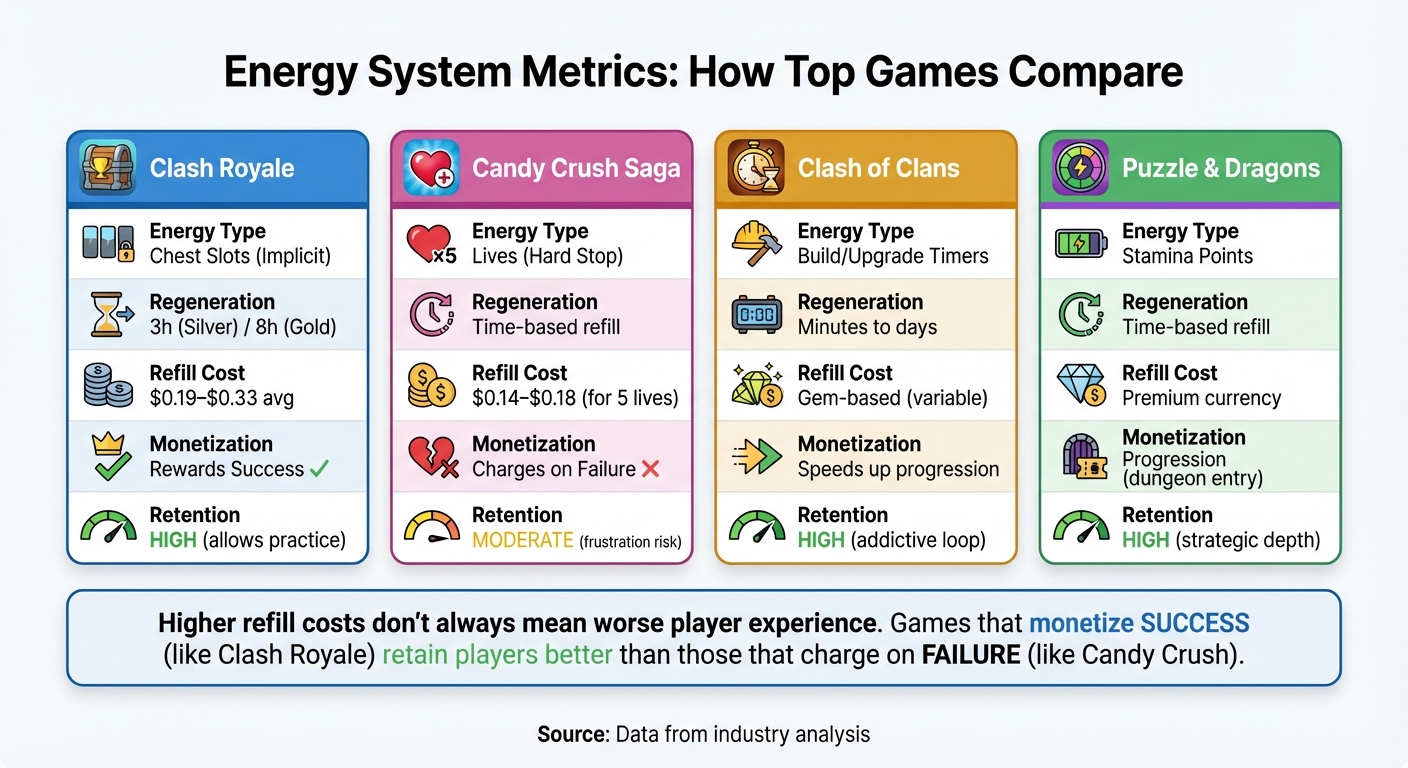
Energy Systems Comparison: Top Freemium Games Metrics and Monetization Strategies
Metric Comparison Table
Looking at energy systems side-by-side reveals the contrasting philosophies behind their designs. The table below breaks down how four popular games handle regeneration, refill costs, and monetization strategies.
| Game | Energy Type | Regeneration Rate | Refill/Skip Cost (USD) | Monetization Driver | Retention Impact |
|---|---|---|---|---|---|
| Clash Royale | Chest Slots (Implicit) | 3h (Silver) / 8h (Gold) | $0.19–$0.33 (avg) | Rewards success | High (allows practice) |
| Candy Crush Saga | Lives (Hard Stop) | Time-based refill | $0.14–$0.18 (for 5 lives) | Charges on failure | Moderate (frustration risk) |
| Clash of Clans | Build/Upgrade Timers | Minutes to days | Gem-based (variable) | Speeds up progression | High (addictive loop) |
| Puzzle & Dragons | Stamina Points | Time-based refill | Premium currency | Progression (dungeon entry) | High (strategic depth) |
Note: Data sourced from industry analysis [2].
This table captures the essence of how each game approaches energy systems, highlighting differences in player experience and monetization strategies. These metrics bring to life the case study insights, showing how even small variations in system design can shape player retention and revenue potential.
One key takeaway is that higher refill costs don’t always equate to a negative player experience. For example, Clash Royale’s model focuses on monetizing success – players pay after winning – which feels more rewarding and generous. On the other hand, Candy Crush Saga requires payment or waiting after failures, which can lead to frustration.
This difference significantly affects retention. Systems like Clash Royale’s, which use “soft waiting” mechanics, encourage players to keep practicing and improving their skills. This approach fosters long-term engagement. In contrast, “hard waiting” systems, such as Candy Crush Saga’s lives-based model, can block gameplay entirely during tough levels. This can frustrate players and increase the likelihood of them quitting.
Ultimately, monetization efficiency hinges on when and how payments are requested. Systems that tie payments to success often build stronger long-term player retention, even if they charge more per transaction.
Conclusion
Energy systems have proven to be a cornerstone of freemium game design, primarily functioning as tools to retain players while also supporting monetization. Game designer Grant explains it best: “Energy is a retention mechanic. It can be used to monetize (and do social stuff), but it’s primarily a retention tool” [1]. Case studies like Clash of Clans and Candy Crush Saga highlight how the timing and context of monetization opportunities often outweigh the actual price in importance.
Over time, these systems have evolved from rigid wait times to more nuanced, reward-based pacing. Modern games like Clash Royale showcase this shift by allowing unlimited play but capping rewards to maintain balance. For example, a 15-minute session in Clash Royale might yield rewards that take 12 hours of real-world time to unlock [5]. This approach limits rewards rather than playtime, encouraging both engagement and spending.
The key to successful energy systems lies in balancing session length, pacing content, and managing virtual economies to avoid inflation. Energy bars, for instance, help structure gameplay into manageable sessions, encouraging players to return regularly. However, designing these systems is far from simple. As Adrian Crook points out: “Designing a fun game isn’t enough. At the heart of a revenue‑positive freemium game is a core loop that keeps players playing and spending” [10]. Developers must rely on data-driven insights to fine-tune refill rates and costs, ensuring decisions are based on player behavior rather than assumptions.
For studios aiming to implement or refine energy systems, expert guidance can make a significant difference. Professional consultation offers the precise analysis needed to strike the right balance between fun and revenue. We at Adrian Crook & Associates have supported over 300 clients since 2008, helping developers identify critical “pinch points” in their game economies. Richard Barnwell, CEO, shared his experience: “Working with AC&A allowed us to clarify key issues with our game design while we were still early enough in the development process to make changes. Because of the specific recommendations we received… our game is both more fun for players and able to monetize those players more effectively” [10].
FAQs
When should a game use hard vs. soft energy?
The decision to use hard or soft energy in a game largely hinges on factors like pacing, monetization, and how you want to keep players engaged. Hard energy is a finite resource, often linked to purchases with real money or deliberate, strategic gameplay. It’s designed to encourage spending and manage how quickly players progress. On the other hand, soft energy replenishes over time or through specific actions, serving as a way to regulate the game’s pace and maintain player interest. Many games use a mix of both systems – soft energy to keep players coming back and hard energy to incentivize premium actions, striking a balance between retention and revenue.
How do you set refill costs and regen rates?
To keep players engaged while monetizing effectively, consider setting energy caps that fit 1–2 typical gameplay sessions. For energy regeneration, aim for a setup that allows 3–4 sessions per day, provided they are spaced out. This approach encourages consistent play without causing frustration, helping players develop a habit while maintaining a steady pace.
The best-performing games often steer clear of overly harsh penalties, creating a smoother and more enjoyable experience for players. When configuring these settings, align them with your game’s overall strategy. At the same time, factor in player psychology to strike a balance between fun and retention.
What metrics show an energy system is effective?
Key metrics to watch are player engagement, session length, retention rates, and how well resources are balanced. A thoughtfully crafted system allows players to use and restore energy smoothly, keeping the game enjoyable without leading to frustration or monotony.