
Localization usually starts when the words are ready. By then, some of the most expensive international problems are already locked into the game.
A map can make a political claim. A fictional culture can borrow real history without understanding it. A paid random-item mechanic can change an age rating. A checkout can support the wrong payment method for the market. None of those problems is fixed by translating the menu.
Game culturalization should begin while a team can still change the concept, mechanic, or asset—not after production hands over a string table. The goal is not to sand away everything specific. It is to know which details make the game worth taking abroad, which assumptions will confuse or exclude players, and which choices create legal or commercial risk.
Game Culturalization Is Product Work
Geogrify founder Kate Edwards describes culturalization through “allegorical distance”: the closer a game gets to recognizable geography, religion, culture, conflict, or history, the more players expect it to be accurate.1 A completely invented continent creates one set of expectations. A map, costume, ritual, or faction that closely resembles a real place creates another.
That makes cultural review part of design. It can affect what the world contains, how a character behaves, which symbols appear, where the game can ship, and whether regional versions are needed. China and India have legally incompatible requirements for depicting some disputed territories; there is no globally neutral version of the map.1
The practical question is not “is this offensive everywhere?” That is impossible to answer and usually produces timid work. The better questions are:
- What real culture, history, place, or belief is the game borrowing?
- Which details will players notice and interpret?
- Who from that culture has reviewed the work while it can still change?
A team does not need a global encyclopedia. It needs a short list of high-consequence choices and someone qualified to challenge them early.
Specificity Can Travel Better Than Neutrality
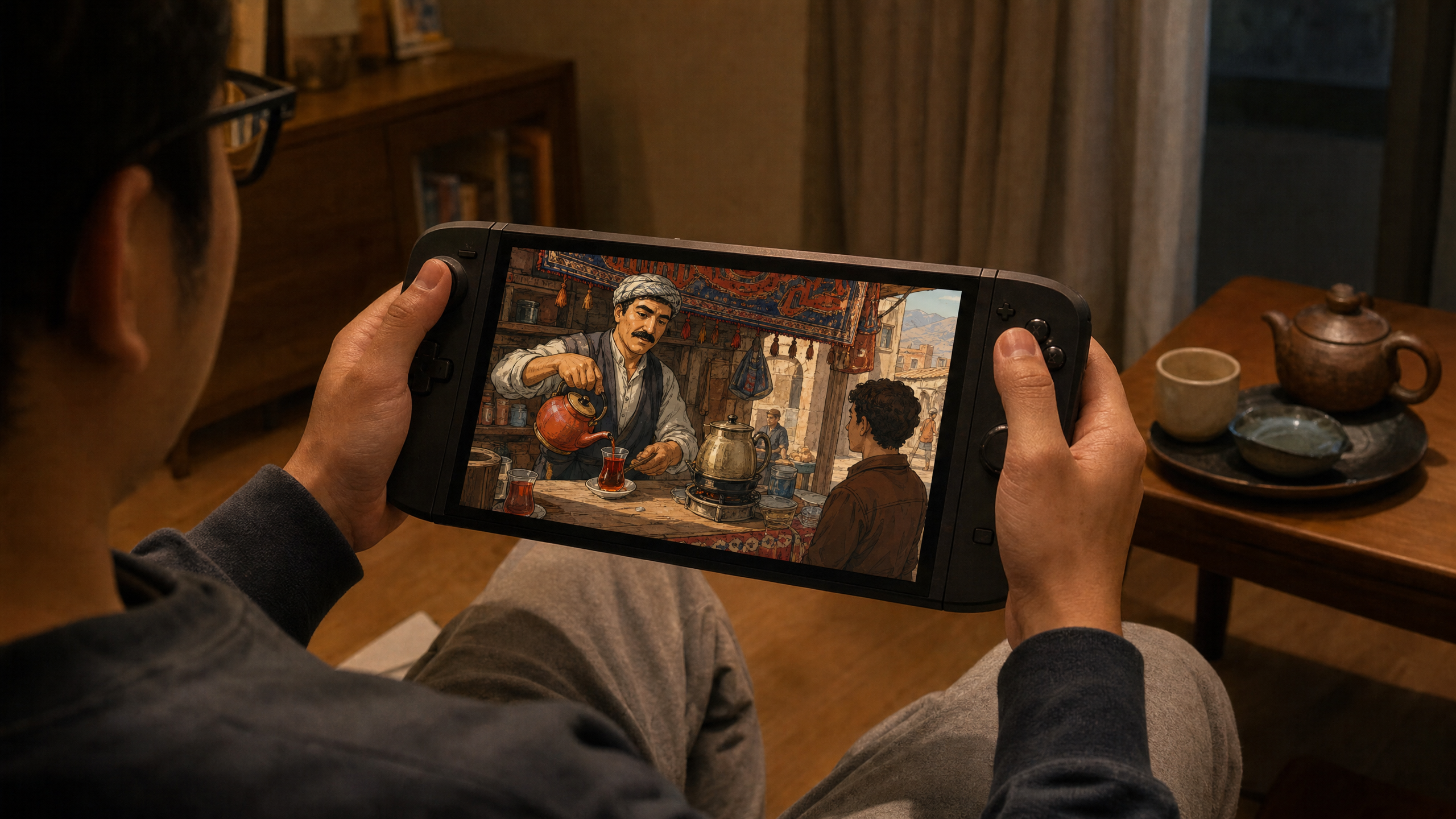
Culturalization is sometimes treated as a process for removing local detail. Istikan Studio’s experience suggests the opposite.2 The seven-person Kurdish-Iraqi team built Istikan Chai around a tea stall in a Middle Eastern bazaar. More than 75% of its Steam sales came from China, according to studio manager Danar Kayfi, despite no publisher, paid marketing, Bilibili presence, WeChat presence, or Chinese speaker on the team.
The result reflects a clear product pattern: the game offers a familiar loop in an unfamiliar place. Players already understand taking an order, making it, serving it, and improving a shop. The istikan glass, market patterns, and hand-drawn setting make that loop distinctive. Simplified Chinese was available from day one, but the game did not pretend its Iraqi identity was disposable.
Istikan is now planning professional Chinese localization from the start for its next cooking game. That is the right sequence. The team is not replacing its point of view with a generic global skin. It is keeping the product specific while making the experience easier to understand and buy.
The job is not to make a game culturally blank. It is to preserve the details players value while removing avoidable confusion, exclusion, and risk.
— AC&A
Localization Reaches Beyond Words
Words are only one part of how a market experiences a game. A Pocket Gamer Connects Nordics recap described a publisher expanding its direct-to-consumer store in Japan and adding PayPay because local payment behavior mattered to conversion.3 The checkout was technically available before that change. It was not yet designed around how enough Japanese customers wanted to pay.
The same principle applies to onboarding, age gates, social features, pricing, calendars, customer support, and live events. A translated feature can still feel foreign if it assumes the wrong habits. As AC&A argued in Billion-Player Games Need Local Access, Not More Platforms, access depends on language, devices, payments, and player context—not just another distribution endpoint.
Every market change should name the player behavior it is meant to improve. If the team cannot say whether a change should improve comprehension, trust, payment completion, retention, or support load, it is probably doing localization as a checklist rather than product work.
Regional Rules Can Change an Existing Product
Cultural and market review cannot be limited to launch. In October 2026, the Games Rating Authority began applying PEGI 16 ratings to existing digital games with paid random items.4 Titles previously rated PEGI 3, 7, or 12 were affected. Character-based gacha games were included alongside item loot boxes.
That change does not merely alter a badge. It can affect audience reach, store presentation, marketing, parental confidence, and the viability of an economy in a region. A mechanic that looked globally portable at launch can acquire a different meaning as local rules and expectations change.
This is why the review needs an owner after launch. Legal can identify formal requirements, but product, economy, community, marketing, and support teams still need to decide what changes for players. The answer may be a regional build, a different offer, clearer disclosure, a mechanic change, or an explicit decision not to serve a market.
In the talk below, Edwards explains how a team’s values shape global success and why cultural assumptions need attention before launch.
A Minimum Viable Cultural Review
Edwards’s small-team game culturalization process is deliberately modest: identify the few cultural elements central to the game, research them using sources from within the culture, and ask at least one knowledgeable person to review them while changes are still cheap.1 A few hours with the right specialist can prevent a much larger rewrite after art, dialogue, marketing, and announcements are finished.
For a practical green-light check, use Edwards’s three steps and add two decisions about market response and post-launch ownership:
- Choose what must remain specific. Write down the cultural details, tone, and creative rules that give the game its identity.
- Identify the high-consequence choices. Review maps, symbols, historical references, social mechanics, monetization, age assumptions, payments, and marketing claims.
- Use informed local review. Give reviewers context and a real route to change the work; do not ask them to bless a finished asset.
- Decide the market response. Choose between one global version, regional variants, removing an unnecessary element, or accepting a documented risk.
- Revisit after launch. Track rule changes, support patterns, community interpretation, payment behavior, and age and content ratings by region.
This complements the evidence discipline in Game Launch Testing Starts With the Business Model. International expansion also needs a test that matches the actual risk. A disputed map, a regional payment method, and a paid random-item mechanic should not share one generic localization approval.
Protect the Game by Understanding the Market
Good game culturalization does not guarantee that everyone will approve of a creative choice. It makes the choice coherent, informed, and defensible. That is a healthier goal than trying to produce something nobody can criticize.
Istikan Studio did not reach Chinese players by hiding where its game came from. It combined a legible loop with a place and point of view players had not seen often. Edwards’s advice explains how to protect that specificity: understand what the work borrows, invite informed challenge early, and know where regional reality requires a different answer.
Translation helps players read the game. Culturalization helps the team decide which game it should ship.
Sources
- PocketGamer.biz — “Another pair of culturally informed eyes: Kate Edwards on culturalisation without a triple-A budget”
- PocketGamer.biz — “Istikan Studio’s Danar Kayfi: Most investors and publishers still don’t see Iraq as a place where games get made”
- PocketGamer.biz — “Four key takeaways from Pocket Gamer Connects Nordics 2026”
- PocketGamer.biz — “Games with loot boxes receive updated PEGI 16 rating for paid random items”