
Licensed IP is still one of the fastest ways for a game to be noticed. Monster Hunter Outlanders reached five million pre-registrations in three weeks.2 Brawl Stars and Duolingo turned their mascots into a two-app event.3 Sega and Netflix are extending Crazy Taxi, Sonic, and Stranger Than Heaven into film and television.4
That attention is real. The mistake is treating it as protection.
Licensed IP can raise a good game’s ceiling, but it does not put a floor under a weak one. The fee, royalty, approval process, fan expectations, and launch timetable all arrive before the audience proves it will stay. A studio should therefore evaluate a license as a measurable product and business advantage—not as a substitute for one.
Licensed IP Shifts the Range of Outcomes
Naavik compared 13,773 Steam games released from 2015 through 2025, including 436 titles based on external IP.1 It benchmarked each title against the median original-IP game from the same release year, reducing the advantage older games have simply because they have been selling longer.
Naavik is clear that this is observational data. It shows an association between external IP and commercial outcomes, not the license’s isolated causal effect.
The results show a meaningful advantage, but not an insurance policy. External-IP games outperformed original-IP games at every measured percentile. The advantage was only 1.23 times at the 10th percentile and grew to roughly four times around the 75th to 90th percentiles. The bottom quarter of licensed games still sold fewer units than the median original game.
The license amplified games that were already working. It did little to rescue the weakest releases. That distinction should change the investment case. A recognizable name may improve discovery, click-through, wishlists, or pre-registration. It cannot repair an unclear promise, an unconvincing core loop, poor reviews, or a budget that only works at blockbuster scale.
Royalties Raise the Break-Even Line
Revenue uplift is not profit. Naavik found that even in the $50–$60 launch-price tier, the median licensed-IP cohort generated $9.8 million in lifetime Steam revenue. A game can beat a comparable original title and still fail to cover its development and marketing budget.
The leaked Insomniac–Marvel terms cited by Naavik ranged from 9% to 26% royalties depending on the SKU. To make the trade-off visible, Naavik applied a simple 20% royalty scenario to its median revenue uplift. The apparent advantage narrowed from a range of 1.52–2.62 times to 1.22–2.10 times.1
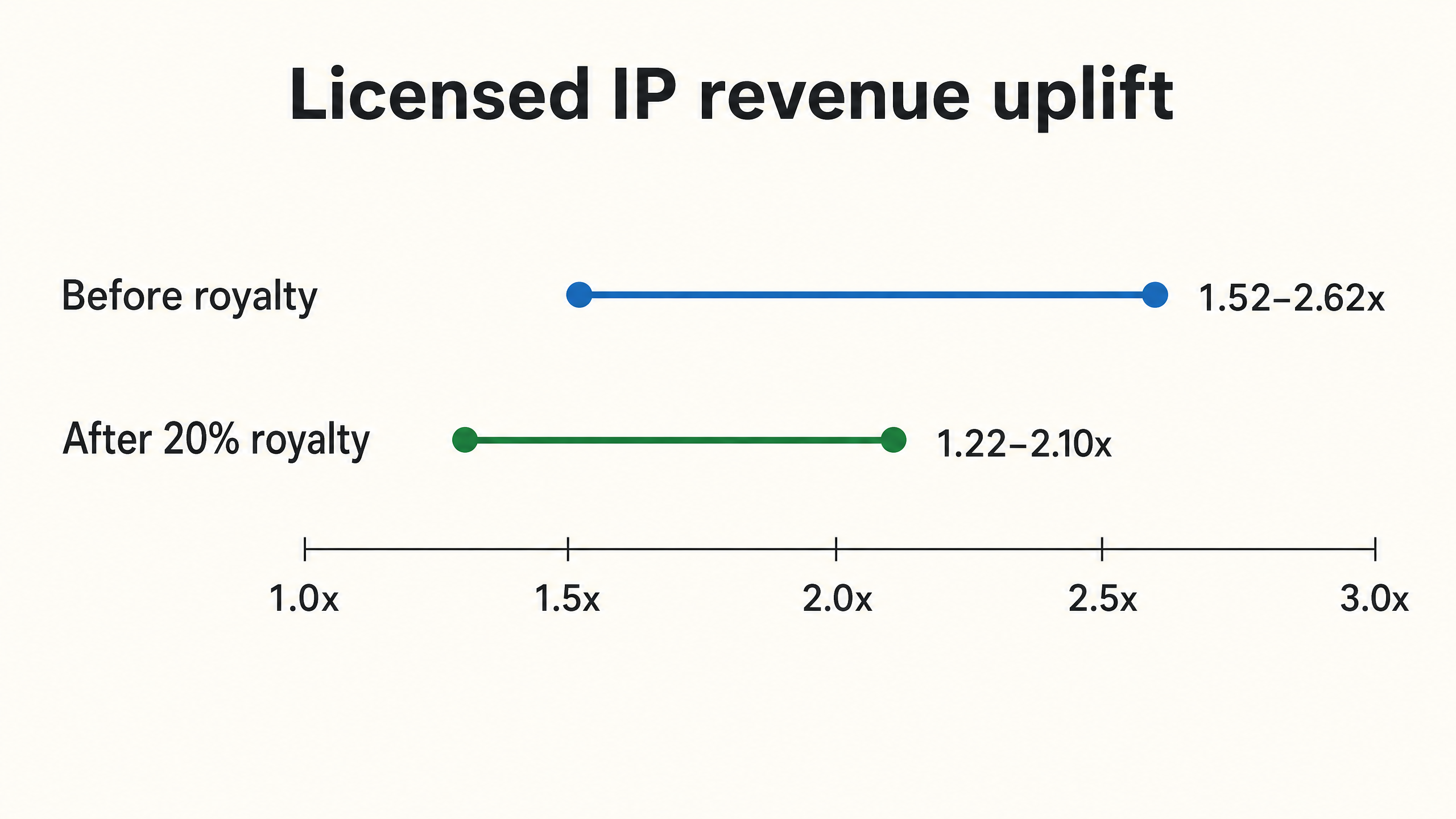
A license should make the net business case better, not merely make the gross revenue number larger. The model needs to include royalties, minimum guarantees, approval-driven rework, production scope, marketing commitments, and the cost of hitting a fixed entertainment window. If the business case requires the top end of the licensed uplift just to break even, the brand has not reduced risk. It has concentrated it.
Attention Needs a Player Behaviour
The strongest licensed products do more than borrow recognition. They turn the reason people care about the brand into something players repeatedly do.
Monster Hunter Outlanders is a useful example. The initial promise is not just familiar monsters on a mobile screen. TiMi is positioning it as a traditional hunting experience, mixing returning creatures with a new Elder Dragon, a new setting, traversal, and rewards tied to pre-registration milestones.2 The trailer embedded below makes that product promise visible. The five-million registration result proves that the franchise can create early demand. The launch still has to prove that mobile players want this version of the hunt for months, not merely that fans wanted to reserve a place.
The Brawl Stars and Duolingo crossover goes further than swapping skins. Duo becomes the boss in a 20-versus-one mode where quiz answers affect rewards and damage. Spike appears inside Duolingo lessons, and completing the learning challenge unlocks a reward in Brawl Stars.3 Each product keeps its own habit while borrowing the other’s character and audience.
Good IP fit can be written as a verb. Hunt. Learn. Collect. Cooperate. If the pitch can only say that players will recognize the character, the product team has described the ad, not the game.
Reach Is Not Product Fit
Transmedia can bring a franchise to people who would never encounter it in a store. Sega’s Netflix slate spans a Crazy Taxi feature, a younger-skewing Sonic animated series, and a live-action Stranger Than Heaven film.4 That range shows why “more reach” is too vague to guide a game team. Each property has a different audience, tone, and job.
A film can make a name familiar. It does not prove that viewers want the game’s price, controls, session length, or progression. The product plan must name the handoff: which audience arrives, what they expect to do, which moment confirms the fantasy, and what gives them a reason to return after the campaign ends.
This is the same distinction AC&A has made about gaining channels without gaining control. A new screen expands access. It does not automatically create demand or a durable player relationship.
Test the License Before Building Around It
AppAgent’s marketability-testing framework separates three questions: market research asks who the audience is, paid concept tests measure which promise earns response and at what cost, and soft launch tests whether the playable game retains and monetizes.5 That sequence is especially useful for licensed games because the famous name can make a weak early metric look reassuring.
A low CPI for a familiar character does not prove that the game will retain. A strong store conversion rate does not prove that the core loop fulfills the fantasy. A large pre-registration total does not prove that the royalty leaves enough margin. Each stage should answer a narrower question.
Do not ask whether the IP is popular. Ask which product risk its popularity removes—and which risks remain untouched.
— AC&A
Before the license shapes the full production plan, a studio should be able to answer:
- Who acts because of the name? Define the audience by observed clicks, wishlists, registrations, demo play, or purchases—not by total franchise followers.
- What player behaviour expresses the fantasy? Identify the mechanic or social action that makes the license more than packaging.
- What is the net uplift? Compare the expected result with a credible original-IP baseline after royalties and variable costs.
- What does the deal make harder? Price approval time, content restrictions, launch timing, localization, live updates, and the risk of rework.
This should connect directly to the launch plan. As AC&A argued in Game Launch Testing Starts With the Business Model, different games need different proof before scale. A licensed premium PC game, a mobile adaptation, and a limited crossover should not share the same green-light scorecard simply because all three use known brands.
Buy the Advantage You Can Measure
Licensed IP is valuable because attention is scarce. It can improve the odds that players notice a game, understand its fantasy, and give it a first chance. Naavik’s data shows that the commercial advantage is not imaginary. It also shows that the advantage is uneven, weakest near the bottom, and smaller after royalties.
The practical conclusion is not to avoid licenses. It is to be precise about what is being bought. A strong deal purchases an audience advantage the team can measure and a fantasy the game can deliver repeatedly. A weak deal purchases recognition, adds cost, and hopes the logo will solve the rest.
Sources
- Naavik — “The Real Value of Licensed IP”
- PocketGamer.biz — “Monster Hunter Outlanders unveils more monsters as 5m pre-registrations achieved”
- PocketGamer.biz — “Brawl Stars and Duolingo launch global mascot crossover”
- PocketGamer.biz — “Sega expands transmedia strategy with Netflix Crazy Taxi film”
- AppAgent — “Mobile Game Marketability Testing: How to Validate Your Game Concept Before Launch”