
Game teams are used to measuring discovery through store rank, paid acquisition, wishlists, creator reach, and organic search. AI game recommendations add another path, and it does not appear to follow the same scoreboard.
In a GameMakers interview about PR and game discovery, Kalie Moore tested a simple question across ChatGPT, Gemini, and Perplexity: what is the best mobile puzzle game? All three named Monument Valley, a premium game first released in 2014 that was not leading the free-download or top-grossing charts cited in the interview.1
That result does not prove that one old game will keep winning, or that AI answers now drive meaningful install volume. It does reveal a measurement problem. AI game recommendations are a second discovery path with different inputs, not a replacement for app-store charts. Teams that collapse both into one idea of popularity will misread what players can find and why.
AI Game Recommendations Measure a Different Kind of Popularity
App stores can rank games using downloads, revenue, ratings, conversion, velocity, and other product signals. A conversational model answers from patterns in its training and retrieval sources. Those sources are words: reviews, guides, interviews, listicles, reference pages, forums, videos, and a studio’s own useful explanations.
The GameMakers example makes the split concrete. ChatGPT cited 24 sources for its answer about mobile puzzle games: 18 best-of lists, five Wikipedia pages, and one Reddit result.1 According to the interview, the cited sources included no standalone conventional reviews.
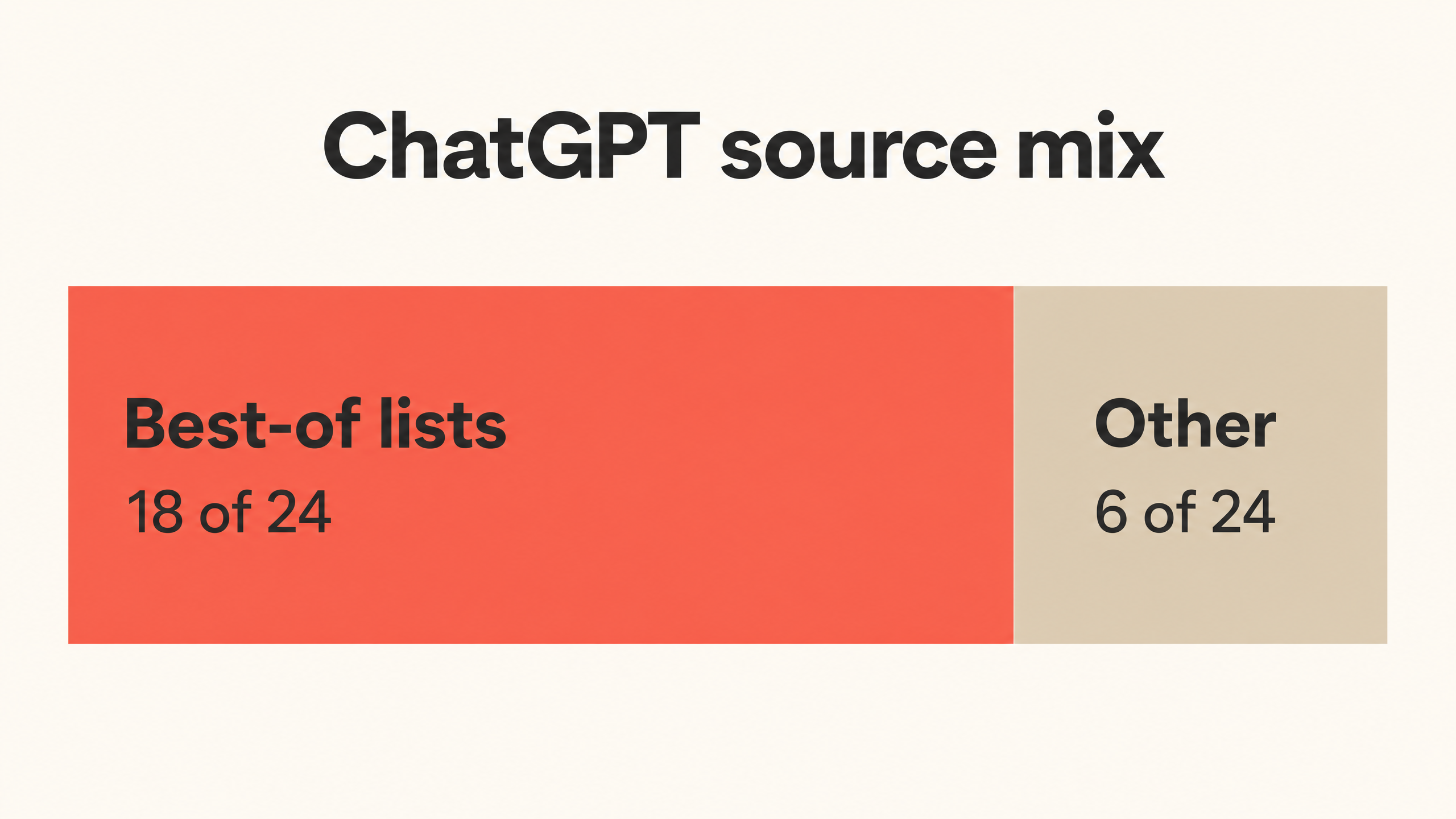
A model can recommend a game because the web has repeatedly explained when and why it is worth playing. That is different from saying the game is currently the biggest commercial product. Paid games may also generate more buyer’s guides than free-to-play games because the reader has a purchase decision to make. A free game with a familiar ad can be easy to install and surprisingly hard to describe in an answer.

Better Recommendations Can Widen the Playable Middle
A recent Mobile Dev Memo analysis points to adjacent evidence from Netflix.2 The underlying Netflix recommendation experiment involved 8.5 million users. Improvements increased consumption and reliance on recommendations while shifting attention away from the most popular titles toward a larger group of moderately popular titles. The effect on the most niche titles was small.3
This is streaming evidence, not a game-store test, and Netflix’s recommender is not an LLM. The useful inference is narrower: better matching can expand the valuable middle without making every obscure title discoverable. A game still needs enough player data, descriptive context, and audience fit for a recommendation tool to distinguish it from thousands of alternatives.
That changes how studios should think about catalog value. The choice is not only blockbuster promotion versus long-tail luck. A well-understood game with a clear audience can become easier to match even after its launch spike has passed.
Together, the examples point to one requirement: a recommendation tool can only match a title using evidence it can recognize.
Press Coverage Is Now Part of Game Metadata
The strongest claim in the GameMakers interview is not that PR can magically manipulate an answer. It is that durable, authoritative writing gives recommendation tools more context to work with. Moore described a client case in which HiRise moved ahead of Roblox on 10 of 12 tracked US prompts after targeted work, while stressing that HiRise already had an earned-media base that models could cite.1
That is vendor-reported evidence, not an independent causal study. Prompts, answers, retrieval indexes, and model versions can all change. Still, it suggests a testable job for communications: make the game’s real audience, differentiators, safety choices, mechanics, and comparisons legible in credible places.
Press coverage now doubles as descriptive metadata. A launch announcement has a short half-life. A specific interview about who the game is for, an independent guide that compares its mechanics honestly, or a maintained page answering a real player question can keep supplying context long after the announcement scrolls away.
Publishing Services Should Include Discovery Evidence
Naavik’s conversation with Midwest Games describes publishing that has split into multiple deal shapes: traditional investment and revenue share, marketing-only support, and for-hire services that let developers keep their IP and revenue.4 Discoverability remains part of the publisher’s job even when capital and ownership are separated.
That makes AI discovery a useful diligence question. A studio buying publishing or PR help should not accept a screenshot of one favorable answer as proof. It should ask what player question was tested, which models and countries were checked, which sources were cited, whether referrals reached a store, and whether those players retained.
AC&A read: a recommendation is not a growth result. It becomes useful only when a studio can trace the path from player question to cited source, store visit, install, and retained play.
Measure the Prompt-to-Player Funnel
Studios already separate impressions, clicks, installs, payers, and retained cohorts in paid acquisition. AI game recommendations need the same discipline. Start with a compact measurement plan:
- Define real player questions. Use queries people ask before choosing a game, such as co-op fit, session length, platform support, accessibility, price, age suitability, or similarity to a known title.
- Record answer share and cited sources. Test by model, market, language, account state, and date. Save the citations, not only the generated recommendation.
- Measure qualified visits. Tag owned links where possible and distinguish a citation click from a branded search that happens later.
- Connect the store step. Watch conversion, install quality, and the effect of landing-page or store-listing changes.
- Judge the cohort inside the game. Compare onboarding completion, early progression, retention, and payer behavior with other discovery paths.
Do not promote “recommended by AI” into a KPI before the downstream player behavior is visible. The answer may be flattering and commercially irrelevant. It may also reach a small, high-intent audience that converts better than its volume suggests. Only the full path can tell the difference.
Write for Player Decisions, Not Announcement Calendars
This work should begin with the product, not with prompt stuffing. Teams need clear pages and credible coverage that answer questions players already have: what the game feels like, who it suits, how sessions work, what friends can do together, which platforms connect, what purchases change, and what makes the experience meaningfully different.
Independent sources matter because a studio cannot manufacture authority by repeating its own claims. So do accuracy and maintenance. Outdated platform support, stale pricing, missing safety details, or inflated comparisons can produce discovery that breaks trust on the next click.
This extends AC&A’s earlier point that player signal is a UA advantage. Search questions and citation paths are another form of player signal. They reveal the comparison a prospective player is making before the store ever sees them. For a young team, that evidence should sit beside the proof described in The New Studio Math, not replace retention or commercial validation.
The Opportunity Is a Better Match, Not a Vanity Metric
AI recommendations will move. Models update, sources disappear, retrieval changes, and a prompt that looks stable in one country may produce a different answer elsewhere. Studios should resist both extremes: dismissing the path because current referral volume is unclear, or treating one top answer as a new chart position.
The durable opportunity is better matching. A player describes a need in plain language. The recommendation tool identifies a game that genuinely fits. The cited material explains the match, and the product keeps the promise after install.
The metric worth keeping is not whether a model names the game. It is whether a good match turns into durable play.