
Game funding has not disappeared. It has become less patient with studios that cannot prove how the product compounds. In this market, product proof beats pitch ambition: founders, product leaders, and publishers need cleaner evidence before the next roadmap review, pitch, or partnership conversation.
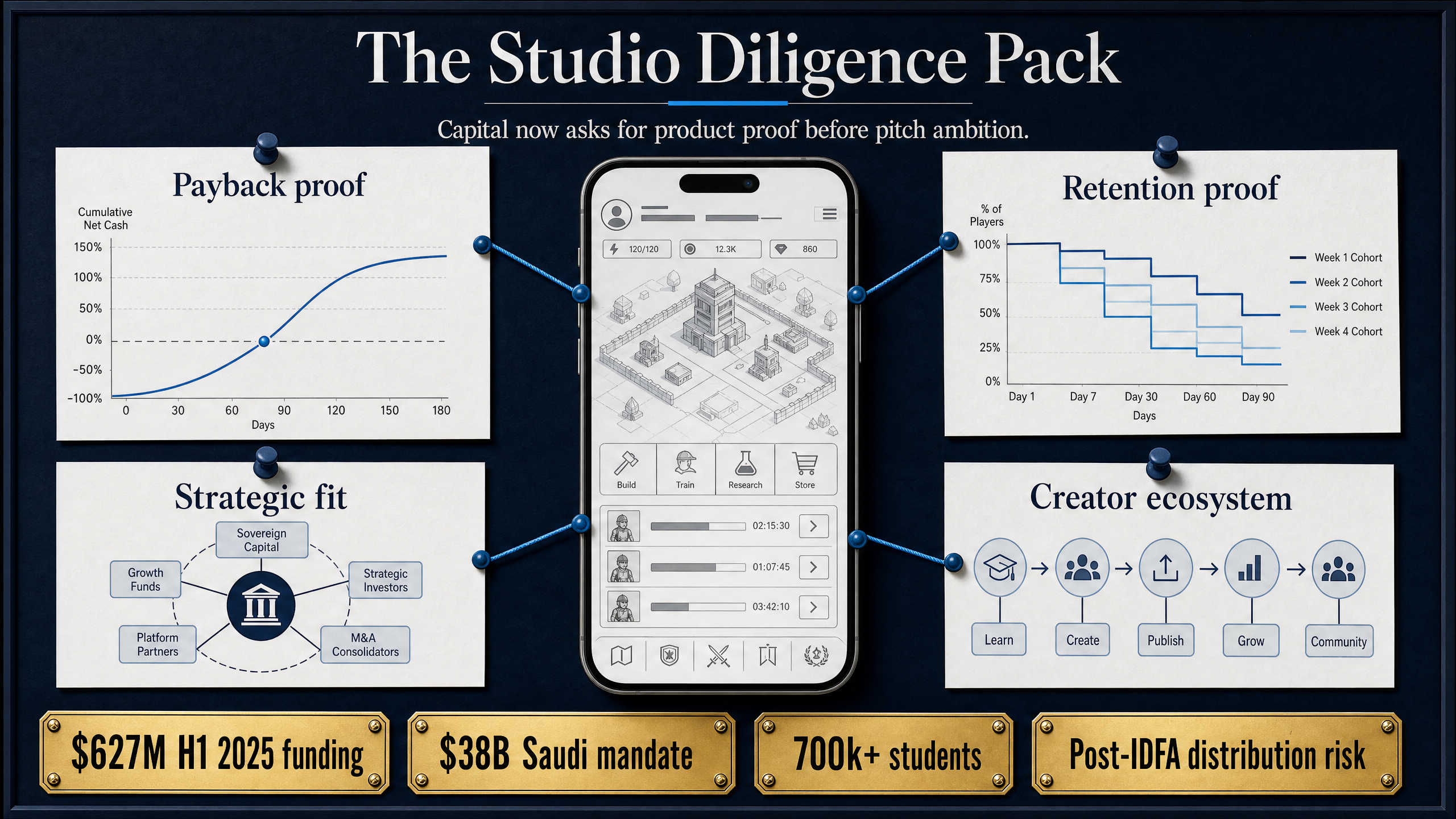
Deconstructor of Fun’s recent investment analysis puts a hard edge on the problem: gaming startup funding has fallen sharply from the 2021 peak, exits are harder to underwrite, and post-IDFA distribution has made paid growth less predictable for new studios.[1] At the same time, Naavik’s analysis of Saudi Arabia’s $38 billion gaming push and PocketGamer.biz’s coverage of the Savvy-Roblox MoU show that capital is still moving when the bet is bigger than one game: infrastructure, ecosystems, talent pipelines, platform leverage, and strategic access.[2][3]
The useful conclusion is not “games are unfundable.” It is sharper than that: the studio story has to become an evidence story.
The Funding Story Is Now an Operating Story
For years, a game pitch could lean heavily on genre, team pedigree, market size, and a believable content roadmap. Those still matter, but they no longer carry the same weight when investors worry about exit scarcity and distribution risk.
Deconstructor of Fun frames the venture problem in fund-math terms: investors need outcomes large enough to return capital, but fewer mid-sized acquirers, compressed multiples, and weaker paid acquisition efficiency make those outcomes harder to see.[1]
That means the product leader’s job changes. A studio cannot only say, “This game can work.” It has to show where the operating leverage comes from:
- Payback proof: the early acquisition loop has a believable path to efficient spend.
- Retention proof: cohorts have reasons to keep returning without constant content escalation.
- Monetization proof: spending maps to durable value, not only event pressure.
- Distribution proof: the game has more than one route to audience.
That is not investor theater. It is better product management.
Strategic Capital Is Buying Ecosystems
The other side of the story is that strategic capital has not lost interest in games. It is just often buying a different shape of asset.
Naavik describes Savvy Games Group as a vehicle launched inside Saudi Arabia’s Public Investment Fund with a $38 billion mandate.[2] PocketGamer.biz’s Savvy-Roblox story is a practical example of what that can look like on the ground: Roblox expanding operational presence in Saudi Arabia, Savvy supporting developer relations, localized training and community building, and more than 700,000 students tied to a related nationwide competition.[3]
That is not just a publishing deal or a one-off investment. It is ecosystem construction: talent, tooling, education, local market access, safety infrastructure, and platform adoption wrapped together.
For studios, the implication is uncomfortable but useful. If you want strategic capital, a platform partnership, or publisher leverage, you need to know what larger system you help strengthen.
Product Proof Beats Feature Ambition
This is where many teams get the sequencing wrong. They try to make the game look larger before they make the business model clearer.
A bigger feature list does not answer the questions capital is now asking. It can even make the story worse, because more systems create more execution risk unless the team can show how those systems compound.
A stronger studio story starts with a smaller set of proofs:
- One audience proof: who reliably understands the promise and why they are reachable.
- One behavior proof: what players repeatedly do that predicts future value.
- One economy proof: why the spending model can grow without poisoning retention.
- One channel proof: why acquisition, platform distribution, creator supply, or partnerships can scale beyond launch novelty.
If those proofs are weak, adding more systems rarely helps. It just gives diligence more places to find uncertainty.
The New Diligence Pack
Before the next financing conversation, publishing conversation, or major roadmap bet, a studio should be able to answer four questions in operating language:
1. What is the route to audience?
Paid UA, IP, creator distribution, platform featuring, web shop, community, regional partnership, or publisher channel. Pick the actual route. “We will test everything” is not a strategy.
2. What compounds after install?
Collection, social obligation, mastery, identity, creator supply, live ops habit, or a recurring utility. Be specific. Retention needs a reason beyond calendar pressure.
3. What makes spending resilient?
The best monetization story is not that whales exist. It is that value grows as the player’s relationship with the product deepens.
4. Why does this matter to someone bigger?
Strategic partners care about market access, creator supply, technology adoption, portfolio fit, brand expansion, or local ecosystem development. If the game does not help a larger system win, the partnership story is probably thin.
Closing: Design for Diligence
The next wave of successful studios will not necessarily be the ones with the largest pitch decks or the most fashionable genre labels. They will be the ones whose products make diligence easier.
That means designing the game and the business together: acquisition truth, retention behavior, monetization architecture, and strategic fit. If the market is less forgiving, the answer is not to make the story louder. It is to make the evidence cleaner.
Sources
- Deconstructor of Fun, “Why Apps Are Beating Games for Investments” – https://www.deconstructoroffun.com/blog/why-apps-are-beating-games-for-investments
- Naavik, “Inside Saudi Arabia’s $38 Billion Gaming Empire” – https://naavik.co/digest/inside-saudi-arabias-38-billion-gaming-empire/
- PocketGamer.biz, “Savvy Games Group and Roblox sign MoU to grow Saudi Arabia’s game development ecosystem” – https://www.pocketgamer.biz/savvy-games-group-and-roblox-sign-mou-to-grow-saudi-arabias-game-development-ecosystem/