
The useful starting point for mobile game habit design is a fourteen-year-old endless runner still operating at blockbuster scale. Most mobile hits from 2012 are not in that conversation.
A launch spike proves that players were willing to try the game. It does not prove that the game has become part of their routine. The durable mobile businesses in the current source set are not being managed as one-time hits. They are being managed as habits.
AC&A read: A game becomes durable when the team can repeatedly create reasons to return, watch how players respond, and use that feedback to improve the game, economy, community work, and distribution plan.
A Long-Running Game Is A Schedule, Not A SKU
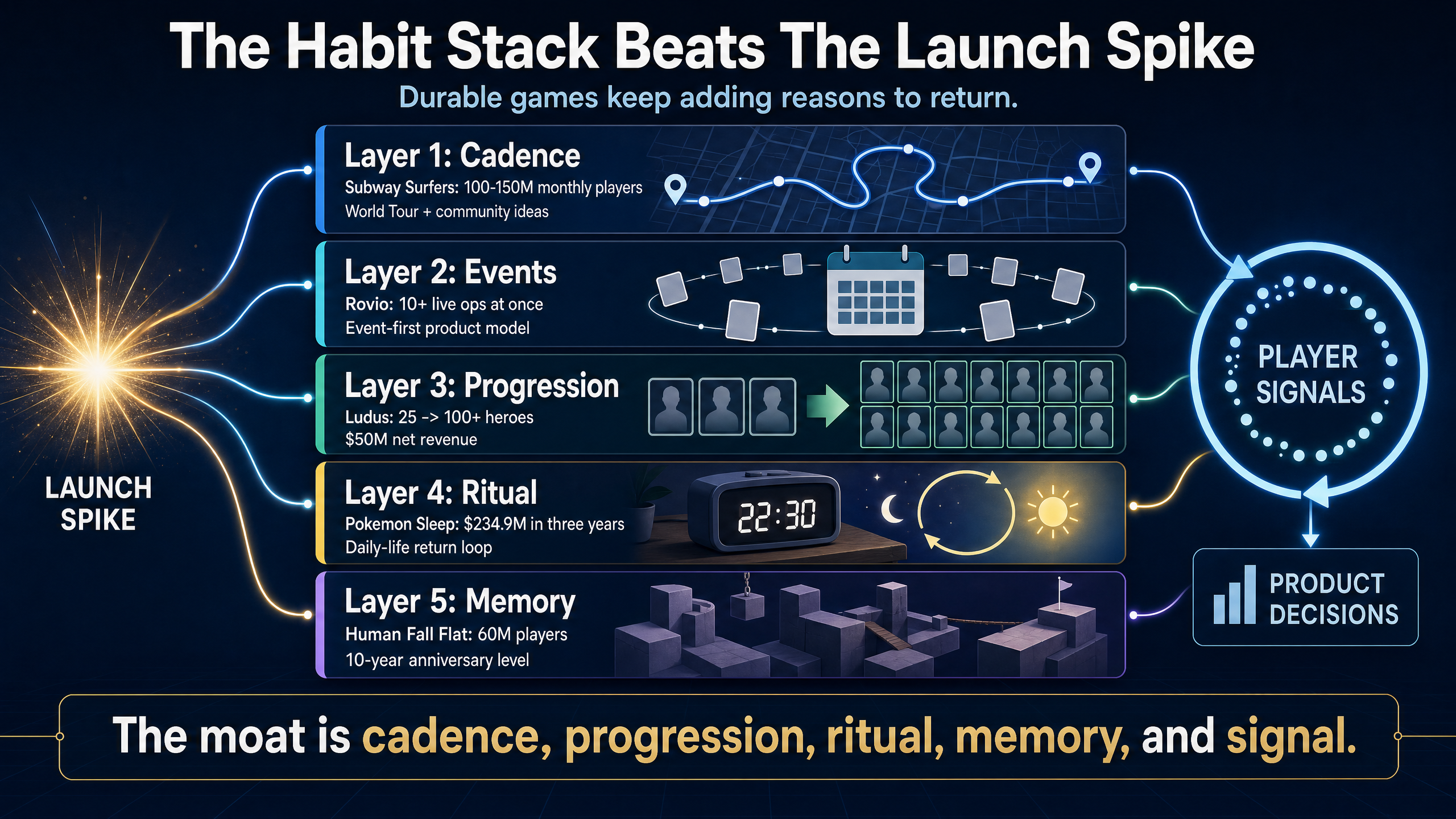
The clearest example is Naavik’s interview with SYBO CEO Mathias Gredal Norvig about Subway Surfers. Fourteen years after launch, the game is still described by SYBO’s CEO as attracting roughly 100 to 150 million monthly players, while many mobile hits from the same era have disappeared from daily conversation.[1]
The important part is not that Subway Surfers still exists. It is how much work now happens around the original endless-runner core: World Tour live ops, artist and designer freedom, community ideas feeding characters and modes, collaborations with games such as Brawl Stars, and a social team trusted enough to catch organic TikTok behavior rather than flatten it into campaign copy.
That is the difference between maintaining content and managing a habit. Content maintenance asks what the team can add next. Habit management asks what kind of return promise the player believes the game will keep making.
Live Ops Is Now Product Architecture
PocketGamer.biz’s coverage of Rovio lead product manager Anastasiya Kara’s live-ops session makes the same point from the industry-history side. Kara traces mobile’s shift from a core-first model to an event-first model, starting with early paid add-ons such as Angry Birds’ $0.99 Mighty Eagle and moving through social casino, top-grossing event calendars, and hypercasual cores that now run fuller live-ops programs.[2]
Her framing matters because live ops is now part of how the game is run every day. A top game is not just a build plus a marketing plan. It is a live service with time-limited events, offers, retention work, content updates, audience segmentation, and economic pressure that all need to coexist without burning out the player.
The mistake is to call that “more events.” The better read is that live ops became the bridge between product strategy and player habit. It decides when to ask for attention, what kind of value is offered in exchange, which cohort should see the ask, and what the team learns from the response.
Progression Has To Give Every Player A Next Decision
The habit point becomes more concrete in PocketGamer.biz’s report on Ludus: Merge Arena crossing $50 million in net revenue. The game has generated $66 million gross since launch, attracted more than 11 million players, and grown from 25 soft-launch heroes to more than 100.[3]
That is not just scale. It is more for players to learn, collect, compare, and care about. A competitive game with dozens of added heroes can keep giving different players new goals, counters, collection pressure, mastery problems, and identity choices. The point is not to add complexity for its own sake. The point is to give the habit enough shape that both a two-year veteran and a new player can believe there is still a next meaningful decision.
Ludus shows the progression version of habit design. Pokemon Sleep offers the ritual version.
PocketGamer.biz reports AppMagic estimates of $234.9 million in gross player spending since July 2023, with year-three spending averaging about $5.7 million per month.[4] The product is unusual because its return loop is anchored in a daily-life ritual, not a combat session or a conventional content grind.
For AC&A clients, the lesson is not “make a sleep tracker.” It is that the strongest retention mechanic may be the one that fits a player’s existing day so well that the game earns a place inside it. Habit design is partly feature design, but it is also calendar design, emotional design, and restraint.
Anniversaries Work When History Becomes Playable
Human Fall Flat’s 10th anniversary update shows another path to durability. PocketGamer.biz reports that the game has reached 60 million players and marked the anniversary with a free PC level inspired by classic stages, plus behind-the-scenes creator material.[5]
An anniversary can be a press beat, but this one is also playable memory. It lets returning players revisit the game’s history through the product itself. That matters because long-running games accumulate culture: old levels, old jokes, old frustrations, player-made techniques, creator stories, and a shared sense that the game has a past worth revisiting.
Naavik’s digest on online fandom and IP extends the same idea beyond one game. The piece traces Backrooms from online meme and creator ecosystem into a major A24 film, while noting that Roblox’s Apeirophobia has more than 422 million visits.[6] The commercial point is not that every meme becomes a film. It is that audience participation can incubate product meaning before a traditional rights-holder formalizes it.
Games teams should take that seriously. Community is not only a distribution channel. In long-running games, community helps preserve the game’s history, brings feature requests into view, builds legitimacy, and sometimes becomes the source of the next IP layer.
New Channels Only Matter If The Habit Is Real
Several adjacent signals point to the same constraint. PocketGamer.biz reports that Netflix saw a 600% year-over-year increase in kids mobile-games engagement, 3x daily-player growth for Netflix Playground, and early traction from cloud game launches, while acknowledging that the base remains small.[7]
Neon’s $13 million Series A points at the commerce side: publishers want more control over payments, loyalty, and player data outside the default app stores.[8] That direction is commercially important, but it does not remove the product test. Cloud access, DTC stores, loyalty infrastructure, and subscriptions are only valuable when they reinforce a game players already have a reason to return to.
The practical audit is simple:
- Cadence: what is the reliable return promise players understand?
- Segmentation: which players need a new challenge, a social reason, a collectible goal, or a lighter touch?
- Memory: how does the game make its own history useful instead of just nostalgic?
- Community input: where do player ideas change the product, not just the marketing calendar?
- Owned relationship: what data or account connection makes the next return smarter?
For teams that need an outside review of that loop, AC&A’s product strategy and live-ops consulting is usually most useful before the roadmap hardens, when the question is still what return habit the game is actually promising.
A hit can buy a team attention. It cannot buy a durable relationship. Every case in this set points at the same constraint: the next moat is not the launch. It is the player habit the team keeps earning after launch.
Sources
- Inside Subway Surfers, Mobile Gaming’s Most Enduring Hit, Naavik, July 21, 2026.
- Rovio’s Anastasiya Kara on how live ops took over mobile’s biggest games, PocketGamer.biz, July 24, 2026.
- Ludus: Merge Arena surpasses $50m in net revenue after two years, PocketGamer.biz, July 24, 2026.
- Pokemon Sleep surpasses $230m in three years, PocketGamer.biz, July 20, 2026.
- Human Fall Flat marks 10th anniversary with 60m players and free level, PocketGamer.biz, July 23, 2026.
- How Online Fandom Is Rewriting the IP Playbook, Naavik, July 26, 2026.
- Netflix says kids’ mobile games engagement jumped 600% as cloud gaming gains traction, PocketGamer.biz, July 21, 2026.
- Neon raises $13m Series A to expand direct-to-consumer commerce platform for game publishers, PocketGamer.biz, July 22, 2026.