
Mobile growth is not dead. The old way of learning from it is.
For years, a common operating assumption was that a studio could build a plausible core loop, spend into paid acquisition, and let retention, CPI, ROAS, creative tests, and monetization telemetry reveal whether the product had legs. That playbook increasingly works best for teams that already have scale, data infrastructure, creative volume, and live-ops depth.
The better question is no longer, “Can we afford UA?” It is: “What player signal can we own before we amplify the product with UA?”
That is the thread running through several recent games-industry signals. PocketGamer’s Mobile Mavens panel argues that mobile has become harder because the barriers are no longer just development quality; they include user economics, data infrastructure, content production, community access, and incumbents’ compounding advantage.1 At the same time, Melon Sandbox has turned a physics sandbox into a creator ecosystem with 150 million installs, 19 million monthly active users, 90,000 user-generated creations, more than 35,000 creators, and 5,000 to 6,000 daily submissions.2 CrazyGames reports 862 million hours of browser gameplay and 1.74 billion sessions, showing that meaningful attention can exist outside the app-store funnel.3
The lesson is not that every studio needs UGC, browser distribution, AI tooling, or a direct-to-consumer strategy. It is sharper: studios need a signal loop that teaches the team what players want before paid scale makes every mistake more expensive.
UA Is An Amplifier, Not The First Source Of Truth
Paid acquisition can scale winners, stress test creative-market fit, and expose a game to audiences organic channels will never reach. But it is a costly way to discover whether the product promise is legible.
That matters because mobile launch risk has moved upstream. A studio is competing against live products with years of event cadence, economy tuning, player segmentation, creative libraries, influencer history, community memory, and accumulated data. If a team waits until paid UA to learn which fantasy, mechanic, creator hook, or progression promise moves players, the team is buying basic research at scale-market prices.
The alternative is not to avoid UA. The alternative is to make UA the amplifier of an existing signal system. Before scaling spend, a studio should already know which audience language gets a response, which moments players share, which progression anxieties create churn, and which objections repeat in community and support channels.
That is an operating model change. UA, product, economy, community, and live ops cannot each own a separate version of the truth. The recurring question should be: what did players tell us through behavior, creation, search, conversation, spend, and churn, and what are we changing because of it?
UGC Scale Is A Product System
Melon Sandbox is the cleanest example of why player signal has to be treated as infrastructure. The interesting number is not only 150 million installs. It is the shape of the system around those installs: 19 million MAU, tens of thousands of creators, thousands of new submissions every day, more than $1 million in creator payouts, and roughly half of paying users still retained after one year.2
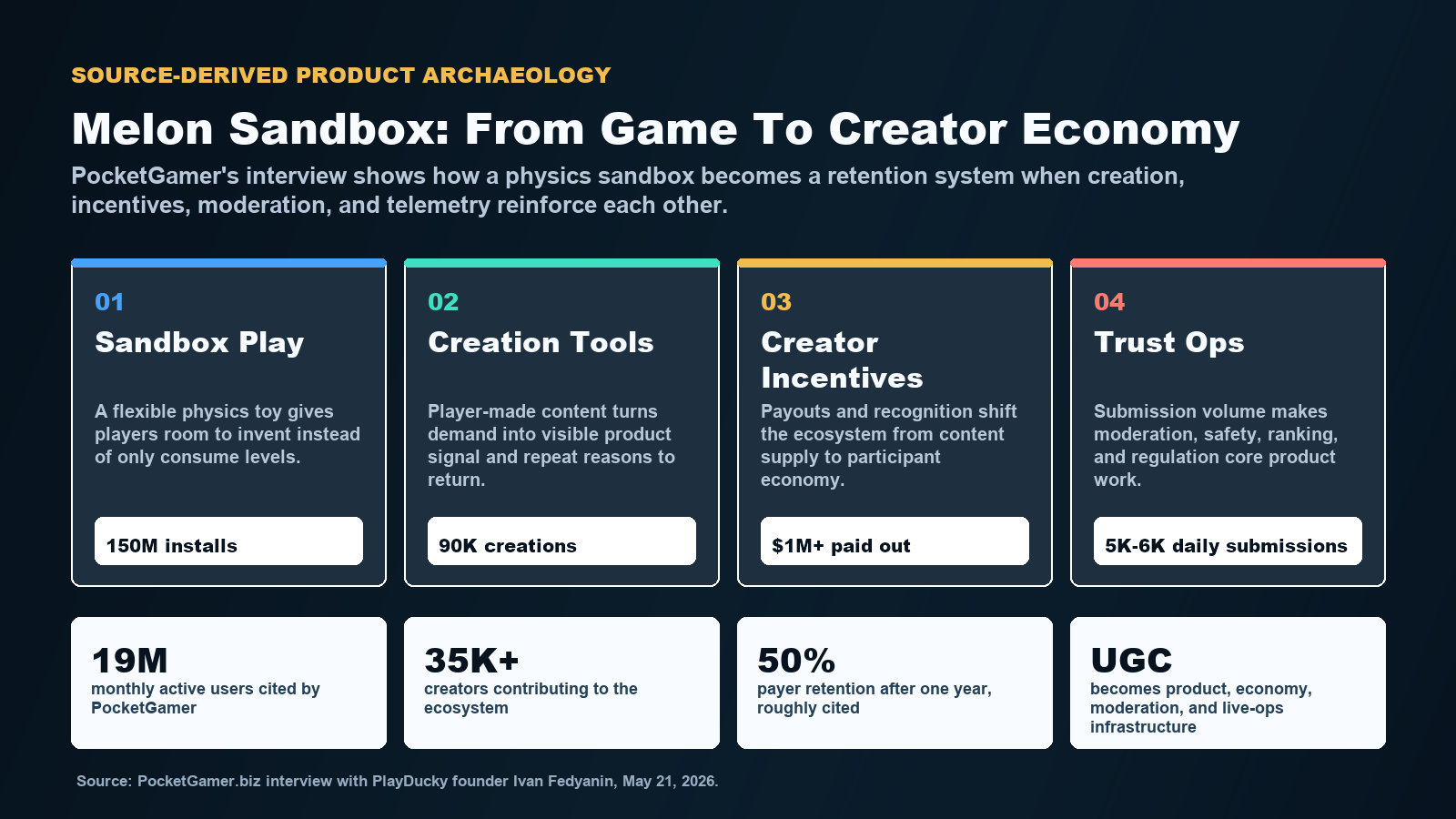
At that point, UGC is no longer a feature category. It is product architecture. Submission volume creates moderation load. Creator incentives become economy design. Content surfacing affects retention. Player identity shifts from consumer to participant. Regulation and child-safety exposure become part of the roadmap.
This is where many studios under-scope creator strategy. They ask whether creation tools would increase content supply. The better question is whether the studio can operate the loop those tools create: promotion, suppression, creator incentives, economy health, moderation pace, and the signals that reveal unmet player demand.
Distribution Channels Are Learning Channels
Browser, community, Roblox, Discord, Steam, TikTok, and creator channels are often described as distribution alternatives. That is true, but incomplete. Their strategic value is that they can teach a studio faster and cheaper than a conventional mobile launch path.
CrazyGames’ reported 1.74 billion browser sessions and nearly 30-minute average session duration show that browser play can generate durable behavioral data, not just casual sampling.3 For the right game, a browser build can answer questions a mobile soft launch might answer later and more expensively: does the premise earn repeat play, which moments create drop-off, and what hooks travel without paid pressure?
The same logic applies to community and creator channels. A Discord server is not a marketing accessory if it changes the roadmap. TikTok is not only a creative testing machine if comments expose misunderstood promises. A Roblox prototype is not only a younger-audience play if it pressure-tests mechanics, UGC demand, or session goals before a heavier native build.
This is also why Naavik’s Xbox analysis is relevant outside the console business. Its argument that Xbox should lean into publishing, multiplatform reach, and the latent power of Minecraft points back to the same strategic asset: owned communities and IP that can produce signal, not just units sold.4
AI Should Compress Signal To Decision
The most useful AI story for teams is not “generate more stuff.” It is “shorten the time between signal and decision.”
FirstLook’s AI agent is pitched around exactly that fragmentation problem: player, campaign, community, storefront, and live-service signals sitting across TikTok, YouTube, Twitch, Discord, Reddit, forums, Steam, Epic Games, Roblox, and other channels.5 Sensor Tower’s acquisition of AppMagic points at a related market-intelligence pressure: studios, investors, and publishers want better visibility into mobile games, off-platform revenue, mobile web, and DTC behavior, often requiring better first-party data and panels.6
The danger is treating these tools as dashboards that make everyone feel informed while no one changes the product. A signal system only has value if it creates operating decisions. Player sentiment belongs in economy design, creator submissions belong in product planning, and browser replay data belongs in launch sequencing when those signals are strong enough.
A practical studio ritual is a player-signal review with one rule: every signal cluster must produce either a product action, a live-ops action, a campaign action, or a conscious decision to ignore it. Otherwise the team is collecting evidence after the roadmap has already decided.
Trust Is Part Of Growth
Player signal is not only about discovering demand. It is also about knowing what can break when demand arrives.
Roblox’s scrutiny around child safety, spending, engagement, and currency mechanics is the obvious warning signal for creator ecosystems.7 Any game that depends on players, creators, or children participating in an economy has to treat trust as product infrastructure. Clear spending flows, moderation queues, reporting tools, content ranking rules, and parental expectations shape whether the ecosystem can scale without losing confidence.
This is where growth and product teams need shared accountability. A UGC loop that maximizes engagement while ignoring trust will damage retention quality. A creator economy that rewards output without managing incentives will produce content volume, but not necessarily player value.
What Teams Should Do
The useful reframing is simple: do not build a UA plan first. Build a player-signal plan first.
For a freemium studio, that plan should answer five questions before serious scale spend:
- Where do we observe high-intent player behavior before paid UA distorts the sample?
- Which player, creator, and community signals are reviewed together rather than in separate dashboards?
- What product or economy decision does each signal source actually influence?
- Which alternative channels can test the promise earlier: browser, community, creator tools, Roblox, Steam, web, or DTC?
- What trust, moderation, and spending rules have to exist before the loop works at scale?
The studios with an advantage will still spend, optimize creative, and buy installs when the unit economics work. But the strongest teams will not use paid UA to discover the basics. They will use it to amplify what their player-signal loop has already learned.
Sources
- PocketGamer.biz: “Mobile has become too expensive for the old playbook”: The Mobile Mavens on rising barriers to entry
- PocketGamer.biz: Melon Sandbox’s 150m installs and UGC evolution
- PocketGamer.biz: CrazyGames sees 862m hours of browser gameplay as total sessions reach 1.74bn
- Naavik: Where Will Asha Sharma Take Xbox?
- PocketGamer.biz: FirstLook launches AI agent to unify player data and game marketing workflows
- PocketGamer.biz: Why Sensor Tower acquired rival AppMagic
- PocketGamer.biz: Roblox under fire as FTC and Ofcom probe spending and child safety