
Retention is everything in mobile gaming. With 77% of players quitting after the first day, keeping users engaged is more critical than ever. Gamified strategies like missions, leaderboards, and surprise rewards help create habits, boost engagement, and increase retention. Here’s a quick breakdown of the top five strategies:
- Daily & Weekly Missions: Encourage consistent play by rewarding players for completing tasks.
- Competitive Leaderboards: Motivate players with rankings while fostering social interaction.
- Milestone-Based Unlocks: Reward progress with meaningful goals and achievements.
- Guild-Based Events: Build community through teamwork and shared challenges.
- Surprise Rewards: Add unpredictability to keep players curious and coming back.
Together, these strategies transform casual players into loyal users while driving revenue growth through game optimization for mobile games.
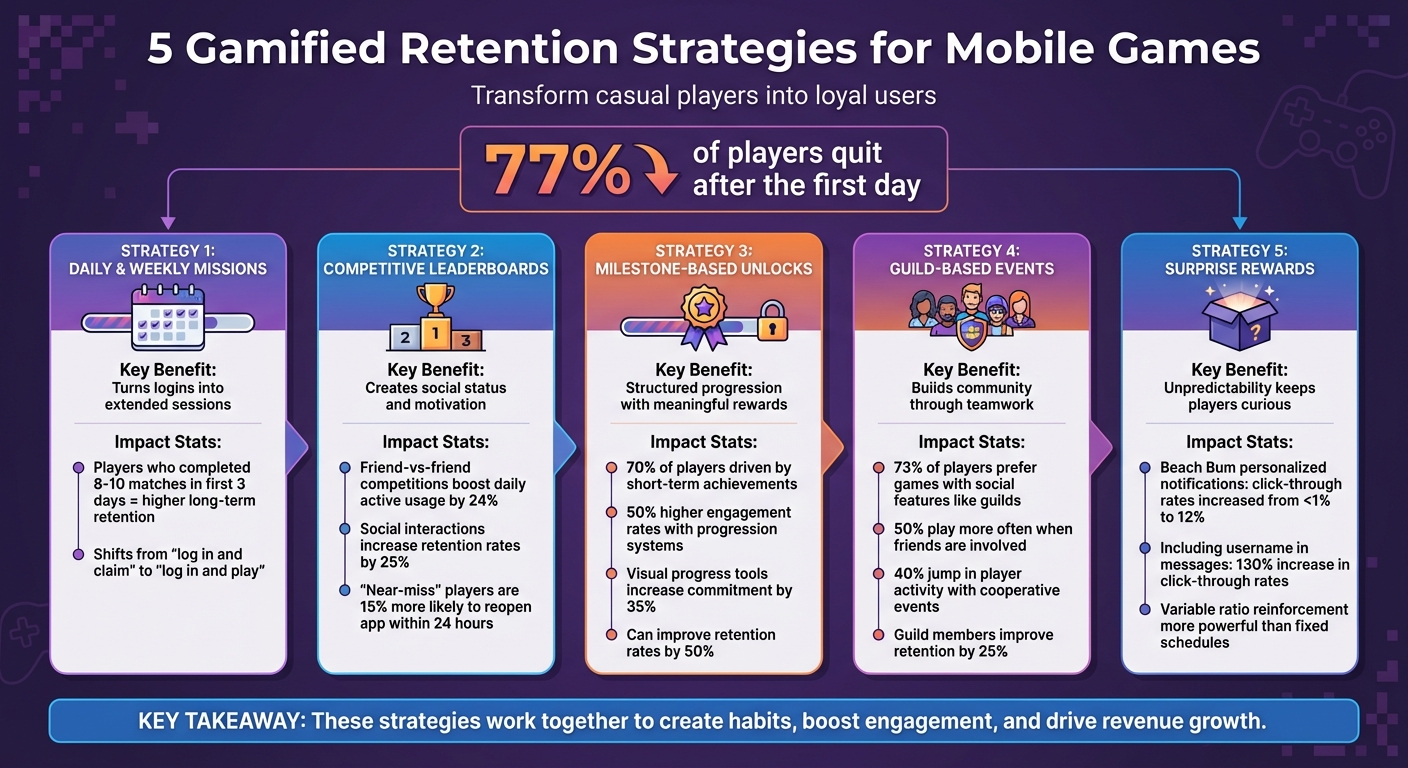
5 Gamified Retention Strategies for Mobile Games: Impact and Benefits Comparison
Experts Reveal Game Retention Tips From Day 1 To Day 180
sbb-itb-fd4a1f6
1. Daily and Weekly Missions
Daily and weekly missions turn quick logins into extended gaming sessions. Instead of just logging in to grab rewards, players are encouraged to complete tasks like winning matches or gathering specific items. This shift from “log in and claim” to “log in and play” not only increases the time spent in-game but also helps players form stronger habits [6].
Player Engagement
Missions provide players with clear, actionable goals. This is especially helpful for new players, guiding them through their next steps [1]. Take Clash Royale, for instance. When it first launched, it lacked a mission system. Later, Supercell introduced quests to give players daily objectives and highlight features they might have missed [1]. The result? Players discovered new game modes and stayed engaged longer.
These missions also reinforce habitual play through incremental rewards. As William Grosso, CEO of Game Data Pros, puts it:
By claiming regular rewards — especially when the rewards get incrementally larger — players get into the habit of logging in, which in turn increases their attachment with the game [2].
This type of fixed-interval reward system turns occasional play into a daily routine, setting the stage for better long-term retention.
Retention Impact
The benefits of mission-driven mechanics extend to retention as well. For example, Head Ball 2, a multiplayer soccer game, discovered that players who completed 8–10 matches within their first three days were more likely to stick around long-term. To encourage this, the developers added missions that included boosters and free items, nudging players toward that match-completion goal [7]. Similarly, Match Masters rewarded players with perks for reaching milestones like levels or trophies, further encouraging ongoing play [7].
Timing also plays a critical role. Introducing daily missions right after the first-time user experience (FTUE) ensures players grasp the game basics before being assigned specific objectives [6]. Push notifications for unfinished missions create a subtle sense of urgency [5]. Additionally, using a “zigzag” reward system – alternating high-value rewards with smaller ones – keeps players motivated without overwhelming them [6].
These strategies make mission-driven systems a cornerstone for boosting retention in modern mobile games.
2. Competitive Leaderboards
Leaderboards take game scores and turn them into something bigger – social status. They transform simple wins and points into visible markers of success, creating a feedback loop that keeps players coming back for more. This taps into deep psychological drivers, meeting the needs for competence, connection, and independence in players’ minds [9][10].
Player Engagement
Leaderboards aren’t just about competition; they’re about motivation. They provide clear, goal-oriented incentives that keep players hooked. As Lloyd Melnick, GM of Chumba at VGW, puts it:
A well designed leaderboard is consistent with these three needs: Competence… Relatedness… and Autonomy [10].
But here’s the catch: the competition needs to feel achievable. Global leaderboards may offer prestige, but they can also discourage new players who find themselves ranked far behind. That’s where segmented leaderboards shine. By organizing players by region, skill level, or friend groups, these boards make goals feel more attainable and socially meaningful [9]. Features like real-time updates, such as iOS Live Activities, add urgency and keep players coming back [5].
Leaderboards also go beyond individual goals, building connections within the gaming community.
Social Interaction
The social aspect of leaderboards is a powerful retention tool. They encourage players to engage not just with the game but with each other. Studies show that friend-vs-friend competitions can boost daily active usage by up to 24% compared to solo tracking [11]. Leaderboards foster this sense of community, turning competition into collaboration.
Even when competition gets intense, features like virtual high-fives can shift the focus from rivalry to recognition, making the experience more positive [10][11].
Retention Impact
Retention is a challenge for mobile games, with the average 30-day retention rate sitting at just 2.4% [5]. Leaderboards tackle this issue head-on. Whether it’s beating a friend’s score, improving their own rank, or aiming for the top spot, players are driven to return. Social interactions tied to leaderboards can boost retention rates by about 25% [12].
The way leaderboards reset also matters. Daily, weekly, or seasonal resets lower the bar for new players while giving seasoned players fresh goals. Instead of a winner-takes-all approach, tiered rewards keep more players engaged. Transparency in scoring, reset schedules, and anti-cheating measures are crucial for maintaining trust and keeping the competition fair [9].
Long-Term Replayability
Leaderboards create a cycle of engagement that keeps players interested even after they’ve mastered the basics [9]. Seasonal rankings tap into players’ desire to achieve mastery and gain recognition [9]. For instance, Fitbit saw a 15% increase in daily user activity after adding leaderboards, proving how effective this feature can be [11].
The “near-miss” effect also plays a big role. Players who just miss out on a win are 15% more likely to reopen the app within 24 hours [11]. This psychological pull, combined with the drive to improve strategies and skills, keeps players coming back for more. It’s a structure that not only boosts retention but also enhances monetization opportunities [9].
Leaderboards lay the groundwork for deeper engagement. Up next, we’ll dive into how milestone-based unlocks can take competitive play even further.
3. Milestone-Based Unlocks
Milestone-based unlocks offer players a structured way to progress while rewarding their efforts. Michail Katkoff, Product Manager at Supercell, puts it this way:
“The desire to become better should always be the main goal for every player. Because in a well-designed F2P game, improving is synonym to progressing and progressing should equal the amount of time spent playing the game.” [14]
Player Engagement
The beauty of milestones lies in their ability to transform big goals into smaller, achievable steps. Research highlights that 70% of players are driven by short-term achievements, and games with well-developed progression systems experience engagement rates that are 50% higher [12].
Milestone unlocks, much like daily missions or leaderboards, create habit-forming gameplay loops that boost retention. Offering meaningful rewards – like new characters or abilities – keeps players invested. For instance, PUBG Mobile‘s Royale Pass led to a staggering 365% increase in global spending [13].
Visual elements such as progress bars or level maps enhance player commitment by 35% [12]. These tools provide clear feedback on progress, creating a psychological reward loop that encourages players to keep coming back for more.
Retention Impact
Well-designed onboarding and progression systems can improve retention rates by as much as 50% [13]. However, striking the right balance in difficulty is key. If milestones are too simple, players lose interest; if they’re overly challenging, frustration sets in. About 60% of players quit when difficulty spikes too quickly without rewarding progress. Tools like push notifications – such as “Only 2 wins away from a Legendary Chest!” – can effectively re-engage players when they’re close to achieving a milestone [13].
Long-Term Replayability
Milestone-based systems foster a cycle of progress and reward that keeps gameplay fresh. Each unlock revitalizes the experience, helping to reduce player churn. For example, trophy-based progression systems allow players to access new game modes or competitive tiers as they advance [13].
This approach is widely used – 91% of the top 500 mobile games rely on milestone-based progression systems, such as Battle Passes, to drive revenue and build player loyalty [15]. These systems often adapt to individual skill levels, catering to the 80% of players who prefer challenges that match their abilities [12]. Additionally, introducing new mechanics gradually through milestone-based tutorials helps players grow without feeling overwhelmed [13].
4. Guild-Based Events
Social Interaction
Guild-based events transform solo gaming into shared adventures, where players connect and collaborate. Joining a guild isn’t just about gameplay – it’s about forming bonds through teamwork. These connections create a sense of social responsibility, which is one of the most powerful motivators for players to return. When players feel accountable to their guildmates, they’re more likely to stay engaged. The stats tell the story: 73% of players prefer mobile games with social features like guilds, and 50% play more often when friends are involved [3][12][18]. Guild events foster interdependence, where every player’s contribution impacts the group’s success, promoting teamwork and long-term engagement. As we’ve noted:
Clans and guilds help drive retention through social pressure and collaboration [1].
Player Engagement
Guild-based events are a proven way to boost engagement. Games with social features like cooperative events see a 40% jump in player activity [12]. A standout example is War Metal: Tyrant, where players in clans generated 20 times more average revenue per user than solo players. Even more striking, just 6% of the player base contributed 55% of the game’s total revenue [17]. These events succeed because they create a sense of community, giving players both status and a sense of belonging [19]. In-game communication amplifies this effect – 65% of players are more likely to keep playing when they can chat directly with others [12]. The result? Stronger social ties that encourage players to stay engaged and return regularly.
Retention Impact
The retention benefits of guild systems are hard to ignore. Players who join guilds improve overall retention rates by 25%, while multiplayer and social features can add 50–100 hours to a mobile game’s lifecycle [12][17]. It’s no surprise that 60% of the top-grossing mobile games include guild or clan features [4]. This retention power comes from the mutual support and accountability that guilds create. Players are motivated to help their teammates, maintain friendships, and tackle shared challenges. Guild events also keep the gameplay fresh, breaking up monotony with cooperative tasks that feel new and exciting [12][17].
Long-Term Replayability
Guild-based events keep players coming back for more. Time-limited tournaments create urgency, while cooperative goals encourage teamwork over the long haul [12][17]. Players who engage with guild features in their first week are 40% more likely to stick around for the long term [12]. By scheduling regular guild events, developers establish “appointment” triggers that seamlessly integrate the game into players’ routines [1][18]. And this is just the beginning – next, we’ll dive into how surprise rewards can take engagement to the next level.
5. Surprise Reward Elements
Adding an element of surprise to rewards builds on the social dynamics of guild events, creating a sense of unpredictability that keeps players hooked.
Player Engagement
Surprise rewards introduce randomness, which keeps players curious and eager to engage. Features like randomized loot boxes, mystery chests, and daily spin wheels tap into the thrill of uncertainty. This unpredictability sparks a dopamine release, making the act of logging in feel rewarding on its own [21]. Research shows that variable ratio reinforcement – rewards delivered unpredictably – has a stronger impact on player behavior compared to fixed schedules [8]. William Grosso, CEO of Game Data Pros, highlights this dynamic:
The randomness aspect adds variable ratio reinforcement to fixed-interval reinforcement… which can powerfully shape player behavior, since it associates unpredictable results with the expectancy of winning a large/valuable reward [8].
The numbers back this up. After Beach Bum introduced personalized push notifications alerting players about nearing a “Legendary Chest”, their click-through rates soared from under 1% to 12% [16]. Even small touches, like including a player’s username in messages, increased click-through rates by 130% [16].
These unexpected rewards not only boost excitement but also lay the groundwork for long-term player retention.
Retention Impact
Surprise rewards work because they tap into the fear of missing out (FOMO), especially when tied to limited-time events. Seasonal content – like holiday-themed skins or exclusive weekend bonuses – creates urgency that drives immediate action [13]. These mechanics turn everyday logins into moments of anticipation, encouraging players to return regularly [21].
Long-Term Replayability
The key to keeping players engaged over time is scaling the value of rewards. Static surprises lose their charm as players progress, but rewards that grow in value maintain their allure [2]. As our founder Adrian Crook explains:
Players love the excitement of the unknown– they aren’t just purchasing an upgrade, they are purchasing the emotions that go along with opening a ‘pack’ and discovering what wonders or disappointments are inside [20].
Smart developers balance predictability and surprise by introducing events like “Epic Saturdays”, where high-value mystery rewards appear on a regular schedule [1]. This approach not only builds a weekly habit but also keeps the experience fresh and exciting.
Conclusion
The five strategies – daily missions, competitive leaderboards, milestone unlocks, guild events, and surprise rewards – work together to transform casual players into dedicated users. Each one taps into a specific psychological motivator: building habits through regular intervals, sparking competition with visible rankings, encouraging progression with clear goals, fostering community through teamwork, and keeping things fresh with unexpected rewards.
When these tactics are integrated into live operations, they create a powerful system that re-engages inactive players and maximizes the lifetime value of each user [22][2]. This approach not only increases revenue by optimizing in-game purchase systems but also presents challenges in execution.
LiveOps strategies can significantly impact revenue generation, often marking the difference between average and outstanding retention rates [4][2]. This retention gap can ultimately decide a game’s profitability. Adrian Crook stated:
Retention is the key to growth in the 2018 mobile landscape… developers should first and foremost optimize for retention [1].
The real test lies in execution. Striking the right balance between event frequency, scaling rewards and game economies appropriately, and tailoring experiences for diverse player groups requires both technical expertise and thoughtful design. Too many events can overwhelm players, while rewards that don’t evolve lose their appeal over time [22]. The best games use consistent mechanics to make playing a daily habit [1].
We at Adrian Crook & Associates provide consulting services in game design and live operations, backed by over 17 years of experience and a portfolio of 300+ clients. With our data-driven approach and customized solutions, we help developers turn retention into a powerful engine for growth in today’s competitive mobile gaming market.
FAQs
Which retention strategy should I add first?
To boost Day 1 retention, start by refining the initial player experience – this is key to keeping players interested in the long run. Prioritize creating an engaging onboarding process that introduces players to the game in a fun and seamless way. Use personalized notifications to re-engage players and guide them through their early interactions. Additionally, focus on rewarding early activity to give players a sense of accomplishment right from the start.
By building strong early retention, you’ll set the stage for introducing features like leaderboards or social elements later, keeping players invested over time.
How do I prevent missions and events from feeling like chores?
To keep missions and events from becoming tedious, focus on making them engaging and worthwhile. Offer rewards that matter, aligning with what players genuinely enjoy, such as opportunities to improve their skills or express their creativity. Mix things up with diverse challenges, compelling storytelling, and objectives that build toward larger, long-term achievements. While external rewards are important, ensure they complement the intrinsic joy of playing. Including optional activities like mini-games or social interactions can also add depth and variety. Finally, carefully pace the missions and weave them seamlessly into the game’s narrative to maintain interest and avoid player fatigue.
How can I use surprise rewards without upsetting players?
Surprise rewards can be a great way to increase engagement and keep users coming back, but the key is in how you implement them. The rewards should feel fair and like they’ve been earned, rather than coming across as manipulative or completely random. For instance, you could provide unexpected bonuses when users hit certain milestones or complete specific challenges. However, it’s important to avoid making the system confusing or frustrating. By ensuring transparency and a sense of fairness, players are more likely to view these rewards as sincere gestures of appreciation, which can build loyalty rather than lead to disappointment.