Mobile Freemium Game Design & Product Management | AC&A2026-06-22T19:29:13Zhttps://adriancrook.com/feed/atom/WordPresshttps://adriancrook.com/wp-content/uploads/2024/07/favicon-300x300-1-150x150.pngAdrian C<![CDATA[Game Platforms Grow Only When People Trust the Rules]]>https://adriancrook.com/?p=83392026-06-22T19:29:13Z2026-06-22T19:29:13ZHow game platforms turn safety rules, creator economics, and brand fit into growth across Roblox, Fortnite, EA, and Tebex.
]]>Game platforms eventually learn that distribution is not the same thing as access. A game can reach millions of players and still lose the people whose permission matters: parents, creators, licensors, brands, payment partners, or the players being asked to spend again.
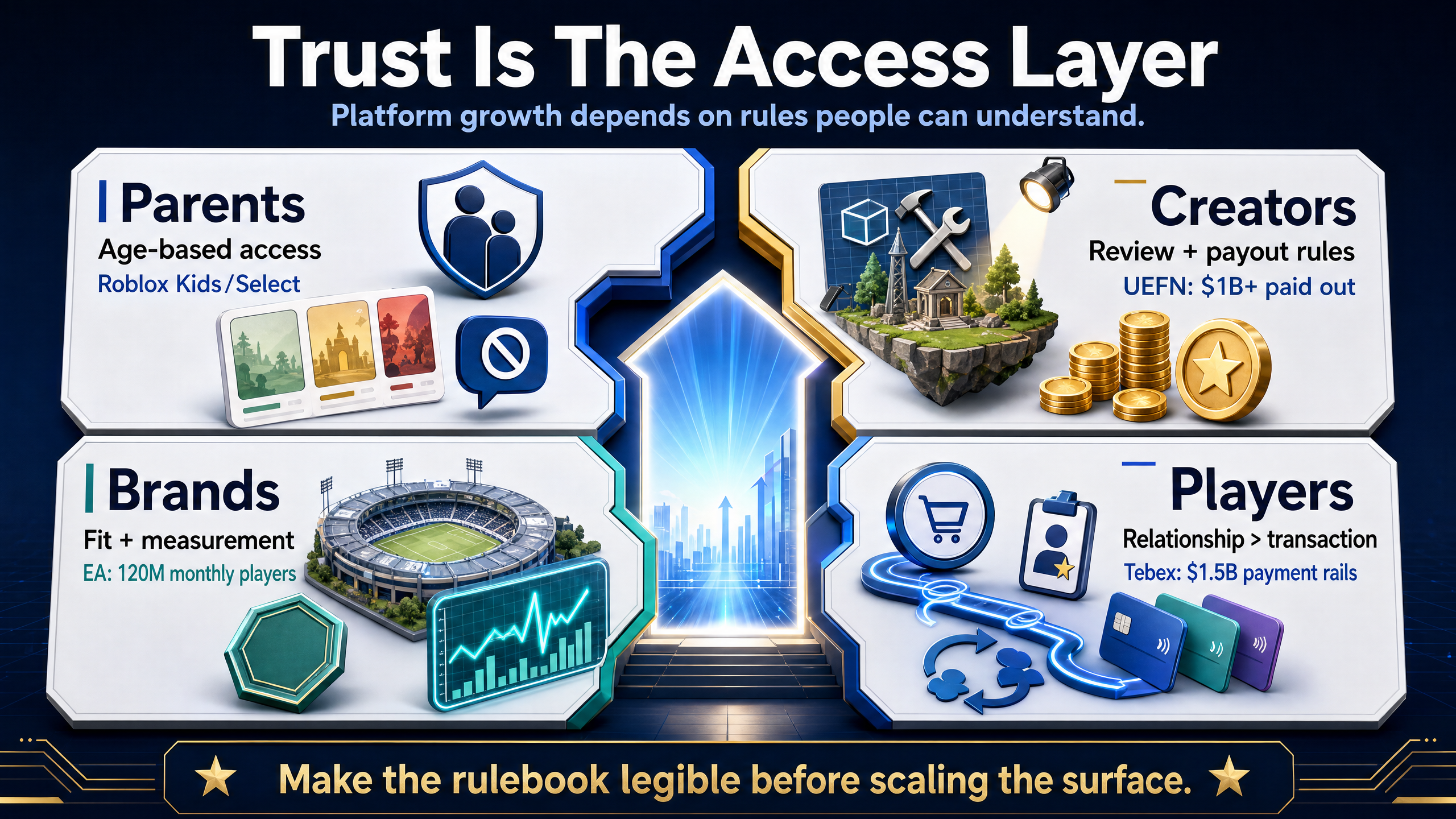
The evidence is getting harder to ignore. Roblox’s Kids and Select accounts turn safety rules into catalog access. Fortnite’s UEFN ecosystem has paid developers more than $1 billion, while Epic keeps rebuilding discovery, mobile input, and creator tooling around that economy. Naavik’s LEGO analysis shows a trusted family brand using games across console, Fortnite, Roblox, physical products, and first-party digital play without treating mobile IAP as the whole prize. EA Advertising is formalizing brand integrations inside sports-game worlds that reached more than 120 million monthly players in fiscal 2026.
The common thread is not “more platforms” or “more brands in games.” It is more specific: the rulebook is becoming part of the product. If people do not understand who gets access, how money moves, what is allowed, what is measured, and what happens when trust breaks, the new surface will not compound.
Roblox Shows Why Safety Is Growth Infrastructure
Roblox’s June rollout is easy to misread as a trust-and-safety update. It is more than that. Roblox Kids and Roblox Select split younger users into age-based experiences, limit chat unless an age check has been completed, give parents broader controls, and require additional reviews for games that want access to under-16 catalogs.1
The developer rules are especially revealing. To publish into the younger-user catalogs, developers must complete ID verification, secure their accounts with two-factor authentication, and either buy a Roblox subscription or pay a refundable publishing fee.1 That is not just moderation. It is platform eligibility.
Deconstructor of Fun’s Roblox piece makes the commercial logic explicit: Roblox’s growth has been built on trust among parents, kids, and developers, and safety investment is not separate from the business model.2 That should sound familiar to any studio operating around children, user-generated content, social play, creators, or licensed brands. The more sensitive the audience, the less a platform can rely on buried policy pages. The default experience has to make the promise visible.
Operator read: if a platform asks parents to approve access, developers to build inside it, or brands to attach their reputation to it, trust has to be designed into the product surface. It cannot live only in compliance docs.
Creators Need Predictable Economics, Not Just Tools
Epic’s current UEFN numbers show how quickly a creator ecosystem becomes a business system. The official State of Unreal 2026 recap says Fortnite developers have been paid more than $1 billion since UEFN launched. Epic also says mobile playtime in developer-made games has more than doubled over the past year, and that recent Discover changes nearly doubled the rate at which newly published islands reach 100 players and 10,000 impressions.3
Roblox is moving through the same problem from a different angle. PocketGamer.biz reports that Roblox’s 2027 brand-integration fees will use a CPM model tied to audience exposure and geography, with creators able to forecast and lock a maximum fee before a campaign launches.4
Creators may object to the fee level. Brands may negotiate the value. But the strategic direction is clear: platforms are turning creator monetization into forecastable market rules. A serious creator economy cannot run only on tooling and informal norms. It needs eligibility rules, discovery rules, payout rules, appeal rules, and brand rules that teams can model before they invest.
Platform trust becomes operational when parents, creators, brands, and players can understand the rules before they commit.
Brand Integrations Are Product Work
LEGO is a useful counterweight to the usual game-brand conversation because it has resisted the obvious mobile monetization answer. Naavik notes that LEGO’s companion apps support the physical product, while its licensed free-to-play mobile catalog has produced only about $18.7 million in net revenue since 2018 – tiny beside LEGO’s broader business.5
Yet LEGO is not sitting out games. It is active in console licensing, LEGO Fortnite, Roblox collaborations, phygital products such as SMART Play, and a new LEGO Digital Play organization.
That is a brand-relationship strategy. LEGO Fortnite Odyssey has logged over a billion player hours, and Naavik cites seven Roblox collaborations reaching roughly 480 million monthly plays.5 Whether those surfaces monetize directly is not the only question. They help LEGO stay trusted, relevant, and playable across the places kids and families already spend time.
EA is approaching the same opportunity from the publisher side. EA Advertising gives brands dynamic placements, custom integrations, branded objectives, vanity items, targeting, measurement, and an EA SPORTS Partner Program across a portfolio with over 120 million monthly players.6 EA’s core claim is that brands should become part of the moment in ways that add value and respect the player experience.
Wooga’s June’s Journey case is the practical version. PocketGamer.biz’s PGC Barcelona writeup says the Wicked and Agatha Christie integrations worked because Wooga carried the license across the funnel: UA creative, store listing, loading screens, tutorial foreshadowing, live events, rewards, and licensor approvals. Wooga reported video CPI down 33%, static CPI down nearly 20%, stronger top-of-funnel metrics, and the game’s best store featuring in two years.7
The lesson is not that every game needs a famous IP or an ad platform. It is that brand integrations have to survive contact with the game loop. A licensed object is not a strategy until it changes acquisition, onboarding, retention, monetization, or reactivation in a way players accept.
Direct Relationships Turn Trust Into Margin
The prior argument around DTC often gets stuck on platform fees. GameMakers’ Tebex piece points to the deeper issue: the direct player relationship is itself a distribution channel. GameMakers, citing Tebex, says the merchant-of-record and DTC platform behind community-server and direct-payment economies has processed $1.5 billion in lifetime payments.8
The numbers matter because they connect trust to spend, even though they should be read as Tebex-reported figures rather than independent market benchmarks. GameMakers cites creator-code purchases where average spend rose from $24 to $41, and a Rust example where it rose from $18 to $60. It also frames merchant-of-record work – tax, fraud, chargebacks, billing support, and local payment methods – as infrastructure that lets world-builders spend less time on payment risk and more time on play.8
This is the same trust pattern in a different commercial wrapper. If a player is going to leave a platform checkout, use a creator code, buy through a web store, or support a community server, they need to believe the transaction will be fulfilled, supported, and worth repeating. The direct relationship is valuable only after the operating experience proves it deserves to be direct.
The Checklist Before Scaling A Platform Surface
Mobile teams are already under pressure to find new engagement levers. PocketGamer.biz’s coverage of a ZBD survey says up to 80% of mobile developers believe engagement and retention strategies are getting stale, while 51% struggle to balance monetization friction with fun.9 That pressure can push teams toward rewards, brands, creators, DTC, and social platforms before the rules are ready.
Before scaling one of those surfaces, a leadership team should be able to answer seven questions:
Access: who is allowed into the surface, and what must they prove first?
Economics: how do creators, brands, studios, and platforms forecast upside and downside?
Player value: what does the player get that they can understand in the moment?
Fit: how does the brand, creator, reward, or payment path fit the game rather than interrupt it?
Measurement: which behavior proves the surface is strengthening retention, not just moving spend forward?
Support: who handles disputes, refunds, moderation, and bad actors?
Reversibility: what can be changed if the surface damages trust?
Those questions sound operational because that is the point. Trust compounds only when it is converted into product rules people can see. Platform growth is not just a matter of opening more doors. It is deciding which doors should exist, who receives a key, what happens after they enter, and why everyone involved should come back.
]]>Adrian C<![CDATA[Energy Systems: Lessons from Top Freemium Games]]>https://adriancrook.com/?p=81742026-04-22T15:24:03Z2026-06-15T05:02:00ZAnalyze how lives, timers, and stamina mechanics in freemium games control session length, boost retention, and drive monetization with data-driven tuning.
]]>Energy systems in freemium games are designed to manage player engagement and drive monetization. They limit gameplay through renewable resources like energy bars, timers, or lives, encouraging players to return regularly or spend money to continue. These systems balance pacing, retention, and revenue generation.
Key takeaways from the article:
Hard vs. Soft Energy Systems: Games like Candy Crush Saga use “hard” systems (e.g., lives), while Clash Royale employs “soft” systems that allow unlimited play but restrict rewards.
Monetization Strategies: Games often offer premium currencies (e.g., Gems in Clash of Clans) to skip wait times or refill energy, nudging players toward spending.
Psychological Triggers: Features like loss aversion (logging in to avoid wasting full energy) and pinch points (early free resources that run out) encourage engagement and purchases.
Examples of Energy Systems:
Clash of Clans: Timers for upgrades and troop training.
Candy Crush Saga: Lives that regenerate over time or can be refilled for $0.99.
Hay Day: Crop growth timers and production queues.
Puzzle & Dragons: Stamina points for dungeon entry with premium currency options.
Developers can improve energy systems by balancing progression and monetization strategies, using data to optimize retention, and seeking expert guidance for design and implementation. Professional game optimization services can help refine these mechanics for long-term success.
In Clash of Clans, energy systems take a different form. Instead of traditional stamina bars, the game uses timers for building upgrades and troop training as a way to manage player progression. These timers can stretch from a few minutes to several days, depending on the level of the upgrade. This design naturally creates pauses in gameplay, encouraging players to check back periodically for resource collection or to start new upgrades.
The game’s monetization revolves around Gems, a premium currency that lets players skip these wait times. As Pete Koistila explained:
Monetization method is based on the need of speeding-up your game progress. More you play, more time you spend to get achievements done. Or you could cut the paths and spend real money instead to fasten your progress in the game [6].
With daily revenues estimated between $750,000 and $5.15 million and an ARPU of around $4.60 [6], Clash of Clans demonstrates the effectiveness of this approach. Supercell also employs a “pinch point” strategy to encourage first-time purchases. Early in the game, players receive free Gems, which they can use to skip timers. Once this supply runs out, the frustration of waiting often nudges players toward buying more Gems.
Next, let’s look at how Candy Crush Saga uses a contrasting energy system to manage player sessions.
Candy Crush Saga popularized the lives system, a hard energy mechanic that limits gameplay sessions. Players start with a set number of lives, and once they’re all used up, they must wait for lives to regenerate (one every 30 minutes) or pay $0.99 for an instant refill [2][9].
This system creates short, engaging sessions lasting between 30 seconds and 2 minutes. Sheldon Laframboise highlighted the benefits of this approach:
The life model… is a system that works and keeps the game fresh by restricting/limiting gameplay sessions. This system helps increase engagement, reduces burn-out and gameplay fatigue [9].
The game’s monetization strategy extends beyond life refills. Players can also purchase extra moves ($0.99) when they’re close to completing a level or invest in premium items like the “Charm of Life” ($16.99), which increases the life pool from five to eight [9]. By June 2013, Candy Crush Saga was generating over $62 million per month. Social features, such as requesting help from friends to unlock new episodes, further boost engagement and encourage spending without directly forcing purchases.
Hay Day takes a different approach by using crop growth timers and production queues to manage pacing. For example, wheat grows in about 2 minutes, while higher-value crops like pumpkins take several hours. Players must time their sessions to harvest and replant efficiently, creating a rhythm that keeps them engaged.
The game monetizes through Diamonds, a premium currency that speeds up production or allows players to buy missing items for truck orders [3]. On February 7, 2014, Supercell reported 29.4 million Daily Active Users across its games, including Hay Day and Clash of Clans.
Puzzle & Dragons: Stamina and Skill-Based Monetization
Puzzle & Dragons combines a traditional stamina system with unique gameplay mechanics to balance pacing and monetization. Players use stamina to enter dungeons, and if they fail, they can spend one Magic Stone ($1) within a 10-second window to continue – particularly tempting when rare items have already dropped during the session [7][8].
The stamina system adapts as players progress. Early on, stamina regenerates quickly, but higher levels increase the cap and slow the refill rate, limiting advanced players to fewer dungeon attempts per session [7]. GungHo also provides players with nearly $20 worth of Magic Stones each month through regular gameplay, making the system feel accessible [8].
Andrew Vestal described the game’s appeal:
Puzzle & Dragons is a skill game that can be played as a money game [8].
In April 2013, the game generated over $100 million in revenue, with monthly earnings in Japan ranging between $54 million and $75.5 million [7][8]. Magic Stones offer multiple uses, including stamina refills, dungeon continues, extra monster slots, friend slots, and spins on the Gacha machine (priced at $5 per pull). The Gacha system is the primary revenue driver, while $1 purchases make it easy for players to transition into paying customers.
These examples highlight how energy systems can vary widely, from timers and stamina to lives and production queues, all while effectively managing pacing and driving monetization. Each approach is tailored to the specific gameplay experience, keeping players engaged while offering opportunities for spending.
sbb-itb-fd4a1f6
Key Lessons for Developers
Balancing Progression and Monetization
The best energy systems reward success rather than punishing failure. Take Candy Crush, for example – it reduces players’ lives when they lose, effectively penalizing them. On the other hand, games like Clash Royale take a different approach: players can play as much as they want, but they need to wait (or pay) to unlock rewards from their wins. This approach makes spending feel optional, not forced, and results in higher revenue per energy unit – ranging from $0.19 to $0.33 in Clash Royale, compared to $0.14 to $0.16 in Candy Crush Jelly Saga[2].
As Andrew Pellerano puts it:
Supercell… only monetizes when its customers are succeeding at Royale [2].
To further refine this balance, developers can incorporate “hard” and “soft” waiting periods. These encourage players to spend at natural pinch points, making purchases feel like a choice rather than a necessity [2][3][4].
Once this balance is in place, data can play a critical role in driving retention.
Using Data to Optimize Retention
Data insights are key to fine-tuning energy systems. The most effective systems rely on modeling lifetime currency flow to ensure players remain engaged. Adrian Crook highlights this point:
If the tuning and balance is not optimized the game stands a chance at commercial failure. The supply and demand of digital currencies is what drives player progression [3].
Tracking how players earn and spend currency helps prevent common game economy problems like inflation and safeguards revenue potential. Developers should also monitor content burn rates – how quickly players move through levels or quests. Typically, energy systems allow for 15 to 30 minutes of gameplay from a full energy bar [1].
To keep players coming back, appointment mechanics can be introduced. These leverage loss aversion, prompting players to check in periodically so they don’t waste regenerating energy [1]. Another effective strategy is offering generous amounts of premium currency early on. This gives players a taste of its value, and data can reveal the ideal moment to encourage their first purchase [3].
Working with Expert Consulting Services
Expert advice can make all the difference when designing energy systems. A well-balanced system depends on managing key variables like faucets, sinks, mission designs, and storage limits. By combining these elements with in-depth data analysis, developers can create systems that drive both engagement and revenue.
We at Adrian Crook & Associates have over 17 years of experience and 300+ clients specializing in energy system design. We provide services like KPI analysis, player persona development, and soft launch planning. Our expertise helps developers design energy systems that perform effectively from the start, ensuring your game achieves both player satisfaction and profitability.
Energy System Metrics Comparison
Energy Systems Comparison: Top Freemium Games Metrics and Monetization Strategies
Metric Comparison Table
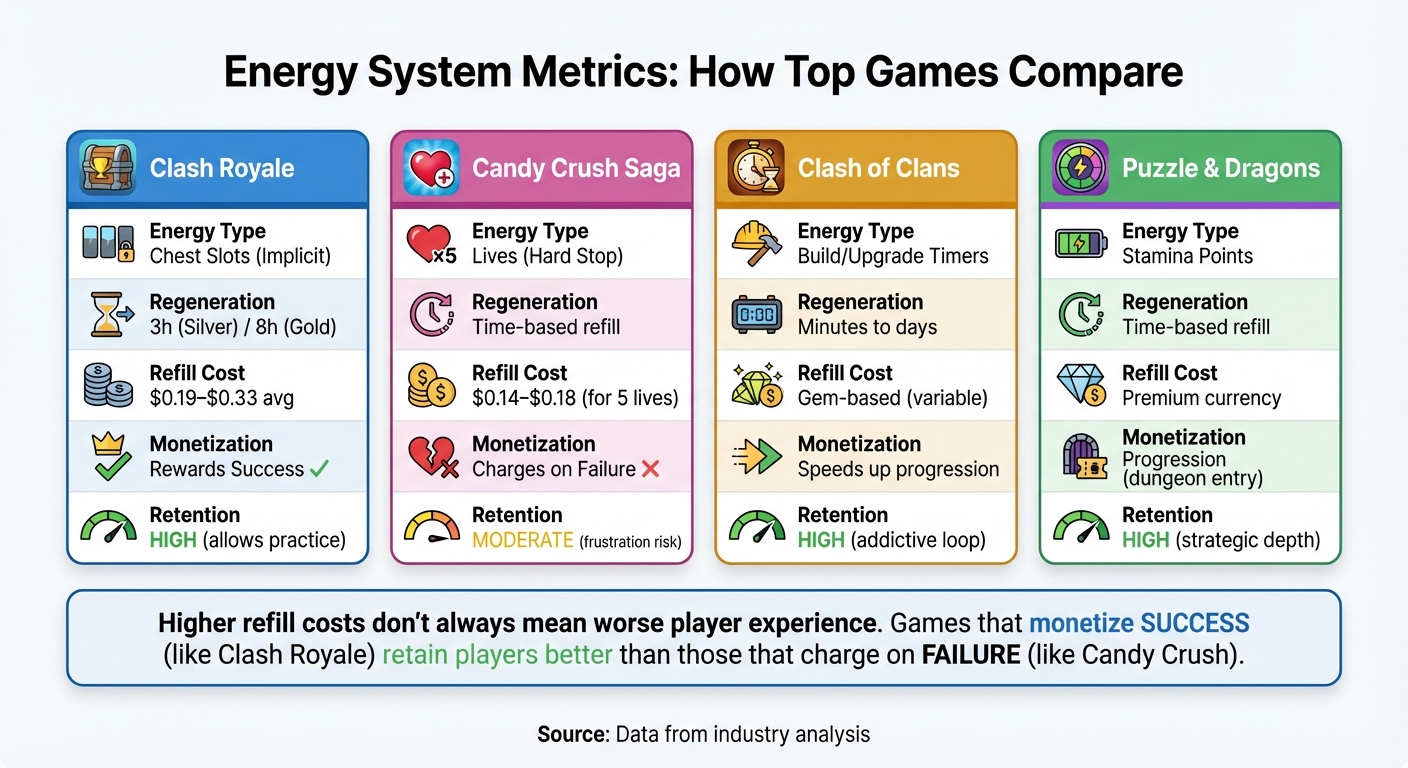
Looking at energy systems side-by-side reveals the contrasting philosophies behind their designs. The table below breaks down how four popular games handle regeneration, refill costs, and monetization strategies.
This table captures the essence of how each game approaches energy systems, highlighting differences in player experience and monetization strategies. These metrics bring to life the case study insights, showing how even small variations in system design can shape player retention and revenue potential.
One key takeaway is that higher refill costs don’t always equate to a negative player experience. For example, Clash Royale’s model focuses on monetizing success – players pay after winning – which feels more rewarding and generous. On the other hand, Candy Crush Saga requires payment or waiting after failures, which can lead to frustration.
This difference significantly affects retention. Systems like Clash Royale’s, which use “soft waiting” mechanics, encourage players to keep practicing and improving their skills. This approach fosters long-term engagement. In contrast, “hard waiting” systems, such as Candy Crush Saga’s lives-based model, can block gameplay entirely during tough levels. This can frustrate players and increase the likelihood of them quitting.
Ultimately, monetization efficiency hinges on when and how payments are requested. Systems that tie payments to success often build stronger long-term player retention, even if they charge more per transaction.
Conclusion
Energy systems have proven to be a cornerstone of freemium game design, primarily functioning as tools to retain players while also supporting monetization. Game designer Grant explains it best: “Energy is a retention mechanic. It can be used to monetize (and do social stuff), but it’s primarily a retention tool” [1]. Case studies like Clash of Clans and Candy Crush Saga highlight how the timing and context of monetization opportunities often outweigh the actual price in importance.
Over time, these systems have evolved from rigid wait times to more nuanced, reward-based pacing. Modern games like Clash Royale showcase this shift by allowing unlimited play but capping rewards to maintain balance. For example, a 15-minute session in Clash Royale might yield rewards that take 12 hours of real-world time to unlock [5]. This approach limits rewards rather than playtime, encouraging both engagement and spending.
The key to successful energy systems lies in balancing session length, pacing content, and managing virtual economies to avoid inflation. Energy bars, for instance, help structure gameplay into manageable sessions, encouraging players to return regularly. However, designing these systems is far from simple. As Adrian Crook points out: “Designing a fun game isn’t enough. At the heart of a revenue‑positive freemium game is a core loop that keeps players playing and spending” [10]. Developers must rely on data-driven insights to fine-tune refill rates and costs, ensuring decisions are based on player behavior rather than assumptions.
For studios aiming to implement or refine energy systems, expert guidance can make a significant difference. Professional consultation offers the precise analysis needed to strike the right balance between fun and revenue. We at Adrian Crook & Associates have supported over 300 clients since 2008, helping developers identify critical “pinch points” in their game economies. Richard Barnwell, CEO, shared his experience: “Working with AC&A allowed us to clarify key issues with our game design while we were still early enough in the development process to make changes. Because of the specific recommendations we received… our game is both more fun for players and able to monetize those players more effectively” [10].
FAQs
When should a game use hard vs. soft energy?
The decision to use hard or soft energy in a game largely hinges on factors like pacing, monetization, and how you want to keep players engaged. Hard energy is a finite resource, often linked to purchases with real money or deliberate, strategic gameplay. It’s designed to encourage spending and manage how quickly players progress. On the other hand, soft energy replenishes over time or through specific actions, serving as a way to regulate the game’s pace and maintain player interest. Many games use a mix of both systems – soft energy to keep players coming back and hard energy to incentivize premium actions, striking a balance between retention and revenue.
How do you set refill costs and regen rates?
To keep players engaged while monetizing effectively, consider setting energy caps that fit 1–2 typical gameplay sessions. For energy regeneration, aim for a setup that allows 3–4 sessions per day, provided they are spaced out. This approach encourages consistent play without causing frustration, helping players develop a habit while maintaining a steady pace.
The best-performing games often steer clear of overly harsh penalties, creating a smoother and more enjoyable experience for players. When configuring these settings, align them with your game’s overall strategy. At the same time, factor in player psychology to strike a balance between fun and retention.
What metrics show an energy system is effective?
Key metrics to watch are player engagement, session length, retention rates, and how well resources are balanced. A thoughtfully crafted system allows players to use and restore energy smoothly, keeping the game enjoyable without leading to frustration or monotony.
]]>Adrian C<![CDATA[Game Studios Have More Channels, But Not More Control]]>https://adriancrook.com/?p=83192026-06-02T23:04:17Z2026-06-02T23:04:17ZD2C stores, platform access, UGC, AI agents, and creator channels only matter when they strengthen the player relationship.
]]>Game studios have more distribution options than they did a few years ago. That does not mean they have more control.
Direct-to-consumer stores, renewed App Store access, Roblox experiences, UGC platforms, AI character agents, creator communities, web shops, and context-aware creative testing all promise some version of the same thing: a better route to the player. The strategic mistake is treating each of those routes as a separate growth hack.
The operator question is more basic: which parts of the player relationship does the studio actually control?
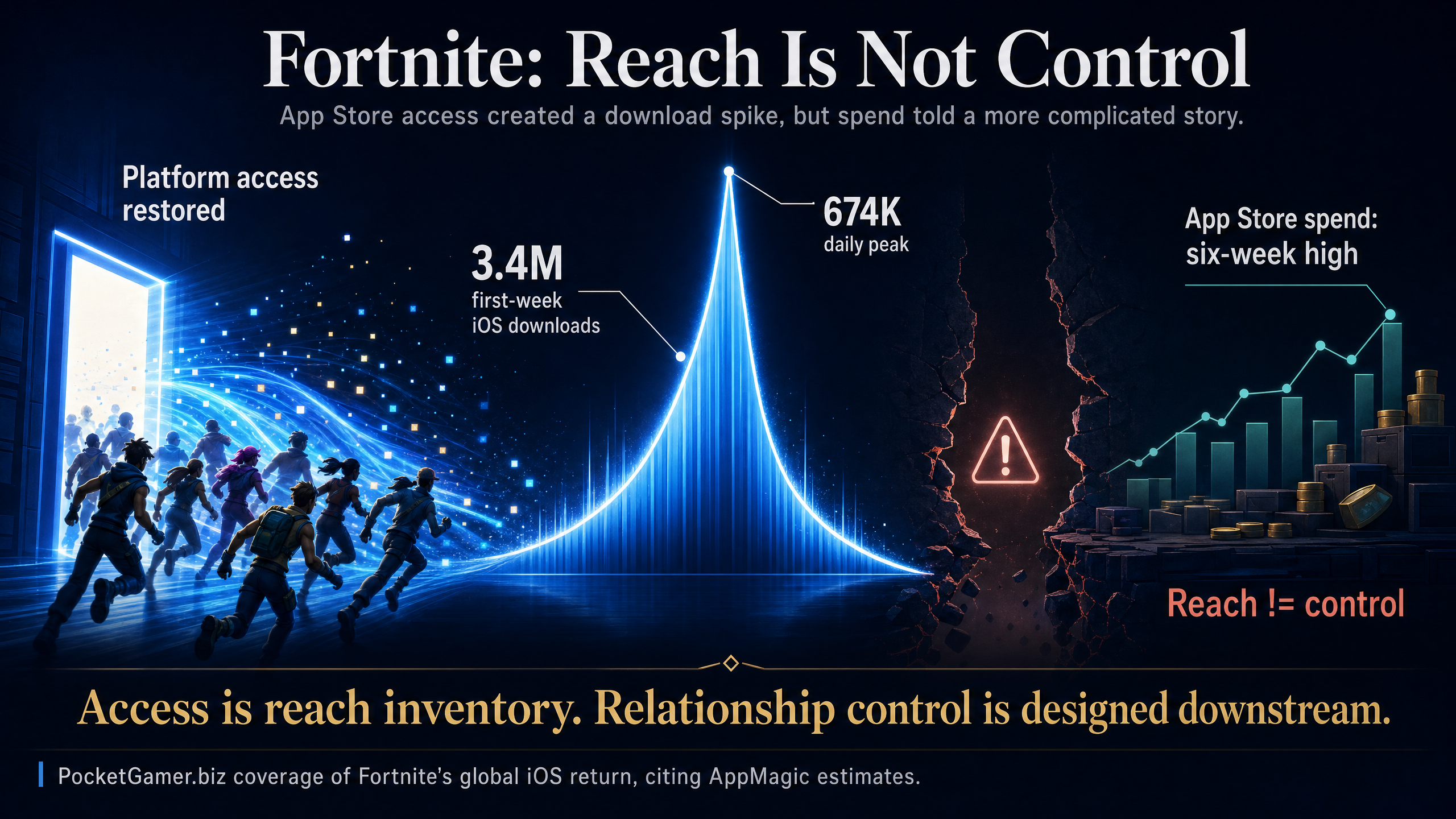
That question sits behind several current games-industry signals. FastSpring argues that D2C has moved from an edge case to a core mobile games strategy as Epic-related rulings and platform-rule changes make web stores more viable.1Fortnite’s global iOS return produced an estimated 3.4 million first-week App Store downloads, but App Store spending rose only to a six-week high.2GDC trend coverage similarly frames D2C, mobile monetization, AI, and co-development as live operating concerns for studios.3FIFA is moving from a single-partner model to a multi-partner digital football ecosystem spanning Roblox, Epic, Konami, SEGA/Sports Interactive, Gamefam, Mythical, Solace, Netflix, and Delphi.4
The common thread is not “add more channels.” It is that every new route to the player now creates product work: account identity, offers, payment paths, community, creator incentives, support, trust, and learning. The studios with an advantage will not be the ones that merely bolt on a web store, ship a Roblox experience, open a creator program, or generate more ads. They will be the ones that connect those surfaces into one operating system for demand, retention, spend, trust, and learning.
Operator read: a new channel only matters if it returns one of three things: player identity, repeat behavior, or product learning.
Platform Access Is Reach, Not Control
Platform access is reach inventory, not relationship ownership.Fortnite’s global iOS return is a useful warning against confusing access with ownership. The reach signal was enormous: PocketGamer.biz, citing AppMagic estimates, reported roughly 3.4 million App Store downloads in one week, a 1,408% daily install surge after the global return, and a daily peak of 674,000 downloads on May 23.2
Source: PocketGamer.biz coverage of Fortnite’s global iOS return, citing AppMagic estimates; AC&A visualization.
But the monetization signal was more ambiguous. The same article noted that player spending through the App Store reached only a six-week high, with possible spending through Epic’s web shop or delayed payer conversion. That gap is the point. Platform access can restore visibility and remove friction, but it does not automatically restore the studio’s preferred economics or relationship with the player.
For operators, the lesson is practical. Treat platform distribution as reach inventory. It can create a surge of installs, returning users, press coverage, and store visibility. It should not be mistaken for a durable player relationship unless the studio also controls account identity, offers, community, messaging, support, payment paths, and the data needed to act on those behaviors.
D2C Is A Repeat System, Not A Fee Hack
D2C is useful when it creates repeat behavior, not just when it avoids fees. Platform fees are visible and politically charged, so D2C gets discussed as a margin story. That is incomplete. Fee avoidance can improve economics, but it does not create demand by itself.
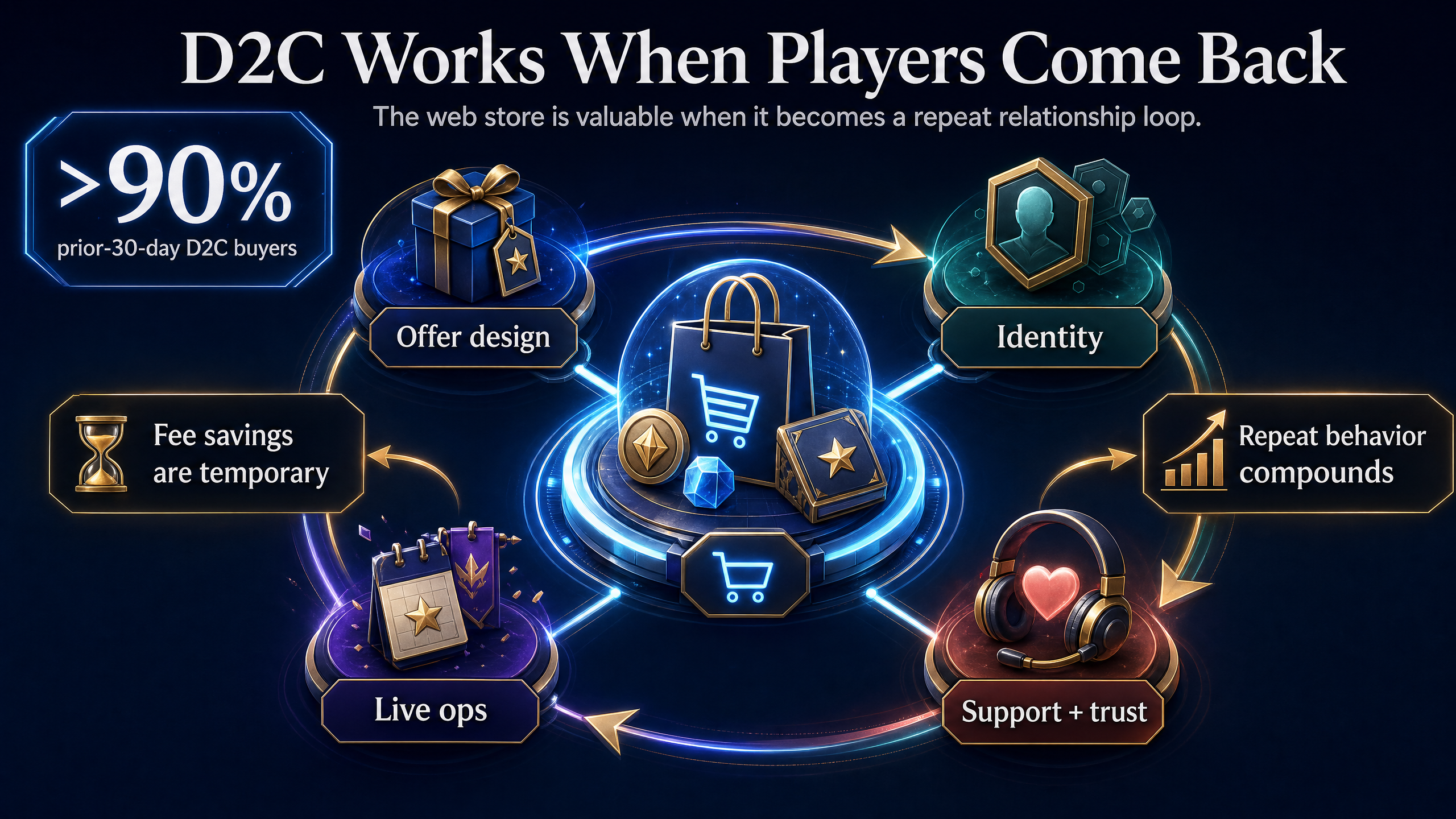
The most useful signal in PocketGamer.biz’s FastSpring interview is repeat behavior. FastSpring’s Chip Thurston said more than 90% of web-store purchases come from customers who made a D2C purchase in the prior 30 days.1 That makes D2C less like a cheaper checkout page and more like a relationship loop.
Source: PocketGamer.biz interview with FastSpring’s Chip Thurston; AC&A visualization.
That distinction changes the work. A web store needs offers worth leaving the app for, a clear reason to return, identity that survives across channels, player-safe payment flows, customer support, live-ops timing, and product logic that does not punish the player for buying outside the storefront. The store is the visible part. The operating system around it is where the advantage comes from.
This is also why the “no-fee window” is the wrong mental model. Platform holders will keep changing fees, steering rules, service definitions, and billing mechanics. A studio that treats D2C as a temporary arbitrage will keep rebuilding around someone else’s policy. A studio that treats D2C as a owned-retention and owned-commerce capability has something that survives rule changes.
IP Strategy Is Becoming A Surface Portfolio
A surface portfolio only works if each surface has a job.FIFA’s digital football strategy shows the same shift from another direction. The move away from a single-partner model is not simply a licensing reset. It is a portfolio approach to audience surfaces: Roblox and Gamefam for participatory play, Konami for esports competition, Epic and Fortnite-adjacent reach, SEGA/Sports Interactive for simulation depth, Mythical and Solace for additional formats, and a Netflix/Delphi project for another branded football experience.4
The scale signals matter. FIFA Super Soccer on Roblox has passed one billion plays and attracts more than 10 million monthly active users. FIFA Rivals has passed 2.5 million downloads. FIFAe has involved more than 120 Member Associations and over 16 million players, with more than 1.1 billion views last year.4
That is not one funnel. It is a map of different jobs. Some surfaces create reach. Some create identity. Some create competition. Some build habit. Some are better for kids, families, creators, spectators, or high-intent spenders. The operator mistake is putting the same KPI on every surface and then declaring half the portfolio a failure.
For AC&A clients, the useful question is: what job does each surface perform, and what information returns to the core operating loop? A Roblox activation that creates social play but no cross-surface identity is only partly useful. A licensed mobile game that monetizes but does not inform future IP demand is leaving signal behind. An esports program that creates viewership but no product learning is brand spend, not strategy.
UGC And AI Agents Move Distribution Inside The Product
UGC turns distribution into product architecture.Tencent’s reported Delta Force UGC initiative is a good example. PocketGamer.biz reported that Tencent IEG recruitment signals point to player creation tools, an in-game editor, content distribution systems, and monetization features for Delta Force, which surpassed 50 million daily active users in China in March 2026.5
At that scale, UGC is not a content feature. It is a distribution system. The product has to decide what gets made, what gets surfaced, what gets monetized, what gets moderated, which creators receive leverage, which players see which content, and how the core game survives the incentives it creates.
Saga’s AI influencer-style character agent points at a similar boundary shift. Crystal Beaumont exists inside Diamond Jewels and on social platforms, while Saga’s Bonoxs Arena integration positions an AI character as a Discord community manager for a tournament platform serving 100,000 monthly users.6 If that work is measured only as “more content” or “cheaper community management,” it will underperform. If it is wired into retention, support, social participation, campaign timing, and trust, it can become part of the player relationship.
The risk is that AI agents and UGC tools create the illusion of owned distribution while actually increasing operating complexity. More content means more ranking decisions. More creators mean incentive design. More automated interaction means moderation and brand safety. More community surface area means more ways to disappoint players publicly.
Creative Needs Context, Not Just Volume
Creative testing needs context, not just more assets.Mobile Dev Memo’s DeCANT essay is useful because it does not treat AI creative as magic output volume. It starts from the opposite premise: automated ad platforms are increasingly opaque, advertiser-side levers are limited, and generative tools can inflate the number of creative assets without increasing the diversity of ideas being tested.8
DeCANT is described as a pre-testing gate that models expected ROAS from creative and deployment context. The underlying empirical setting used nearly 100,000 ad-level observations and more than 10,000 unique creatives. The broader lesson for game studios is not that every team needs that exact architecture. It is that creative should be evaluated in context:
Where it runs: country, channel, and placement.
How it appears: timing, format, and message.
Who it interrupts: the player state at the moment of exposure.
That matters because channel control is not only about where the player can buy. It is also about which promise the player sees, how the studio learns from that exposure, and whether campaign outcomes improve product decisions. More assets without a structured testing gate can make the team feel faster while making the learning system worse.
Mobile Dev Memo’s audience-building podcast adds the adjacent caution: rented social distribution can distort demand signals, while weak audience portability leaves creators and businesses exposed to platform incentives they do not control.7 Games have the same problem. A viral clip, a paid ad spike, or a creator activation is not owned distribution unless the studio can carry the relationship into the next product, event, purchase, or community touchpoint.
The Operator Takeaway
More channels only create control when they improve the studio’s relationship with the player. Every growth surface creates product consequences.
A studio building around this reality should answer six questions before it scales a new channel:
What job does this surface perform: reach, monetization, retention, learning, trust, community, or creator supply?
What player identity or behavioral signal comes back to the studio?
What product, economy, live-ops, or creative decision changes because of that signal?
What repeat behavior makes the channel durable after the first spike?
Which platform-rule or algorithm change would break the plan?
Who owns the operating loop across product, UA, economy, community, support, and analytics?
The answer is rarely “do less distribution.” Most studios need more surface area, not less. But every new surface should either improve the player relationship or teach the team something it can use. Otherwise it is only another rented channel with a better launch headline.
]]>Adrian C<![CDATA[Player Signal Is the New UA Advantage]]>https://adriancrook.com/?p=83122026-05-26T01:39:29Z2026-05-26T01:39:29ZMobile growth is shifting from bought installs to first-party player signal across UGC, browser play, community channels, and live ops.
]]>Mobile growth is not dead. The old way of learning from it is.
For years, a common operating assumption was that a studio could build a plausible core loop, spend into paid acquisition, and let retention, CPI, ROAS, creative tests, and monetization telemetry reveal whether the product had legs. That playbook increasingly works best for teams that already have scale, data infrastructure, creative volume, and live-ops depth.
The better question is no longer, “Can we afford UA?” It is: “What player signal can we own before we amplify the product with UA?”
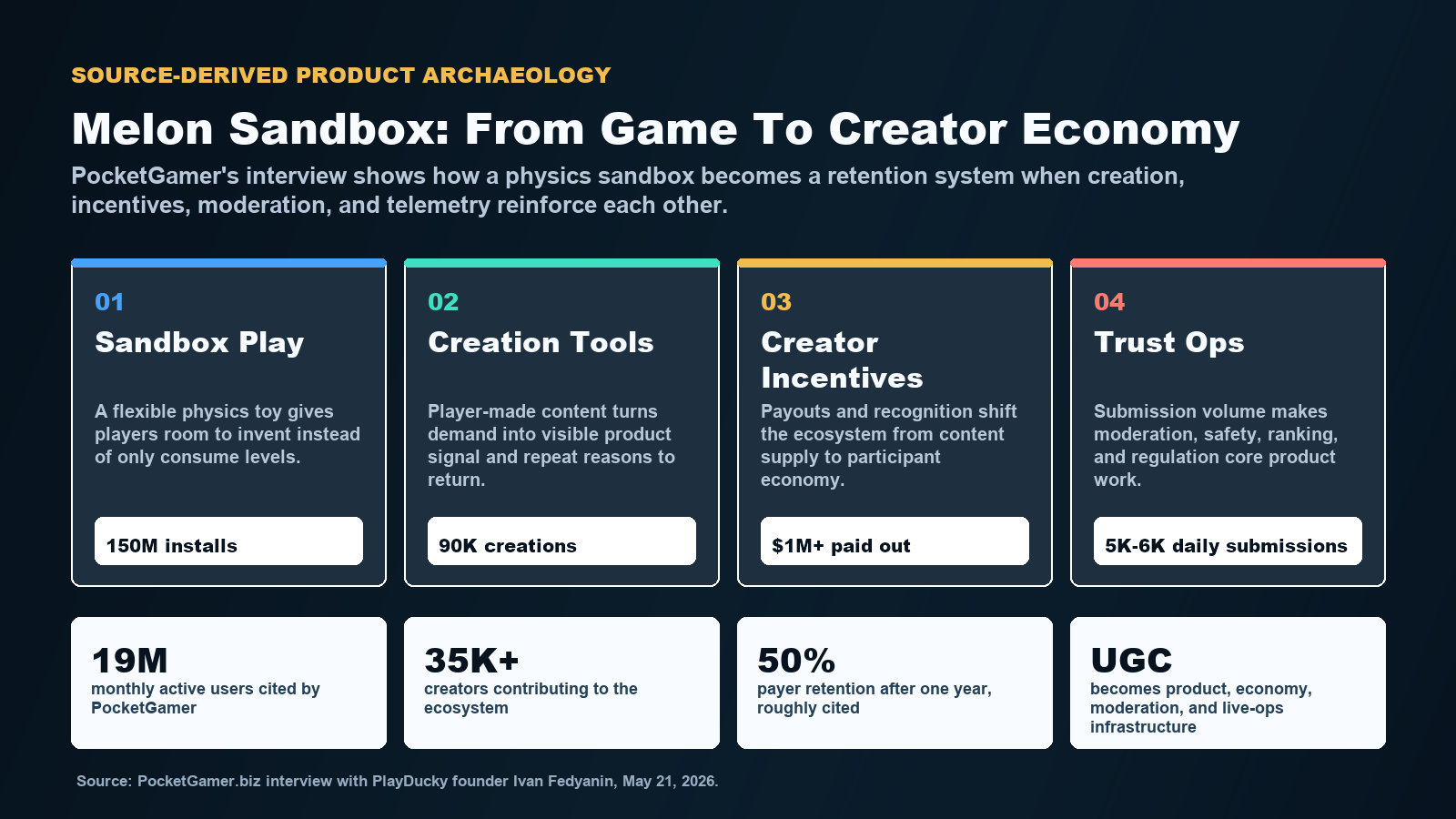
That is the thread running through several recent games-industry signals. PocketGamer’s Mobile Mavens panel argues that mobile has become harder because the barriers are no longer just development quality; they include user economics, data infrastructure, content production, community access, and incumbents’ compounding advantage.1 At the same time, Melon Sandbox has turned a physics sandbox into a creator ecosystem with 150 million installs, 19 million monthly active users, 90,000 user-generated creations, more than 35,000 creators, and 5,000 to 6,000 daily submissions.2 CrazyGames reports 862 million hours of browser gameplay and 1.74 billion sessions, showing that meaningful attention can exist outside the app-store funnel.3
The lesson is not that every studio needs UGC, browser distribution, AI tooling, or a direct-to-consumer strategy. It is sharper: studios need a signal loop that teaches the team what players want before paid scale makes every mistake more expensive.
UA Is An Amplifier, Not The First Source Of Truth
Paid acquisition can scale winners, stress test creative-market fit, and expose a game to audiences organic channels will never reach. But it is a costly way to discover whether the product promise is legible.
That matters because mobile launch risk has moved upstream. A studio is competing against live products with years of event cadence, economy tuning, player segmentation, creative libraries, influencer history, community memory, and accumulated data. If a team waits until paid UA to learn which fantasy, mechanic, creator hook, or progression promise moves players, the team is buying basic research at scale-market prices.
The alternative is not to avoid UA. The alternative is to make UA the amplifier of an existing signal system. Before scaling spend, a studio should already know which audience language gets a response, which moments players share, which progression anxieties create churn, and which objections repeat in community and support channels.
That is an operating model change. UA, product, economy, community, and live ops cannot each own a separate version of the truth. The recurring question should be: what did players tell us through behavior, creation, search, conversation, spend, and churn, and what are we changing because of it?
UGC Scale Is A Product System
Melon Sandbox is the cleanest example of why player signal has to be treated as infrastructure. The interesting number is not only 150 million installs. It is the shape of the system around those installs: 19 million MAU, tens of thousands of creators, thousands of new submissions every day, more than $1 million in creator payouts, and roughly half of paying users still retained after one year.2
Source: PocketGamer.biz interview with PlayDucky founder Ivan Fedyanin; AC&A visualization.
At that point, UGC is no longer a feature category. It is product architecture. Submission volume creates moderation load. Creator incentives become economy design. Content surfacing affects retention. Player identity shifts from consumer to participant. Regulation and child-safety exposure become part of the roadmap.
This is where many studios under-scope creator strategy. They ask whether creation tools would increase content supply. The better question is whether the studio can operate the loop those tools create: promotion, suppression, creator incentives, economy health, moderation pace, and the signals that reveal unmet player demand.
Distribution Surfaces Are Learning Surfaces
Browser, community, Roblox, Discord, Steam, TikTok, and creator channels are often described as distribution alternatives. That is true, but incomplete. Their strategic value is that they can teach a studio faster and cheaper than a conventional mobile launch path.
CrazyGames’ reported 1.74 billion browser sessions and nearly 30-minute average session duration show that browser play can generate durable behavioral data, not just casual sampling.3 For the right game, a browser build can answer questions a mobile soft launch might answer later and more expensively: does the premise earn repeat play, which moments create drop-off, and what hooks travel without paid pressure?
The same logic applies to community and creator surfaces. A Discord server is not a marketing accessory if it changes the roadmap. TikTok is not only a creative testing machine if comments expose misunderstood promises. A Roblox prototype is not only a younger-audience play if it pressure-tests mechanics, UGC demand, or session goals before a heavier native build.
This is also why Naavik’s Xbox analysis is relevant outside the console business. Its argument that Xbox should lean into publishing, multiplatform reach, and the latent power of Minecraft points back to the same strategic asset: owned communities and IP that can produce signal, not just units sold.4
AI Should Compress Signal To Decision
The most useful AI story for operators is not “generate more stuff.” It is “shorten the time between signal and decision.”
FirstLook’s AI agent is pitched around exactly that fragmentation problem: player, campaign, community, storefront, and live-service signals sitting across TikTok, YouTube, Twitch, Discord, Reddit, forums, Steam, Epic Games, Roblox, and other channels.5 Sensor Tower’s acquisition of AppMagic points at a related market-intelligence pressure: studios, investors, and publishers want better visibility into mobile games, off-platform revenue, mobile web, and DTC behavior, often requiring better first-party data and panels.6
The danger is treating these tools as dashboards that make everyone feel informed while no one changes the product. A signal system only has value if it creates operating decisions. Player sentiment belongs in economy design, creator submissions belong in product planning, and browser replay data belongs in launch sequencing when those signals are strong enough.
A practical studio ritual is a player-signal review with one rule: every signal cluster must produce either a product action, a live-ops action, a campaign action, or a conscious decision to ignore it. Otherwise the team is collecting evidence after the roadmap has already decided.
Trust Is Part Of Growth
Player signal is not only about discovering demand. It is also about knowing what can break when demand arrives.
Roblox’s scrutiny around child safety, spending, engagement, and currency mechanics is the obvious warning signal for creator ecosystems.7 Any game that depends on players, creators, or children participating in an economy has to treat trust as product infrastructure. Clear spending flows, moderation queues, reporting tools, content ranking rules, and parental expectations shape whether the ecosystem can scale without losing confidence.
This is where growth and product teams need shared accountability. A UGC loop that maximizes engagement while ignoring trust will damage retention quality. A creator economy that rewards output without managing incentives will produce content volume, but not necessarily player value.
The Operator Takeaway
The useful reframing is simple: do not build a UA plan first. Build a player-signal plan first.
For a freemium studio, that plan should answer five questions before serious scale spend:
Where do we observe high-intent player behavior before paid UA distorts the sample?
Which player, creator, and community signals are reviewed together rather than in separate dashboards?
What product or economy decision does each signal source actually influence?
Which alternative surfaces can test the promise earlier: browser, community, creator tools, Roblox, Steam, web, or DTC?
What trust, moderation, and spending rules have to exist before the loop works at scale?
The studios with an advantage will still spend, optimize creative, and buy installs when the unit economics work. But the strongest teams will not use paid UA to discover the basics. They will use it to amplify what their player-signal loop has already learned.
]]>Adrian C<![CDATA[Your Difficulty Curve Is a Revenue Strategy]]>https://adriancrook.com/?p=82942026-05-18T20:26:29Z2026-05-18T20:26:28ZHybrid-casual puzzle winners show why difficulty timing, event pressure, and purchase routing now need to be tuned as one revenue system.
]]>The difficulty curve is not just level-design tuning. In hybrid-casual puzzle games, it is a revenue strategy: the moment a player first feels real friction determines whether spending feels like help, commitment, or punishment.
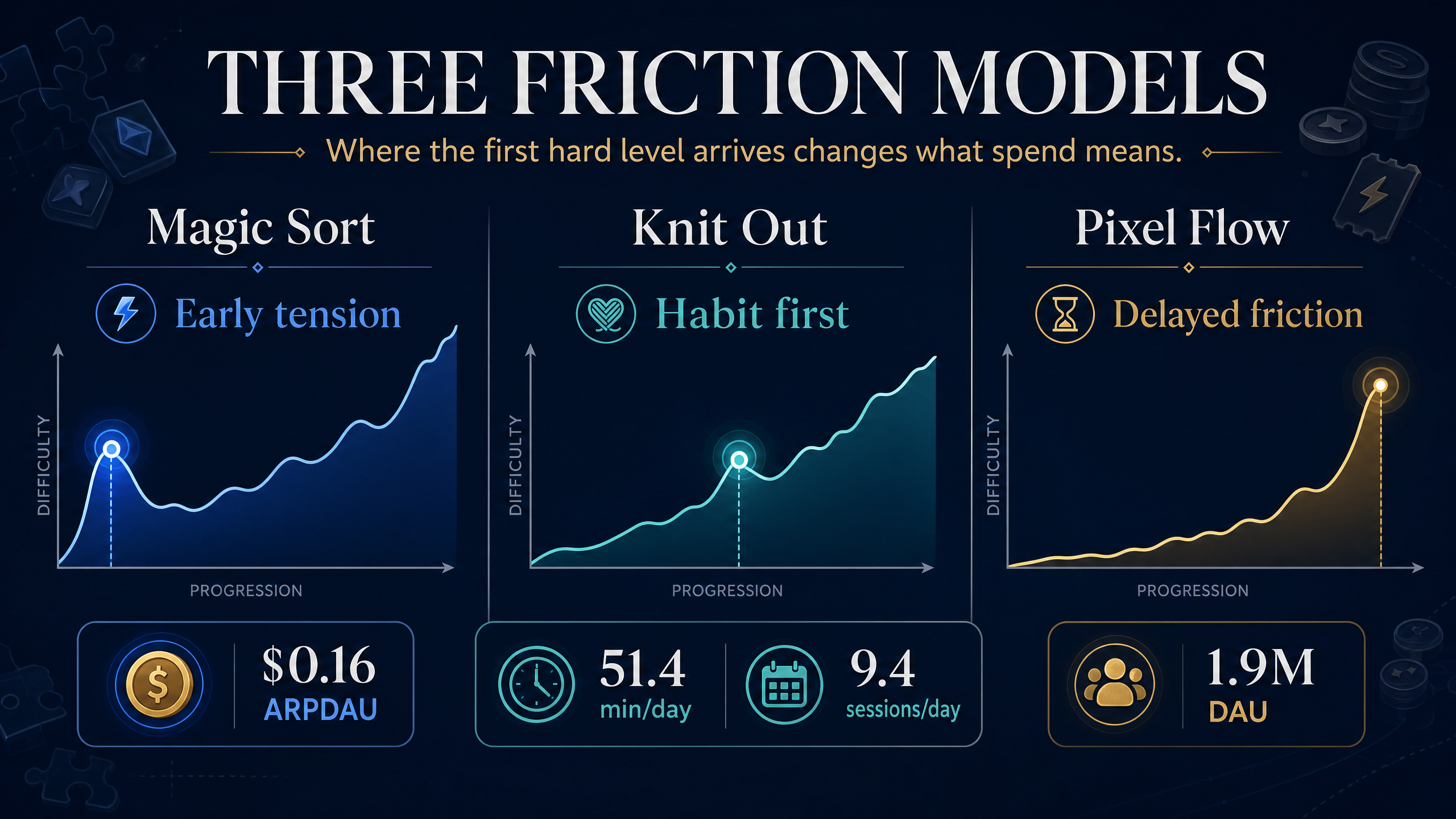
That is the useful operator lesson from the current sort-puzzle market. PocketGamer.biz’s comparison of Magic Sort, Knit Out, and Pixel Flow frames three games in the same broad genre as three different monetization designs, with nearly $200 million in annual revenue attached to the set.[1] Grand Games’ $70 million Series B adds a funding signal around the same space: short-session hybrid-casual loops are still investable when the operator can show that the loop repeats across titles and teams.[2]
The wrong read is “sort puzzles are hot.” The better read is that the winners are not only choosing themes, ad cadence, or IAP packs. They are choosing when the player should fail for the first time, and what that failure is supposed to do commercially.
Difficulty Is the First Monetization Decision
Most teams talk about difficulty after the core loop is already built. That sequencing is backwards. In a puzzle product, the first serious friction point tells you what business you are actually building.
If friction arrives too early, the game may get quick monetization pressure but weak habit formation. If it arrives too late, the game may build long sessions but under-train players to value boosters, extra moves, or other help mechanics. If friction arrives after the player has already formed a daily routine, spending can feel less like a shakedown and more like protecting progress.
That is why PocketGamer’s most useful claim is not one particular game’s revenue number. It is the argument that the first major difficulty peak can be a stronger predictor of success than early conversion or average-player snapshots.[1] The key question is not “is level 12 too hard?” It is “what commercial behavior should the first hard level create?”
Source-derived comparison based on PocketGamer.biz’s May 2026 sort-puzzle monetization analysis.[1]
Three Games, Three Friction Models
The useful way to read the sort-puzzle comparison is as a set of operating models.
Magic Sort appears to monetize by creating tension early. PocketGamer cites a relatively high ARPDAU for the genre, but the tradeoff is that early pressure needs careful handling: if the player has not built enough attachment, “help” can feel like a toll booth.[1]
Knit Out is more interesting as a habit-first model. Its pressure is framed as arriving later, after the player understands the loop and has more reason to care about saving progress. That is a different monetization posture: the design is not only increasing difficulty, it is changing the player’s emotional context before asking for relief.
Pixel Flow pushes in the other direction. PocketGamer cites long daily playtime, frequent sessions, and large DAU, which suggests a product that buys scale and routine before applying hard pressure.[1] The risk is obvious: a game can be loved, played, and still leave money on the table if it delays value exchange too far.
None of these approaches is universally correct. The point is that each one implies a different economy. The level curve, ad cadence, booster design, event calendar, and shop strategy have to agree with the same friction model.
Funding Follows Repeatable Pressure
Grand Games’ Series B matters because it gives the category a capital-market signal without turning the article into a funding recap. The company is not being rewarded for one broad genre label. It is being rewarded for an operating claim: it can build short-session hybrid-casual games repeatedly, across titles such as Magic Sort and Block Out.[2]
That is what studios should copy, not the surface theme. A fundable hybrid-casual model has to show that friction can be tuned, tested, and monetized without breaking the daily loop. That requires evidence:
Failure timing: where the first meaningful loss happens and what it teaches.
Recovery behavior: whether players retry, watch, spend, or leave.
Booster meaning: whether paid help preserves mastery or replaces it.
Event fit: whether events reinforce the core loop or distract from it.
Channel fit: whether the same promise can survive ads, organic discovery, and store featuring.
This is why “make the game harder” is not a strategy. A good difficulty curve is an economic instrument. A bad one is just churn with a spreadsheet attached.
Web Stores Change the Economy, Not Just the Margin
GameRefinery’s April market review and PocketGamer’s Pixel Federation coverage point to a second piece of the same system: direct purchase paths are becoming part of the operating model.[3][4]
It is tempting to treat web stores as a finance or platform-fee tactic. That undersells the design impact. If more value moves through a web shop, the in-game economy still has to create the reason to buy. Events, currencies, bundles, loyalty rewards, and progression pressure all become part of the route to purchase.
Pixel Federation’s reported Pixel Shop share is a useful reminder: direct-to-consumer revenue does not appear by placing a storefront outside the app.[4] It appears when the game has already trained players to understand value, urgency, and return behavior. The web store captures demand; the product creates it.
What to Audit Before Scaling
A studio does not need to clone the current sort-puzzle leaders. It does need to answer the same operating questions before scaling spend or adding monetization complexity.
1. Where is the first meaningful fail state?
Do not only measure whether players pass early levels. Measure what they learn when they fail, how many retries they tolerate, and whether help feels legitimate.
2. What is the product asking the player to protect?
Progress, streak, collection, event rank, social status, or session flow. If the player is not protecting anything, monetization has to lean on pressure alone.
3. Does paid help preserve mastery?
The healthiest puzzle economies sell relief without making the player feel stupid. If boosters replace mastery instead of preserving it, revenue may spike before retention pays the bill.
4. Do events intensify the right behavior?
Events should focus the core loop, not merely decorate it. A good event gives the player a stronger reason to engage with the same skill, economy, or social loop the base game needs.
5. Is the purchase route aligned with the pressure?
If direct purchase paths, bundles, and loyalty offers sit outside the player’s actual motivation, they will look like margin optimization. They should feel like the natural next step in a loop that already works.
Closing: The Curve Is the Strategy
Hybrid-casual puzzle growth is easy to misread from the outside. The category can look like a set of simple mechanics and quick creative tests. The stronger operators are doing something more precise: they are deciding when players should struggle, why they should come back, and where payment should fit into that emotional sequence.
That makes difficulty design a board-level product question. If the curve is wrong, better ads, richer events, and a cleaner web store will not fix the product. If the curve is right, those systems can compound.
]]>Adrian C<![CDATA[How to Balance Premium and Free Resources in Game Economies]]>https://adriancrook.com/?p=81772026-04-22T15:22:14Z2026-05-18T16:29:00ZBalance paid and earned currencies to reward players, prevent inflation, and offer fair progression with resource sinks, events, and data-driven tuning.
]]>Free-to-play games thrive on a delicate balance between premium (paid) and free (earned) resources. If this balance shifts too far, it can alienate players and hurt revenue. Here’s the key takeaway: paying players want meaningful value for their money, while free players expect fair progression for their time.
To maintain this balance:
Premium resources (hard currency): Scarce, impactful, and purchased with real money.
Free resources (soft currency): Earned through gameplay, abundant enough to reward effort.
Progression paths: Offer both grind-based and paid options, ensuring no essential content is locked behind paywalls.
Resource sinks: Use time-limited events, cosmetics, and utility upgrades to keep the economy stable and solve common economy problems.
Data-driven adjustments: Monitor metrics like retention, conversion rates, and currency flows to tweak the system as needed.
The goal is simple: keep free players engaged while giving paying users a reason to spend – without breaking the game’s economy or trust.
Game Economy Design: How to ensure player satisfaction and commitment, with Oscar Clark
sbb-itb-fd4a1f6
Understanding Premium and Free Resources
Premium vs Free Currency Balance in Game Economies
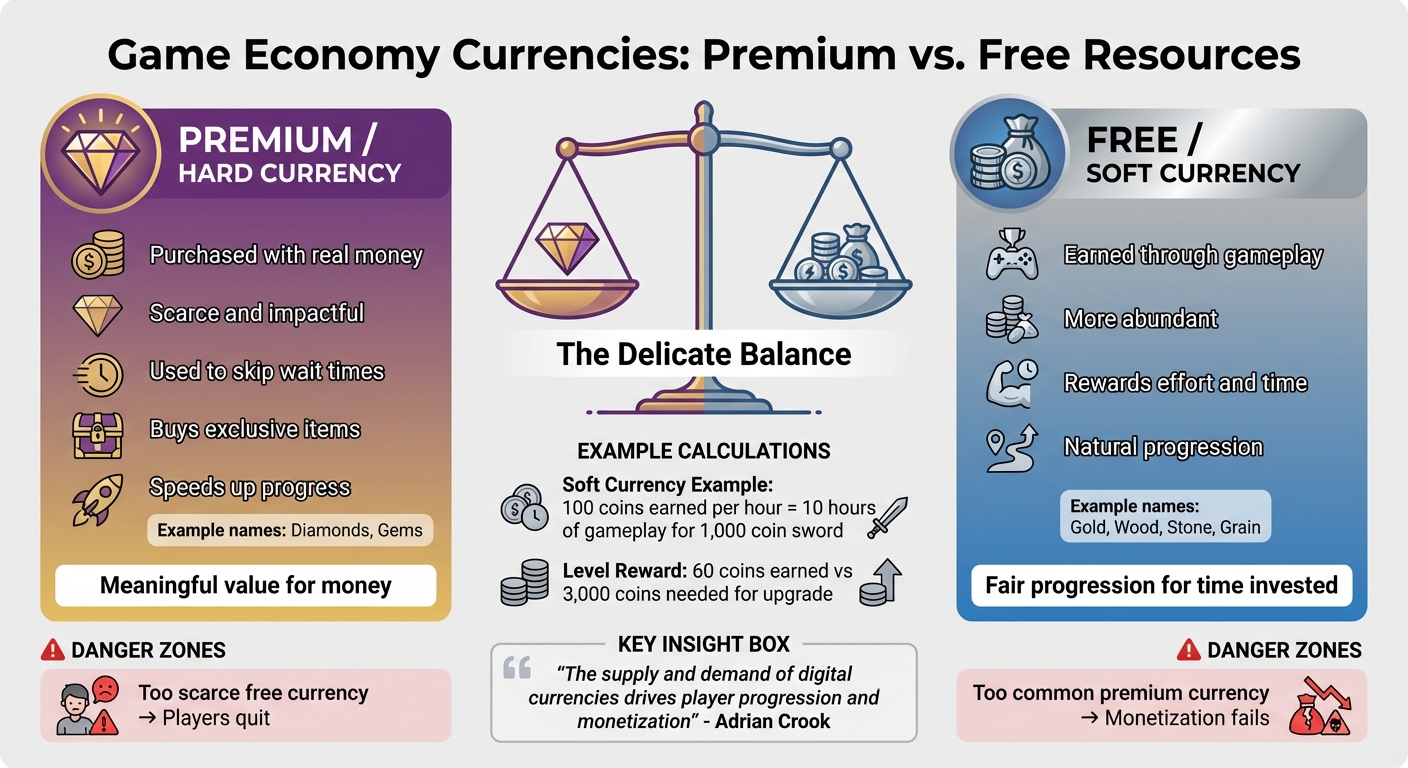
In the world of games, two types of in-game currencies dominate: hard currency (premium) and soft currency (free). Hard currency is bought with real money through microtransactions, while soft currency is earned by playing the game – like completing levels or finishing missions.
Defining Hard and Soft Currencies
Hard currency serves as a major revenue generator. It allows players to skip wait times, buy exclusive items, or speed up their progress[3]. For instance, in strategy games, players often spend premium currency – commonly called Diamonds – to bypass waiting periods or substitute for missing resources. On the other hand, soft currency, often referred to as Gold, and other resources like Wood, Stone, or Grain, are earned naturally during gameplay.
Soft currency rewards effort and progression. Imagine a player earns 60 coins for completing a level but needs 3,000 coins for a meaningful upgrade[7]. Or consider a sword that costs 1,000 gold coins. If a player earns 100 coins per hour, they’d need to play for 10 hours to afford it[4]. This clear link between time, effort, and reward helps players measure the value of their gameplay investment. By understanding these dynamics, it becomes clear why managing scarcity and accessibility is so important for maintaining the value of both types of currency.
The Role of Scarcity and Accessibility
Scarcity is what makes premium currency valuable. If hard currency were too easy to obtain, it would lose its appeal and hurt monetization efforts[2]. Keeping it scarce ensures it remains desirable for skipping time gates or gaining other advantages. On the flip side, soft currency needs to be more abundant to provide regular rewards and enable steady progression. Striking this balance is critical – if free currency is too scarce, players may feel pressured to spend money and might quit the game. But if premium currency becomes too common, it undermines your ability to monetize effectively, especially since most free-to-play players don’t make purchases.
"The supply and demand of digital currencies is what drives player progression through the content and serves as the pivotal element for monetizing players."
Adrian Crook, Founder, Adrian Crook & Associates[1]
This delicate balance between scarcity and accessibility shapes how players progress and ensures there are meaningful paths for all types of players.
Creating Different Progression Paths for Players
The best free-to-play games strike a balance by letting players choose how they want to progress – either through grinding for rewards or by purchasing shortcuts. Both options should lead to the same level of power, ensuring no paywalls block essential content.
Balancing Pay-to-Win and Free-to-Play Progression
The term "pay-to-win" can destroy a player’s trust in a game. To avoid this, all gameplay-critical content must be accessible through normal play[5]. Premium purchases should speed up progress, not gatekeep powerful items[3].
"Any game that uses a free-to-play economy should allow non-paying users to unlock and progress to the point of any paying players."
Adrian Crook, Founder, Adrian Crook & Associates [5]
Research from simulated strategy game economies reveals that the top 2% of highly skilled free-to-play players can outperform 19% of paying players by mastering resource management[3]. This proves that skill and strategy should outweigh spending power, fostering a fair and competitive environment.
Smart monetization focuses on offering permanent upgrades, like extra builders or expanded inventory slots, alongside cosmetic items such as character skins. These options provide lasting value or personal expression without forcing players into pay-to-progress scenarios[5][6].
Giving Players Choice in How They Progress
Players value having control over how fast they progress. Whether they invest time in extended gameplay or choose to pay to skip wait times, both paths should feel equally rewarding.
"Other players, who do not want or have time to grind, can bypass this through a purchase. In this way, both non-payers and payers alike are happy with the amount of content they can access."
Adrian Crook, Founder, Adrian Crook & Associates [5]
Giving new players a small amount of premium currency early on lets them experiment with features like speeding up timers or buying booster packs. This removes the guesswork around premium options and helps players decide if future purchases align with their preferences[1][5].
Adding mid-tier currencies like "Skip-Its", which allow players to claim rewards without watching ads[6], or dual-track season passes can diversify progression options. These features cater to different playstyles while offering bonus perks to paying players, creating a more inclusive and engaging system.
Next, we’ll explore how resource sinks play a critical role in maintaining a balanced in-game economy.
Implementing Resource Sinks to Maintain Economy Health
To keep your in-game economy stable, it’s crucial to balance the ways players earn and spend currency. Economists often refer to earning opportunities as "faucets", but without effective ways to spend, or "sinks", inflation can spiral out of control. The solution? Create spending opportunities that are not only functional but also engaging for players[8].
As Jihoz from Axie Infinity puts it: "Ultimately, people need to be spending for fun, status, convenience, flexing for the economics to work permanently"[8]. In other words, the best sinks are those that enhance the gameplay experience without crossing into pay-to-win territory.
Using Time-Limited Events and Sales
Time-limited events are a fantastic tool for driving player spending. They create a sense of urgency – players know they only have a short window to take advantage of these opportunities. This taps into the fear of missing out (FOMO) while offering real value. For example, holiday events, seasonal cosmetics, or exclusive character variants give players a reason to spend their currency immediately rather than saving it indefinitely. This approach keeps the economy active and prevents large reserves of unused currency from piling up.
Premium currency can also play a role here, especially when it’s used to bypass "pinch points" like long wait times or progression bottlenecks[1]. By offering time-limited boosts or accelerators during events, you allow players to enjoy more content in less time, without disrupting the game’s overall balance. For those who prefer steady progression, the choice to spend is entirely optional. Pairing these events with cosmetic and utility-based sinks ensures players have a variety of meaningful ways to spend their currency.
Encouraging Cosmetic and Non-Essential Purchases
Cosmetic items are a go-to for removing currency from circulation without impacting competitive fairness. Things like character skins, emotes, profile customizations, or housing decorations give players a way to express their individuality while naturally reducing excess currency in the system[16, 19].
Utility-based upgrades are another effective sink. These include features like expanded inventory space, faster travel options, or the ability to reset stats. Such upgrades appeal to players who value convenience and efficiency, offering them time-saving perks without giving them a competitive edge[8].
The most resilient in-game economies combine multiple sink types to cater to different player motivations. For instance:
Social players might spend on rare titles or collectibles that showcase their wealth or status.
Achievement-driven players are more likely to invest in tools that streamline their progression.
Monitoring and Adjusting Based on Player Data
Creating a well-balanced game economy isn’t a one-and-done process – it needs constant fine-tuning to stay effective and profitable [1]. As Jon Radoff, CEO of Beamable, aptly states: "In a live game, you simply can’t monetize people who are no longer there" [9]. This highlights the importance of tracking meaningful metrics and running experiments to maintain a thriving economy over time.
Key Metrics for Economy Health
To keep your game economy on track, focus on metrics that provide a clear picture of its health. Retention rates – measured at intervals like day 1 (d1), day 7 (d7), and day 30 (d30) – are critical. These rates reveal how many players stick around after their first day, week, or month of gameplay [9]. Retention is the backbone of long-term monetization; if players drop off too soon, even the best currency sink adjustments won’t save your revenue streams.
Another key metric is your conversion rate, which measures the percentage of players who transition from free to paying users. Pair this with Average Revenue Per Daily Active User (ARPDAU) – calculated by dividing total daily revenue by the number of active players. ARPDAU often sees a two- to threefold boost during live events, offering valuable insights into what drives spending [9]. Keep an eye on Lifetime Value (LTV) as well, which represents the total revenue a player generates over their time in the game, and churn rate, which tracks how quickly players are leaving [9][10].
Balancing currency inflows and outflows is another crucial aspect. If players accumulate soft currency faster than they can spend it, inflation can set in, diminishing the sense of progression and engagement [1][9]. Also, monitor your catalog value – the total worth of all in-game purchases available. A robust catalog ensures dedicated players always have meaningful ways to spend, reducing reliance on unpredictable high-spending "whales" [9]. These metrics lay the groundwork for targeted A/B testing to fine-tune your game economy.
Using A/B Testing for Continuous Improvements
Once you’ve established the key metrics, A/B testing becomes your go-to tool for refining the economy. A prime example is experimenting with the point at which a player runs out of free premium currency and faces the decision to make a purchase [1]. By testing different amounts of free currency, you can find the sweet spot – giving players enough to explore premium features (like skipping timers) while still encouraging them to buy more [1].
Another useful strategy is modeling currency flows to estimate the value of free rewards, allowing for precise adjustments [1]. By tweaking one variable at a time and analyzing its impact on metrics like retention and ARPDAU, you can use these insights to adapt your economy to player behavior while ensuring long-term profitability.
Conclusion
Striking the right balance between premium and free resources requires constant fine-tuning. Experts stress this point: "If the tuning and balance is not optimized the game stands a chance at commercial failure" [1]. A healthy game economy relies more on thoughtful adjustments than on impressive visuals or a seamless user interface.
Earning and maintaining player trust is key to sustainable monetization. Premium currencies should act as time-saving options, not barriers that exclude free players from meaningful progress [3]. When free-to-play players can still compete effectively – despite a 60% average power gap with premium spenders – your economy feels fair rather than exploitative [3].
To ensure this balance, focus on performance metrics. Keep an eye on retention rates, conversion rates, ARPDAU, and currency flows to catch potential issues early. Use A/B testing to refine your system by tweaking one variable at a time. Additionally, model currency inflows and outflows over a player’s lifetime to understand the true monetary value within your economy [1].
Your economy needs to serve both the free-to-play majority and the paying minority. Offer multiple progression paths, integrate meaningful resource sinks, and implement gradual progression barriers that respect player choices [2][7]. Players can quickly detect when systems are designed to exploit them, and once trust is broken, it’s incredibly hard to regain [11].
The most successful game economies evolve based on real player behavior. By combining clear progression paths, dynamic resource sinks, and data-driven adjustments, you can create an economy that stays strong and keeps players engaged.
FAQs
How do I set the right price and scarcity for hard currency?
To strike the right balance between price and scarcity for hard currency, it’s crucial to align its perceived value with its availability. This approach encourages players to spend while avoiding frustration or alienation.
Using psychological pricing tactics can make a big difference. Strategies like price anchoring (showing a higher price first to make the actual cost seem like a deal), the decoy effect (offering a middle option that makes one choice more appealing), and limited-time offers can subtly guide players’ purchasing decisions.
Another effective method is creating urgency. Exclusive items or time-sensitive deals can make the currency feel more valuable without flooding the game with it. This way, you maintain its desirability while supporting a fair and engaging in-game economy.
What are safe ways to monetize without making the game pay-to-win?
To generate revenue without turning your game into a frustrating pay-to-win scenario, it’s crucial to focus on fairness and optional spending. A great approach is implementing a dual-currency system. In this setup, players can earn soft currency through gameplay, while hard currency is used for extras like convenience or purely cosmetic items – things that don’t give paying players an unfair edge.
Keep the emphasis on cosmetic or non-essential items, ensuring that your resource systems remain balanced and that free players still experience meaningful progression. Avoid creating paywalls that block access to core gameplay. Instead, introduce features like limited-time offers or social mechanics that encourage spending in a way that feels optional and rewarding, rather than forced.
Which metrics best reveal inflation or imbalance in my economy?
When it comes to spotting inflation or imbalance in your game economy, keeping an eye on specific metrics is crucial. Three key areas to focus on include:
Resource Flow: Are resources piling up too quickly or becoming too hard to obtain? Tracking how resources enter and leave the economy can reveal if players are hoarding or struggling to acquire essentials.
Spending Patterns: How are players using their resources? Monitoring spending behavior helps identify whether in-game items or upgrades are priced appropriately or if certain options are being ignored.
Progression Speed: Are players advancing too fast or hitting walls? Keeping tabs on how quickly players progress can highlight whether your economy is rewarding effort fairly or skewing the experience.
Regularly diving into player data ensures you can spot and fix these issues before they spiral out of control. A well-balanced economy keeps players engaged and ensures gameplay remains fair and enjoyable.
]]>Adrian C<![CDATA[The New Studio Math: Product Proof Beats Pitch Decks]]>https://adriancrook.com/?p=82722026-05-12T14:29:51Z2026-05-12T14:29:49ZProduct proof now matters more than pitch ambition: studios need evidence of payback, retention, distribution leverage, and strategic fit.
]]>Game funding has not disappeared. It has become less patient with studios that cannot prove how the product compounds. In this market, product proof beats pitch ambition: founders, product leaders, and publishers need cleaner evidence before the next roadmap review, pitch, or partnership conversation.
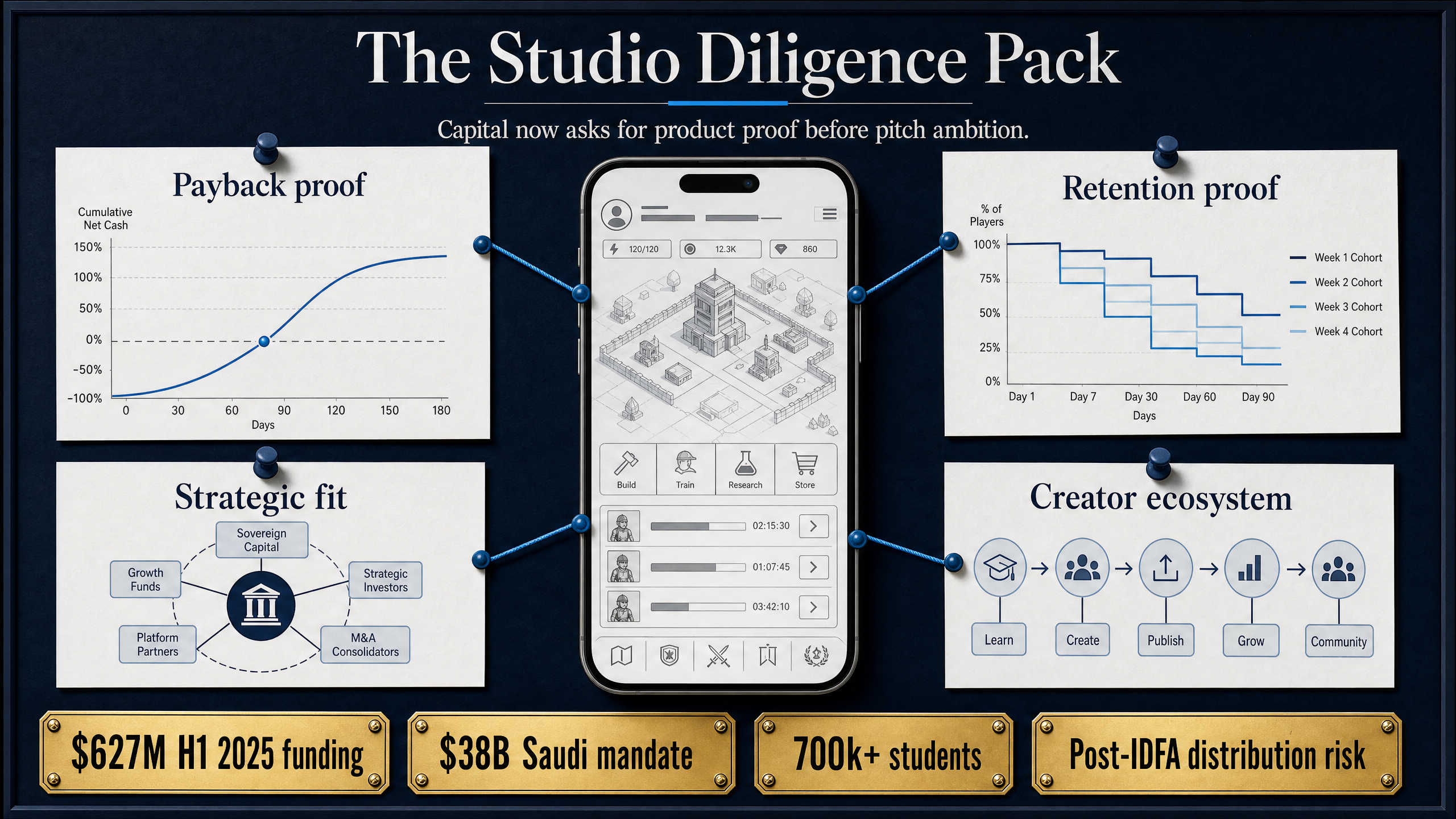
Deconstructor of Fun’s recent investment analysis puts a hard edge on the problem: gaming startup funding has fallen sharply from the 2021 peak, exits are harder to underwrite, and post-IDFA distribution has made paid growth less predictable for new studios.[1] At the same time, Naavik’s analysis of Saudi Arabia’s $38 billion gaming push and PocketGamer.biz’s coverage of the Savvy-Roblox MoU show that capital is still moving when the bet is bigger than one game: infrastructure, ecosystems, talent pipelines, platform leverage, and strategic access.[2][3]
The useful operator conclusion is not “games are unfundable.” It is sharper than that: the studio story has to become an evidence story.
The Funding Story Is Now an Operating Story
For years, a game pitch could lean heavily on genre, team pedigree, market size, and a believable content roadmap. Those still matter, but they no longer carry the same weight when investors worry about exit scarcity and distribution risk.
Deconstructor of Fun frames the venture problem in fund-math terms: investors need outcomes large enough to return capital, but fewer mid-sized acquirers, compressed multiples, and weaker paid acquisition efficiency make those outcomes harder to see.[1]
That means the product leader’s job changes. A studio cannot only say, “This game can work.” It has to show where the operating leverage comes from:
Payback proof: the early acquisition loop has a believable path to efficient spend.
Retention proof: cohorts have reasons to keep returning without constant content escalation.
Monetization proof: spending maps to durable value, not only event pressure.
Distribution proof: the game has more than one route to audience.
That is not investor theater. It is better product management.
Strategic Capital Is Buying Ecosystems
The other side of the story is that strategic capital has not lost interest in games. It is just often buying a different shape of asset.
Naavik describes Savvy Games Group as a vehicle launched inside Saudi Arabia’s Public Investment Fund with a $38 billion mandate.[2] PocketGamer.biz’s Savvy-Roblox story is a practical example of what that can look like on the ground: Roblox expanding operational presence in Saudi Arabia, Savvy supporting developer relations, localized training and community building, and more than 700,000 students tied to a related nationwide competition.[3]
That is not just a publishing deal or a one-off investment. It is ecosystem construction: talent, tooling, education, local market access, safety infrastructure, and platform adoption wrapped together.
For studios, the implication is uncomfortable but useful. If you want strategic capital, a platform partnership, or publisher leverage, you need to know what larger system you help strengthen.
Product Proof Beats Feature Ambition
This is where many teams get the sequencing wrong. They try to make the game look larger before they make the business model clearer.
A bigger feature list does not answer the questions capital is now asking. It can even make the story worse, because more systems create more execution risk unless the team can show how those systems compound.
A stronger studio story starts with a smaller set of proofs:
One audience proof: who reliably understands the promise and why they are reachable.
One behavior proof: what players repeatedly do that predicts future value.
One economy proof: why the spend surface can grow without poisoning retention.
One channel proof: why acquisition, platform distribution, creator supply, or partnerships can scale beyond launch novelty.
If those proofs are weak, adding more systems rarely helps. It just gives diligence more places to find uncertainty.
The New Diligence Pack
Before the next financing conversation, publishing conversation, or major roadmap bet, a studio should be able to answer four questions in operating language:
1. What is the route to audience?
Paid UA, IP, creator distribution, platform featuring, web shop, community, regional partnership, or publisher channel. Pick the actual route. “We will test everything” is not a strategy.
2. What compounds after install?
Collection, social obligation, mastery, identity, creator supply, live ops habit, or a recurring utility. Be specific. Retention needs a reason beyond calendar pressure.
3. What makes spending resilient?
The best monetization story is not that whales exist. It is that value grows as the player’s relationship with the product deepens.
4. Why does this matter to someone bigger?
Strategic partners care about market access, creator supply, technology adoption, portfolio fit, brand expansion, or local ecosystem development. If the game does not help a larger system win, the partnership story is probably thin.
Closing: Design for Diligence
The next wave of successful studios will not necessarily be the ones with the largest pitch decks or the most fashionable genre labels. They will be the ones whose products make diligence easier.
That means designing the game and the business together: acquisition truth, retention behavior, monetization architecture, and strategic fit. If the market is less forgiving, the answer is not to make the story louder. It is to make the evidence cleaner.
]]>Adrian C<![CDATA[The Second Game Strategy: Designing F2P Economies That Don’t Burn Players Out]]>https://adriancrook.com/?p=82482026-05-07T21:41:01Z2026-05-07T21:40:58ZSecond-game F2P economy design can lower pressure without flattening spend by selling identity, continuity, social value, and creator-driven attachment.
]]>The most useful F2P economy design story is not that cozy games are hot, or that UGC is hot, or that AI is coming for game development. Those are symptoms. The deeper shift behind the second game strategy is that the pressure profile of successful live games is changing.
For the last decade, many free-to-play economies have leaned on intensity: daily obligations, stat checks, time-limited events, competitive guild pressure, power ladders, and content drops that become work for both the studio and the player. That model still works in some genres. In 4X and deep RPG, pressure is often part of the product.
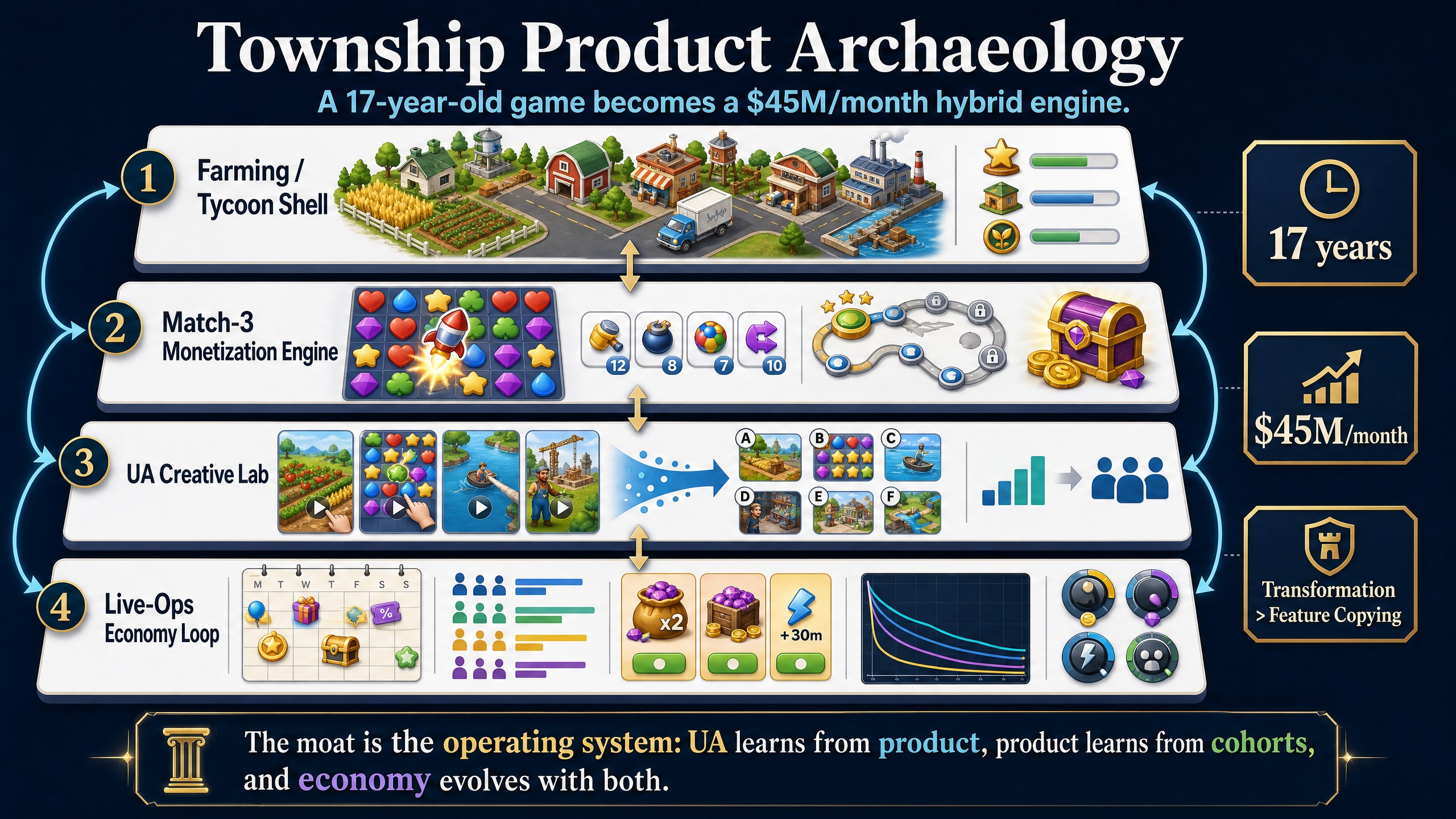
Recent games-industry coverage gives several reminders that intensity is getting more expensive to operate. Naavik wrote about China’s largest publishers moving from the anime-gacha ARPG race toward lifestyle-sim and “second game” formats.[1] Naavik’s Dorian podcast covered creator-led interactive fiction, female-first fandoms, and no-code UGC tools.[2] GameRefinery highlighted Township’s long transformation into a hybrid engine it cites at roughly $45M/month.[3] Mobile Dev Memo’s Phil Black episode put the same issue in economy-design terms: modern mobile games need broader acquisition and deeper monetization fit at the same time.[4]
The useful operator pattern is this: lower-pressure systems can still monetize when they are built around identity, expression, convenience, collection, social value, UGC, and long-term attachment.
Pressure Is Getting Expensive
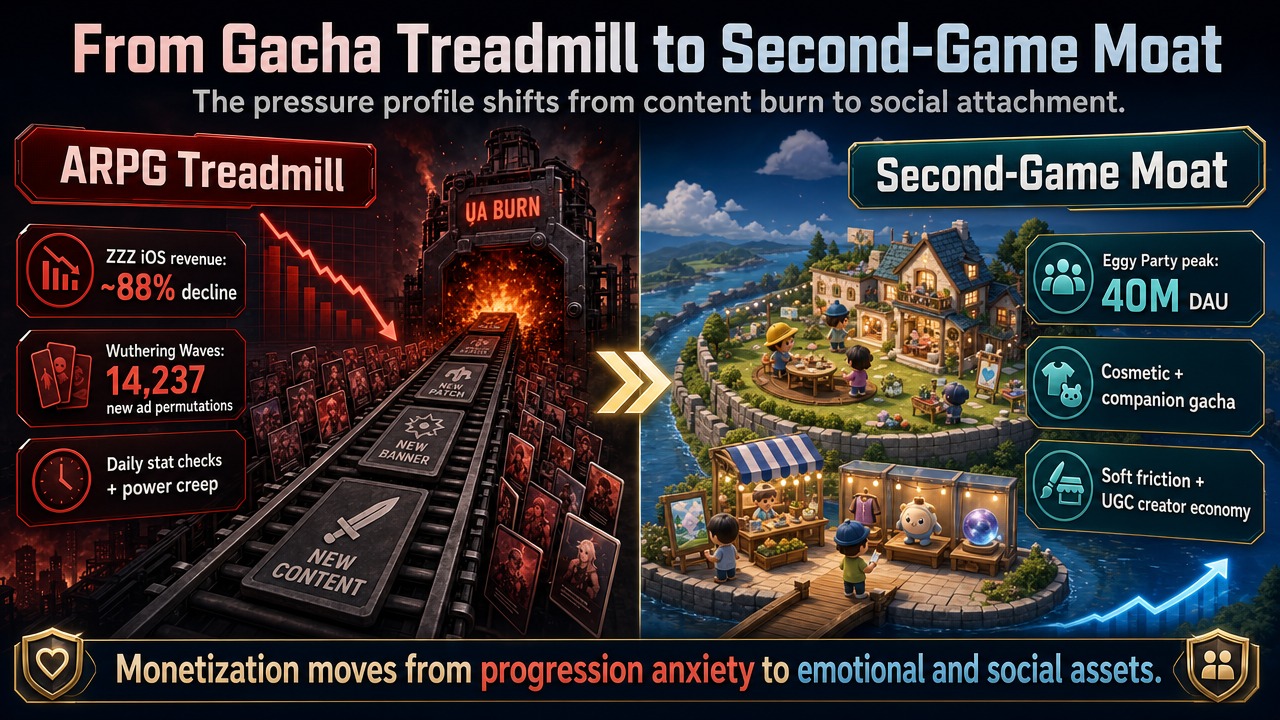
Naavik’s China analysis is useful because it frames the cozy/lifestyle-sim pivot as economics, not taste. The problem with combat-heavy gacha ARPGs is not simply that players want something cuter. It is that the model demands enormous content production, constant UA creative output, and a player base willing to tolerate progression anxiety.
That combination is difficult for incumbents and brutal for challengers. A high-pressure content treadmill trains players to consume novelty at the speed of the studio’s pipeline. Every update has to be big enough to matter, every monetization beat has to justify attention, and every acquisition campaign has to fight creative fatigue. Naavik points to lifestyle-sims as a way to shift monetization away from raw power and toward cosmetics, companions, soft convenience, and eventually UGC.[1]
Per Sensor Tower estimates cited by Naavik, Zenless Zone Zero’s China iOS revenue fell roughly 88% from its July 2024 launch-window peak to early 2026; DataEye metrics cited in the same article show Wuthering Waves adding 14,237 new ad permutations in December 2025 alone.[1] That is what a saturated pressure economy looks like: revenue compression on one side, creative exhaustion on the other.
This is why “second game” is a better phrase than “cozy game.” Cozy describes mood. Second game describes a role in the player’s life. A second game is designed to be returned to without demanding that the player reorganize their day around it.
The design question becomes: what does the player want to return to when they are not being forced back?
Second Game Strategy: F2P Economies Are Not Low Monetization
Many teams hear cozy, social, or lifestyle and assume soft engagement means weak revenue. Soft engagement does not mean weak revenue; it means the game is not primarily selling relief from pain.
A pressure-heavy economy asks, “What happens if the player skips today?” A second-game economy asks, “What makes this world worth checking in on even when nothing is on fire?”
That difference changes what the economy can sell:
Identity: avatars, homes, companions, collections, and taste.
Continuity: a world that gets richer over months, not just sharper during events.
Convenience: soft acceleration and quality-of-life offers that respect the low-pressure promise.
Social value: visible ownership, gifting, collaboration, and status that does not require power creep.
Creation: player-made content that gives the community a reason to generate meaning faster than the studio can manufacture novelty.
Cosmetics do not monetize because they are cosmetics. They monetize when the game creates enough attachment, visibility, scarcity, and taste-making for cosmetic ownership to matter.
Naavik’s China analysis turns the second game strategy into an economic argument: pressure-heavy ARPG content burn versus lower-pressure lifestyle-sim attachment.
Township Shows the Operator Version
GameRefinery’s Township recap is interesting because it is not about one clever feature. It is about long-term product transformation. The article describes how Township evolved across eras, combining a tycoon-style front end, match-3 monetization, and years of UA adaptation into a coherent business.[3]
The $45M/month figure is not a feature story. You cannot import a farm, a wardrobe, a battle pass, a creator marketplace, or a puzzle layer and expect the market to reward the transplant. The advantage is usually the operating model underneath it: how the team tests, how UA feedback changes onboarding, how live ops talks to economy design, and how quickly the roadmap adapts to cohort behavior.
GameRefinery’s Township recap is useful because the $45M/month headline is tied to years of product, UA, and live-ops adaptation.
Source video: GameRefinery links to the Two & a Half Gamers episode on Township’s long-term evolution.
UGC Is Infrastructure, Not Garnish
The Dorian episode points at a related but distinct opportunity. Naavik frames Dorian around interactive storytelling, female-first fandoms, and a no-code platform that lets creators build and monetize free-to-play experiences.[2]
UGC can become a durability layer. It changes the content equation from a studio-only production problem into a marketplace and tooling problem. If creators can produce meaningful experiences, and if players can discover and value those creations, then the economy has more places to sell identity, status, convenience, and expression.
Deconstructor of Fun’s investment analysis makes the same point from the capital side. It argues that investors are more comfortable with consumer apps, tools, infrastructure, and recurring-engagement businesses than with hit-driven game studios.[5] For game teams, the implication is not to abandon games. It is to recognize that the market increasingly rewards durable systems, not only content bets.
AI Is About Fit, Not Output
The Mobile Dev Memo episode with Phil Black is worth watching because Black frames AI as a matching problem, not just a production problem. The important AI question for F2P is not only “Can we generate more assets?” It is “Can we match the economy more precisely to the user?”
That has direct implications for second-game design. If the game is selling identity, convenience, and social meaning rather than raw power, then personalization becomes more valuable. The system needs to understand what a player cares about, what kind of pressure they tolerate, which cosmetics signal taste, which goals feel relaxing rather than obligatory, and which offers feel like service rather than extraction. That is where retention and monetization stop being separate disciplines.
In other words, AI is most strategically useful when it helps the game become more legible, more adaptive, and more commercially precise.
Source video: Mobile Dev Memo’s episode on the modern mobile gaming economy with Phil Black.
Do Not Copy the Visible Practices
PocketGamer.biz has a useful piece about why copying “best practices” fails.[6] The point applies directly here.
You cannot look at a successful cozy game, UGC platform, merge game, puzzle game, or 4X product and simply import the visible features. The feature is the artifact. The advantage is the decision system underneath it.
For a studio, the practical questions are:
What role should this game play in a player’s week?
How much pressure is appropriate for that role?
What does the player value besides power?
Which systems compound without linear content production?
Where does monetization express identity, convenience, or aspiration instead of frustration?
Does the UA promise match the product the team actually operates?
Does the organization have the rhythm to learn faster than the market copies?
The next wave of F2P opportunity may not come from making games softer. It will come from making their economies more precise.
Most studios that attempt this will not fail at the feature level. They will fail because the person running UA has never sat in an economy design review, and the person running economy design has never seen a UA creative brief.
]]>Adrian C<![CDATA[How To Reduce Drop-Off During Onboarding]]>https://adriancrook.com/?p=81512026-05-06T14:48:15Z2026-04-08T08:01:18ZCut early mobile-player drop-off with faster core gameplay, interactive tutorials, timed rewards, and data-driven A/B testing.
]]>Did you know most players quit mobile games within hours of downloading them? Around 73% leave in the first 24 hours, and 80% are gone by Day 3. These early exits hurt your bottom line, especially with acquisition costs up 222% over the last decade. But here’s the good news: small tweaks to your onboarding process can make a huge difference.
Here’s what works:
Simplify the first experience: Remove barriers like sign-ups or splash screens. Let players jump into the fun immediately.
Show gameplay fast: Skip long tutorials and showcase the core mechanics within minutes.
Use interactive tutorials: Teach by doing, not by overwhelming players with text.
Reward early actions: Quick wins, like beating a first level or earning rewards, keep players engaged.
Tailor the experience: Offer skip options for experienced players and extra guidance for beginners.
Track and test: Use data to pinpoint where players drop off and A/B test changes to improve retention.
The goal? Create a smooth, engaging start that keeps players coming back. Every second counts in onboarding – make them count.
Mobile Game Player Drop-Off Statistics and Retention Benchmarks
How to Improve Your App’s Onboard Process
Simplify the First-Time User Experience
Did you know that 20% of players abandon a game within the first two minutes? [8] That’s a huge loss right at the start. To keep players engaged and improve retention, it’s crucial to make the initial experience as seamless as possible.
Remove Barriers to Entry
Nothing kills excitement faster than splash screens, legal disclaimers, or account sign-ups blocking the fun. Instead, shift legal agreements to your App Store page [2] and hold off on asking for app ratings, notifications, or social media connections until players have had a chance to enjoy your game [2][5]. As GameAnalytics aptly puts it:
"Users should do something fun as soon as they open your mobile game"[9].
Early engagement can also be derailed by forced account creation, immediate paywalls, intrusive ads, or a flood of purchase options [9]. These distractions only frustrate new players. Strip away anything that isn’t essential to the core experience and let the gameplay speak for itself.
Once these obstacles are gone, you can focus on building an onboarding process that feels natural and engaging.
Create a Smooth Onboarding Flow
With the initial hurdles cleared, it’s time to guide players through your game in a way that feels intuitive. Use progressive disclosure – gradually introduce features and UI elements instead of overwhelming players with everything at once [5][10]. For seasoned players, include skip options so they can dive straight into the action [2][5].
Tracking tutorial steps can help you identify where players get stuck or drop off. Remember, early return rates hover around 50% [8], so every step of the onboarding flow matters.
Show Core Gameplay Early
The faster players experience the heart of your game, the better. Within the first few minutes, they need to see why your game is worth their time [9]. Start with an exciting action or story sequence that showcases core mechanics without bogging players down in lengthy explanations [5].
Teach the core loop – the main activities players will repeat to progress. For example, battling monsters to earn gold and upgrading gear [2]. Data shows that sessions longer than nine minutes result in a 31% Day 1 retention rate, compared to just 20% for shorter sessions [8]. Since most first sessions average under 20 minutes [8], every second counts. Make it memorable.
Design Tutorials That Adapt to Players
Experienced players tend to breeze through tutorials, while newcomers often need more detailed guidance. To cater to this range of skill levels, tutorials should be flexible and adaptable. Breaking them into smaller steps, incorporating interactive learning, and tailoring the experience to different player types can make onboarding more effective.
Break Tutorials into Small Steps
Overloading players with too much information at once can lead to frustration and disengagement. Instead, introduce one concept at a time with clear, easy-to-follow instructions. For instance, Clash Royale breaks its onboarding into five short tutorials. Each segment introduces a new concept, such as combining cards for stronger attacks, helping players gradually build their skills and confidence. Gamified onboarding tools, like checklists with visual progress indicators, have been shown to increase user activation rates by 40% [2][12].
Use Interactive, Hands-On Learning
Passive tutorials often fall flat. Interactive, hands-on methods are far more effective at keeping players engaged and reinforcing key skills. As the BBC points out:
"Good onboarding is implicit, and children won’t even notice it. Bad onboarding is explicit, cumbersome, and can form a barrier to play" [7].
Let players learn by doing. Use visual cues and immediate in-game practice to teach actions, and include contextual help that triggers based on player behavior. This "just-in-time" assistance feels natural, keeps players immersed, and helps them build muscle memory [13].
Customize Tutorials for Different Player Types
After establishing clear and incremental learning steps, take it a step further by tailoring the tutorial experience to match the player’s skill level. Give players control over how much guidance they receive. For example, Carcassonne offers a choice between a beginner-friendly "Go ahead" option and a "Later" option for more experienced players [2]. Some games, like Call of Duty Mobile, go even further by using bot-filled lobbies to help new players secure early wins, easing them into competitive gameplay. This approach is crucial, as 60% of players quit if a game becomes too challenging too quickly [11].
To make tutorials even more accessible, always include a "Skip Tutorial" button and a reference section where players can revisit instructions as needed [2][13]. These small additions can make a big difference in ensuring a smooth onboarding experience for all players.
Use Early Rewards to Drive Engagement
Rewards play a crucial role in keeping players engaged, from their first interaction with the game to becoming regular participants. The secret lies in knowing the right timing and type of rewards to offer.
Time Rewards for Maximum Impact
The first few moments of gameplay are incredibly important. Giving players a quick and easy win – like defeating a minor enemy or completing a starter level – creates a positive emotional connection they’re likely to remember [3]. These "Quick Wins" help players feel accomplished early on, encouraging them to stick around.
Capitalize on this window by front-loading rewards. For example, hand out in-game currency, power-ups, or cosmetic items as players complete tutorial steps. Linking these rewards to learning new game mechanics reinforces the desired behaviors [3].
Once the first session wraps up, transition to offering variable rewards. This shift, inspired by operant conditioning principles, keeps players intrigued without overwhelming them [3]. These early successes pave the way for deeper engagement strategies down the line.
Personalize Rewards for New Players
After building early momentum, the next step is tailoring rewards to match individual player preferences. Some players value faster progression, while others focus on customization or social interactions. By analyzing early gameplay behavior, you can offer rewards that resonate. For example, if a player gravitates toward combat, provide boosters or extra lives. If they spend time on customization, offer skins or decorative items.
Personalization also fosters a sense of ownership, which boosts engagement [3]. Take Two Dots, for instance: the game introduces players to a free "shuffler" power-up before Level 10. Shortly after, it highlights where they can purchase premium items, giving them a taste of advanced features without pressure [2].
The results of personalization speak for themselves. In 2023, East Side Games partnered with Mistplay on a campaign that rewarded specific in-game actions, leading to a 9.5% increase in Day 7 retention [6]. Similarly, justDice launched an early churn prevention campaign that triggered shortly after installation. Players who hadn’t completed the setup process received reminders to finish onboarding and claim a welcome bonus, cutting early churn by 26% [16].
Build Positive Feedback Loops
Once early and personalized rewards are in place, maintain engagement by creating ongoing feedback loops. Rewards should be part of a cycle that keeps players motivated. Tools like progress bars and checklists tap into the Zeigarnik Effect – the natural urge to complete unfinished tasks [12]. For example, over 6 million Duolingo users have kept streaks of seven days or more, driven by point systems and streak rewards [12].
Pair these rewards with sensory cues like sparkles and sound effects to amplify their impact [14]. These subtle enhancements make each reward feel more satisfying and encourage players to keep playing. As Amol Bhalerao, an experienced game developer, explains:
"The onboarding process is the bridge between download and habit-forming gameplay. In other words, it’s your best chance to keep players past the first session" [3].
You can also build anticipation by showcasing advanced rewards that are locked for now. Let players see what they can earn at higher levels or through specific achievements. This sparks curiosity and motivates them to return, even after the initial excitement starts to wear off [3][1].
sbb-itb-fd4a1f6
Optimize Onboarding Messages and Communication
Clear and timely communication is key to guiding players effectively, especially during their first interactions with your app. Considering that 77% of users stop using an app on the first day[15], how you approach these early moments can make a huge difference in retaining them.
Use Behavior-Triggered Messages
Instead of overwhelming players with instructions right at the start, deliver guidance when it’s most relevant. For example, the puzzle game Two Dots introduces the "shuffler" power-up only after players have completed several levels. This tutorial appears just before Level 10, ensuring players understand its value after experiencing normal gameplay [2].
Behavior-triggered messaging also allows you to adjust based on player performance. If a player struggles with a task, you can offer additional hints or slow the pace. On the other hand, if they’re breezing through, you can skip unnecessary explanations [3]. This approach helps balance the experience, reducing both frustration and boredom. Fruit Ninja 2 uses a clever two-step permission prompt during gameplay rather than at launch, ensuring players see the benefit – like virtual rewards – before being asked to grant permissions [17].
Similarly, Apple recommends delaying permission requests until players understand their value through provisional notifications. As Apple puts it: "Make the request in a context that helps the user to understand why your app needs authorization"[17].
Design for Silent Play Sessions
Many players mute their devices during gameplay, making visual signals just as important as audio cues. If you rely solely on sound, you risk leaving players confused. To avoid this, pair every audio message with visual elements like animated arrows, glowing highlights, or hand icons that appear when players approach an objective [3][7].
The BBC UX&D team emphasizes this concept:
"Good onboarding is implicit, and children won’t even notice it. Bad onboarding is explicit, cumbersome, and can form a barrier to play"[7].
Keep instructions short and seamlessly integrated into the game environment. For critical mechanics like jumping or special controls, consider briefly pausing the action to ensure clarity [7]. This approach not only improves understanding but also supports accessibility for all players.
Segment Messages for Player Types
Tailoring your messages to different player types ensures they feel relevant and engaging. Segmentation based on behavior, skill level, and preferences can make a big impact. For instance, Beach Bum Games boosted its push notification click-through rate from under 1% to 12% by segmenting messages. They also achieved a 250% increase in average CTR for quest-related notifications by using specific "Quest_ID" tags [18].
For new players, offer clear tutorials, while experienced players should have the option to skip them [2][3][15]. As OneSignal explains:
"Personalization begins with user segmentation. Gaming apps often attract a diverse audience with varying levels of skill, engagement, and preferences. If you are to accurately drive each of these player groups in the right direction… you must meet them where they are"[18].
Targeted strategies can also drive measurable results. Betmate, for example, saw an 11% increase in ID verification and a 30% rise in new user deposits by tailoring messages using behavioral data like "Deposit_Status" [18].
Adjust your tone to match each player’s style. Casual players might respond better to friendly nudges like, "Claim your daily bonus!" Competitive players, on the other hand, may prefer a challenge-focused tone: "New leaderboard rewards await!" [18]. And since 95% of users who don’t receive push notifications within the first 90 days will churn[15], establishing a regular communication pattern early – aligned with each player’s activity – keeps them engaged without feeling overwhelmed [17].
Measure and Improve Onboarding Performance
To make your onboarding process better, you need to measure it first. Tracking the right metrics helps you understand where players are thriving and where they’re getting stuck. Start with Day 1 retention – this is your main benchmark. For mobile games, average Day 1 retention typically ranges between 26.48% and 27.69%, though it varies by genre [1]. For example, match games often see higher retention at 32.65%, while strategy games average around 25.39% [15]. Beyond Day 1, keep an eye on Day 7 and Day 30 retention to gauge long-term engagement. Across the gaming industry, Day 30 retention is notably low, averaging just 2.4% [4]. These benchmarks offer a roadmap for selecting the most relevant metrics to track during onboarding.
Track Key Onboarding Metrics
Some metrics are especially important for onboarding success. Start with the onboarding completion rate and Time to Value (TTV) – this measures how quickly players reach their "Aha!" moment, the point where they see the value in your game. Another critical metric is the activation rate, which tracks how many users achieve key milestones, like completing the first level or using a core feature. Will Egan, CMO at Ausmed, sums it up well:
"Being able to measure each interaction in the onboarding workflow is the key to helping you methodically design and optimize a great onboarding experience"[19].
Ausmed is a great example of how this works in practice. Between 2022 and 2024, they boosted their activation rate from 15% to 75%. They achieved this by using behavioral tracking and surveys to identify friction points, then simplifying the onboarding process to remove unnecessary steps [19].
Run A/B Tests for Optimization
Once you’ve identified your key metrics, A/B testing is your next step. Controlled experiments let you fine-tune the onboarding experience. Test different elements like tutorial lengths, the timing of signups, or where rewards are placed to see what improves retention. For instance, Marvel Snap condensed its complex card game mechanics into a tutorial under four minutes, making the game more approachable for a broader audience outside of traditional CCG players [15]. Focus on key actions and measure their impact on Day 1 retention and ARPU (Average Revenue Per User). Quick split-testing for onboarding and monetization has been shown to boost ARPU by anywhere from 20% to 400% [20]. Just be sure to test these changes with new users only [20].
Find and Fix Friction Points
Funnel analysis is a powerful tool for pinpointing where players drop off during the onboarding process. Map out every step, from the initial install to activation, to see where the bottlenecks are. For example, Wordscapes uses real-time data to identify players stuck on specific levels. When this happens, the game sends personalized notifications with hints to help them move forward [21]. Tools like session replays and heatmaps can also show where players hesitate or ignore cues [19]. Eliminating these friction points can have a big impact – just a 25% increase in activation can lead to a 34% boost in Monthly Recurring Revenue over a year [22]. By smoothing out these rough patches, you’ll not only improve retention but also set the stage for stronger long-term revenue growth.
Conclusion
Onboarding is the gateway between a download and creating a loyal player base. The reality is harsh – early player drop-off happens fast, and those first few minutes can make or break the connection. Every tactic we’ve discussed – whether it’s simplifying the first-time experience or running A/B tests – works together to keep players engaged beyond that critical first day.
As Amol Bhalerao wisely says:
"Onboarding is your best opportunity to make that connection – so make it fun, fast, and unforgettable"[3].
By showcasing core gameplay early, rewarding progress, and removing unnecessary barriers, you’re laying the groundwork for better retention and higher lifetime value (LTV). But it doesn’t stop there. The onboarding process must evolve as player preferences and market trends shift. Regular updates, data tracking, and testing are key to ensuring that every new install has the best shot at becoming a loyal, paying player.
The most successful games treat onboarding as an ongoing service, not just a one-time tutorial. By analyzing cohort data, addressing friction points, and adapting to player behavior, you can transform initial interest into a habit-forming experience.
It all boils down to this: your onboarding flow is vital – make every moment count. Start small, experiment often, and keep refining.
FAQs
How can I find out where players drop off during onboarding?
To figure out where players drop out of your onboarding process, start by mapping their journey step by step. Use analytics tools to track key events – like when users install the app, complete tutorial checkpoints, or take their first in-game action. By comparing the number of players entering each stage to those who leave, you can calculate drop-off rates and spot the areas where players are most likely to disengage.
Break down your data by categories such as device type, operating system, or region. This helps identify whether specific groups face unique challenges. For a closer look, gather qualitative insights using tools like in-app surveys, heatmaps, or session replays. These methods can reveal why players are leaving certain stages. Once you’ve pinpointed the trouble spots, focus on refining those areas. Test your updates with A/B experiments to see how they affect retention rates.
How can I personalize the onboarding experience to keep different types of players engaged?
To make onboarding more engaging, it’s essential to recognize that players come with varying motivations and skill levels. Start by segmenting your audience into groups like casual players, who enjoy straightforward, quick experiences; core players, who appreciate a gradual build in complexity; and advanced users, who thrive on challenges and premium features. Design the onboarding process to cater to these groups. For instance, casual players might appreciate the option to skip tutorials, core players could benefit from milestone-based tutorials, and advanced users may enjoy detailed guides or early access to premium content.
Another way to personalize onboarding is through dynamic difficulty adjustment. By analyzing how players perform early on, you can tweak the gameplay – making it easier for beginners while introducing a steeper challenge for seasoned players. Additionally, reward customization can play a big role. Casual players may respond well to simple, easy-to-achieve rewards, while advanced users might be drawn to exclusive, high-value items.
Lastly, leverage real-time analytics to track player behavior during onboarding. Pay attention to which features each group interacts with most and use this data to fine-tune the experience. A thoughtful, data-driven approach ensures that every player feels engaged and appreciated from the very start.
How do early rewards impact player retention and engagement in mobile games?
Early rewards are a key strategy for grabbing players’ attention and keeping them engaged. By giving out incentives like bonus items, extra in-game currency, or small power-ups right at the start, developers can create a quick sense of achievement and excitement. This early boost not only leaves a positive first impression but also helps improve Day-1 retention, encouraging players to stick around and start building a routine.
For these rewards to work well, they need to be simple to earn, closely tied to the main gameplay, and spaced out thoughtfully to keep the experience exciting without overwhelming the player. When included as part of the onboarding process, early rewards make it easier for players to keep going, increase the time they spend playing, and motivate them to come back. This method not only turns first-time players into regular ones but also sets the stage for long-term engagement and potential monetization.
]]>Adrian C<![CDATA[Subscription Models for Mobile Games]]>https://adriancrook.com/?p=81282026-01-15T07:53:45Z2026-02-10T17:22:00ZHow battle passes, VIP tiers, and premium access drive recurring revenue, retention, pricing tactics, churn risks, and fair-play design in mobile games.
]]>Subscription models are reshaping mobile gaming by offering recurring payment options like battle passes, VIP memberships, and premium access. These models provide developers with consistent revenue streams and players with perks like exclusive content, ad-free experiences, or in-game benefits. In 2022, subscriptions accounted for 36% of mobile gaming revenue, and spending is projected to reach $11 billion by 2025.
Key points include:
Battle Passes: Time-limited rewards tied to seasonal challenges.
VIP Memberships: Passive benefits like ad removal and daily bonuses.
Premium Access: Unlocks exclusive game content or features.
While subscriptions boost player retention and lifetime value, challenges like high churn rates and pricing sensitivity require careful planning. Combining subscriptions with in-app purchases and ads, alongside offering free trials and tiered pricing, can maximize engagement and revenue.
The balance lies in providing meaningful perks without creating "pay-to-win" dynamics, ensuring fairness and long-term player trust.
Mobile Game Subscription Models: Types, Benefits, and Challenges Comparison
Types of Subscription Models in Mobile Games
Subscriptions have become a key strategy in expanding revenue streams for mobile games, offering tailored options to suit different player preferences. Let’s dive into some of the most prominent subscription models.
Battle Pass Subscriptions
Battle passes are structured around a tiered reward system that encourages players to complete season-based challenges. These challenges unlock exclusive content such as skins, in-game currency, and XP boosts [2][1]. Typically, games offer two tracks: a free one with basic rewards and a premium one that requires payment, which increases player engagement. This model has gained significant traction, with 41% of the top-grossing mobile games incorporating season passes as part of their monetization strategy [2].
Games like Fortnite and PUBG Mobile were early adopters in the shooter genre, but this model has since spread to other genres, including puzzle games like Gardenscapes and Homescapes. Teis Mikkelsen from Multiscription highlights the appeal of this system:
"Battle passes have become a really popular way to monetize F2P games… It’s essentially a time-limited subscription, but brilliant in that it drives both spend and engagement, as players must play to earn the potential rewards they paid to get access to."
Seasons typically last anywhere from two weeks to a year, creating a sense of urgency that keeps players engaged. Some publishers now offer auto-renewing subscriptions to ensure seamless access to new seasons, turning one-off purchases into consistent revenue.
While battle passes focus on time-limited rewards, other models provide ongoing perks without requiring active gameplay.
VIP Membership Subscriptions
VIP memberships are all about convenience and exclusivity, offering perks like ad removal, daily bonuses, shop discounts, and access to special tournaments. Unlike battle passes, VIP rewards are passive, meaning players benefit simply by maintaining their subscription.
This model has a notable impact on player retention. For instance, XFLAG reported that VIP subscribers play 20% more daily [8]. Similarly, in Legendary: Game of Heroes, VIP members achieved a 95% daily log-in rate [8]. This heightened engagement directly boosts lifetime value, as Scopely explains:
"Due to the retention associated with monthly subscriptions, the ARPU curves for subscribers are steeper than those of non-subscribers leading to much higher overall LTVs for these players." [8]
Pricing for VIP memberships typically ranges from $9.99 per month for standard games to $29.99 per month for RPGs with deeper progression systems [7][8].
Premium Access Subscriptions
Unlike battle passes or VIP memberships, premium access subscriptions provide entry to substantial content that is otherwise locked behind a paywall. These subscriptions grant access to full game features, exclusive content, or special modes. For example, Minecraft Realms Plus offers private server access, while GTA+ provides exclusive vehicles and in-game currency for $5.99 per month [2][1].
Some publishers have taken this a step further with subscriptions that span multiple games. For instance, Apple Arcade bundles hundreds of games for casual players, while single-game premium subscriptions are better suited for "AAA-like" titles with deeper engagement [6].
This model emphasizes content depth and exclusivity, making it ideal for games with expansive libraries or episodic releases. Players are drawn in by the promise of unique experiences they can’t find elsewhere.
Benefits and Challenges of Subscription Models
Subscription models have redefined how mobile games earn revenue and keep players engaged, but they come with their own set of trade-offs that developers need to handle carefully.
Advantages of Subscription Models
One of the biggest perks of subscription models is the steady stream of income they provide. Unlike the unpredictable earnings from one-time purchases or ad revenue, subscriptions create a consistent cash flow. This makes financial planning easier and allows developers to focus on long-term content updates without worrying about sudden drops in revenue [1].
Subscriptions also boost the lifetime value (LTV) of players by extending their engagement with the game. Matej Lančarič, a UA Mobile Growth Expert, highlights this:
"Subscription models increase customer lifetime value (LTV) by maximizing the revenue earned per customer over time" [1].
This recurring interaction not only builds player loyalty but also encourages stronger emotional ties to the game.
Interestingly, subscriptions can also lead to more in-app purchases. Once players commit to a subscription, they often see the fee as a sunk cost, which makes them more likely to spend on additional in-game items to enhance their experience [6][12]. This creates an opportunity for developers to capture even more value from their most engaged players, without relying entirely on big spenders (often referred to as "whales").
However, while the benefits are clear, subscription models also bring several challenges that developers must address.
Challenges of Subscription Models
One major hurdle is the high churn rate. Nearly 30% of annual subscriptions are canceled within the first month, often due to a lack of fresh content or right after the initial billing cycle [5][9]. This means developers are under constant pressure to deliver top-notch content to keep subscribers engaged [9][10].
Pricing is another tricky area. Developers need to strike a balance – set the price too high, and players may feel excluded; set it too low, and the revenue might not cover development costs. In fact, 38% of subscribers reported they would have kept their subscription if there were lower-priced options available [5]. Additionally, compared to free-to-play games, subscription models can create a higher barrier to entry, which might limit the initial player base [9]. Guy Kroupp from Getgud.io cautions:
"Poorly chosen monetization models can lead to player churn rates as high as 80% within the first month" [9].
Finally, there’s the risk of a “pay-to-win” stigma. If the benefits offered through subscriptions give players an unfair competitive edge, the game might feel unbalanced. This perception can lead to frustration and, ultimately, player attrition [10][11]. Designing a subscription model that feels valuable without tipping the scales too far is an ongoing challenge for developers.
Benefits vs. Challenges Comparison Table
Here’s a quick look at how the advantages and challenges of subscription models stack up:
Key Metric
Advantages
Challenges
Retention
Builds long-term loyalty and daily habits
High churn if value isn’t consistently refreshed
Revenue
Steady, predictable cash flow
Converting free users to paid remains difficult
Design
Enables deep progression and meta-layers
Requires constant content updates (LiveOps)
Market
Perceived as a safer option than loot boxes
Competes with other subscriptions for player budgets
User Experience
Offers ad-free, premium gameplay
Risk of being seen as “pay-to-win” if unbalanced
How to Implement Subscription Models
Creating a successful subscription model involves careful timing, smooth integration with other revenue streams, and pricing that clearly communicates the value being offered.
Timing and Paywall Placement
Timing plays a huge role in how players perceive subscription offers. Instead of immediately hitting users with a paywall, let them first engage with the core gameplay or reach a meaningful milestone. This way, they can experience the value of your game before being asked to commit financially.
Take Legendary: Game of Heroes by N3TWORK, for example. The game introduced a $29.99 monthly VIP subscription after players had progressed beyond the initial stages. They highlighted VIP perks with unique UI markers and offered benefits like a dedicated VIP store, early access tokens for bosses, and premium customer support. This strategy paid off with a D425 retention rate of about 20% and a 95% daily log-in rate among its 30,000 active subscribers [8].
Another effective approach is to use contextual prompts or metered paywalls. These appear when players hit a natural stopping point, like running out of daily lives or failing a level multiple times. This makes the subscription feel less like a sales tactic and more like a helpful solution [3].
For instance, Scopely’s Wheel of Fortune introduces its $9.99 per month "All-Access Pass" immediately after the first-time user experience. This subscription bundles exclusive rewards, discounts, and energy boosts, encouraging players to develop a daily playing habit [2][8].
These timing strategies lay the groundwork for combining subscriptions with other revenue streams.
Combining Subscriptions with IAP and Ads
Once the timing is right, blending subscriptions with in-app purchases (IAP) and ads can significantly boost revenue. Many successful mobile games rely on a mix of subscriptions, IAP, and ads to give players flexibility while maximizing earnings [6]. Subscriptions can even encourage additional spending by offering exclusive discounts on IAP, creating a loop of continuous engagement and spending [6].
NEOWIZ’s Cats & Soup is a great example. The game combines interstitial and rewarded ads with IAP and multiple subscription tiers, generating $230,000–$270,000 in monthly revenue. Players can choose from options like a 7-day ad-removal for $0.99, a 30-day ad-removal for $3.99, or premium daily reward packages for $9.99 [4].
Setting Up Pricing Tiers
Pricing tiers are essential for balancing affordability with perceived value, making it easier for players to try out subscriptions and commit long-term. Offering a variety of plans – weekly, monthly, and annual – can cater to different budgets and preferences [13]. For example, weekly subscriptions often hover around $4.99, monthly plans around $9.99, and annual plans start at $29.99 or more [2][4]. Annual plans often include significant discounts, encouraging long-term commitment and reducing churn.
To lower the barrier to entry, start with a low-tier option and build in opportunities for upselling [6]. Introductory offers, such as free trials or discounted rates (e.g., $1.99 per month for the first three months), can also make the initial decision easier for players [3].
Don’t forget about platform-specific incentives. For instance, on the iOS App Store, developers’ revenue share increases from 70% to 85% after a subscriber has been active for one year [3]. Organizing pricing tiers into subscription groups – where players can only select one option at a time – helps avoid confusion and accidental multiple purchases. It also makes it easier to manage upgrades, downgrades, and crossgrades [3].
Lastly, each pricing tier should offer something distinct. Higher tiers should provide exclusive perks like unique content or VIP support, rather than just "more of the same" [14][8].
sbb-itb-fd4a1f6
Best Practices for Subscription Models
Once your subscription model is live, fine-tuning it becomes essential. The key lies in tracking the right metrics, experimenting with offers, and earning player trust through fair and transparent design.
Key Performance Indicators to Track
Keeping an eye on the right metrics can make or break the success of your subscription model. Here are a few critical ones:
Monthly Recurring Revenue (MRR): This helps smooth out revenue inconsistencies across varying subscription durations.
Lifetime Value (LTV): Predicts the total revenue per player by multiplying ARPDAU (Average Revenue Per Daily Active User) by the average player lifetime.
Churn Rate: Divided into voluntary churn (users canceling subscriptions) and involuntary churn (billing issues like expired credit cards). Involuntary churn accounts for about 20% of cancellations [15]. Reducing churn by recovering 50% of failed payments – through push notifications or in-app reminders – can lower overall churn by around 10% [15].
Conversion Rates: Track key moments like trial start rates and trial-to-paid conversion rates. A trial conversion rate of 33% is a solid benchmark for mobile apps [15].
LTV:CAC Ratio: A ratio of 3:1 is often seen as the gold standard for sustainable growth [16].
Don’t forget to monitor proceeds versus gross revenue. App store fees, typically 30%, often drop to 15% after a user has subscribed for a year – a crucial detail for accurate financial planning [15].
These metrics not only provide insights into revenue stability but also guide future testing and promotional strategies.
A/B Testing and Seasonal Promotions
A/B testing is invaluable for fine-tuning everything from onboarding flows to pricing strategies and messaging about subscription benefits. Testing different subscription tiers, pricing models, and perks can reveal what resonates most with your audience [17][6].
Timing your promotions with major content updates or seasonal events can also boost results. Players are more likely to see value in subscriptions right before significant in-game events or updates [8]. Battle Passes are a great example – they package perks within a defined timeframe, creating urgency and driving engagement [6].
Introductory pricing can also lower the barrier to entry. For instance, offering the first three months at $1.99 instead of $9.99 can significantly increase initial conversions [8]. Another option is "time cards", which temporarily unlock subscription features (e.g., a 3-month pass) without requiring auto-renewal, appealing to players hesitant about ongoing commitments [8].
Visual cues can further highlight the value of subscriptions. For example, using distinct color schemes – like purple for VIP features versus blue for standard gameplay – helps players quickly understand what they’re getting [8].
Avoiding Pay-to-Win Perceptions
To maintain trust, subscription benefits should enhance convenience rather than provide unfair advantages. Non-paying users must still be able to progress through normal gameplay, even if it takes longer.
Focus on perks like time-saving features (e.g., faster building times or shorter cooldowns) or cosmetic items (e.g., exclusive skins or emotes) that let players express themselves without disrupting game balance. Battle Passes are a great example, as they reward players based on skill and time rather than direct purchases [6]. Dual progression tracks – where all players can advance but subscribers gain access to an enhanced premium track – also help maintain fairness.
Consider adding features that benefit the entire community. For instance, troop donations or shared buffs foster cooperation rather than individual advantages. XP or soft currency multipliers can cater to different play styles while keeping the competition fair.
It’s also important to clearly distinguish subscription perks from standard gameplay using unique UI elements. Avoid placing paywalls on core content – keeping game modes and levels accessible to free players helps preserve trust and community cohesion.
For deeper insights into optimizing subscription models, Adrian Crook & Associates offers expertise in freemium mobile game design and live operations.
Conclusion
Subscription models now contribute to 36% of mobile gaming revenue, with projections estimating they’ll hit $11 billion by 2025. This highlights their growing importance in providing steady income streams and delivering enhanced player value [2]. The secret to success lies in striking the right balance between value and trust. Players need to see clear, meaningful benefits – whether it’s through Battle Passes, VIP memberships, or ad-free gameplay – that genuinely enhance their gaming experience. These perks serve as the foundation for effective and thoughtful implementation strategies.
Getting implementation right takes careful consideration. Decisions like when to introduce paywalls or how to structure tiered pricing significantly impact both player perception and revenue [2][4]. Offering free trials can lower the barrier to entry, while consistent perks such as XP boosts and exclusive cosmetics keep players engaged without veering into pay-to-win territory.
As mentioned earlier, maintaining subscription value and player trust requires constant attention and refinement. Avoiding "regretted benefits" and addressing platform-specific challenges are just part of the equation. As Teis Mikkelsen puts it:
"Being successful with subscription requires as much thought and expertise as ads and IAP, so you need to do your research" [6].
With around 83% of mobile games failing within three years [10], this underscores the critical need for a well-crafted subscription strategy that supports a game throughout its lifecycle.
For developers looking to maximize their chances of success, expert guidance can make all the difference. Adrian Crook & Associates brings over 17 years of experience and has worked with more than 300 clients to create profitable, player-focused subscription models. Their consulting services – ranging from KPI analysis to soft launch planning – are designed to tackle the challenges outlined in this guide, helping developers build subscription systems that deliver long-term results.
FAQs
How do subscription models help retain players in mobile games?
Subscription models are a powerful tool for keeping players engaged by offering continuous value. Whether it’s exclusive content, special in-game perks, or monthly rewards, these benefits create a sense of commitment that motivates players to log in regularly. Over time, this steady interaction helps nurture player loyalty.
For developers, subscriptions provide a steady stream of revenue, allowing them to fund regular updates, seasonal events, and tailored features that keep the gameplay experience dynamic and engaging. By crafting subscription tiers that work seamlessly with free-to-play elements, developers can enhance player satisfaction while boosting retention for the long haul.
How can developers reduce churn in subscription-based mobile games?
To keep players hooked on subscription-based mobile games, developers must focus on delivering consistent value and crafting an experience that keeps players coming back. When players feel they’re getting exclusive perks, frequent updates, and a genuine connection to the game, they’re far less likely to cancel their subscriptions.
Some effective approaches include starting with a smooth and enjoyable onboarding process, offering subscription plans that cater to different spending habits, and keeping the game fresh with regular updates like exclusive items or limited-time seasonal events. Features that build a sense of community – like guilds or leaderboards – can deepen player loyalty. Additionally, rewarding long-term subscribers with special anniversary gifts or increasing perks over time can be a great way to encourage renewals.
Adrian Crook & Associates specializes in helping developers fine-tune retention strategies, optimize subscription models, and design engaging live operations to boost revenue while reducing churn.
How can mobile games offer subscription benefits without being seen as ‘pay-to-win’?
To steer clear of the dreaded "pay-to-win" label, focus on crafting subscription perks that add value to the player experience without tipping the competitive scales. Perks like ad-free gameplay, unique cosmetic items, early access to new content, or quality-of-life upgrades (think faster crafting timers) can make players feel rewarded without disrupting the game’s fairness.
Transparency is just as important. Be upfront about what the subscription includes, highlighting benefits like cost savings or exclusive content rather than anything that might give a gameplay edge. When players feel assured that the game remains balanced, they’re more likely to embrace the subscription model.
Lastly, keep an eye on how these perks affect the overall game experience. Regularly assess and tweak the offerings to ensure they enhance enjoyment without compromising fairness. A well-thought-out subscription plan can keep players engaged while maintaining a level playing field.