
Free-to-play games thrive on a delicate balance between premium (paid) and free (earned) resources. If this balance shifts too far, it can alienate players and hurt revenue. Here’s the key takeaway: paying players want meaningful value for their money, while free players expect fair progression for their time.
To maintain this balance:
- Premium resources (hard currency): Scarce, impactful, and purchased with real money.
- Free resources (soft currency): Earned through gameplay, abundant enough to reward effort.
- Progression paths: Offer both grind-based and paid options, ensuring no essential content is locked behind paywalls.
- Resource sinks: Use time-limited events, cosmetics, and utility upgrades to keep the economy stable and solve common economy problems.
- Data-driven adjustments: Monitor metrics like retention, conversion rates, and currency flows to tweak the system as needed.
The goal is simple: keep free players engaged while giving paying users a reason to spend – without breaking the game’s economy or trust.
Game Economy Design: How to ensure player satisfaction and commitment, with Oscar Clark
sbb-itb-fd4a1f6
Understanding Premium and Free Resources
Premium vs Free Currency Balance in Game Economies
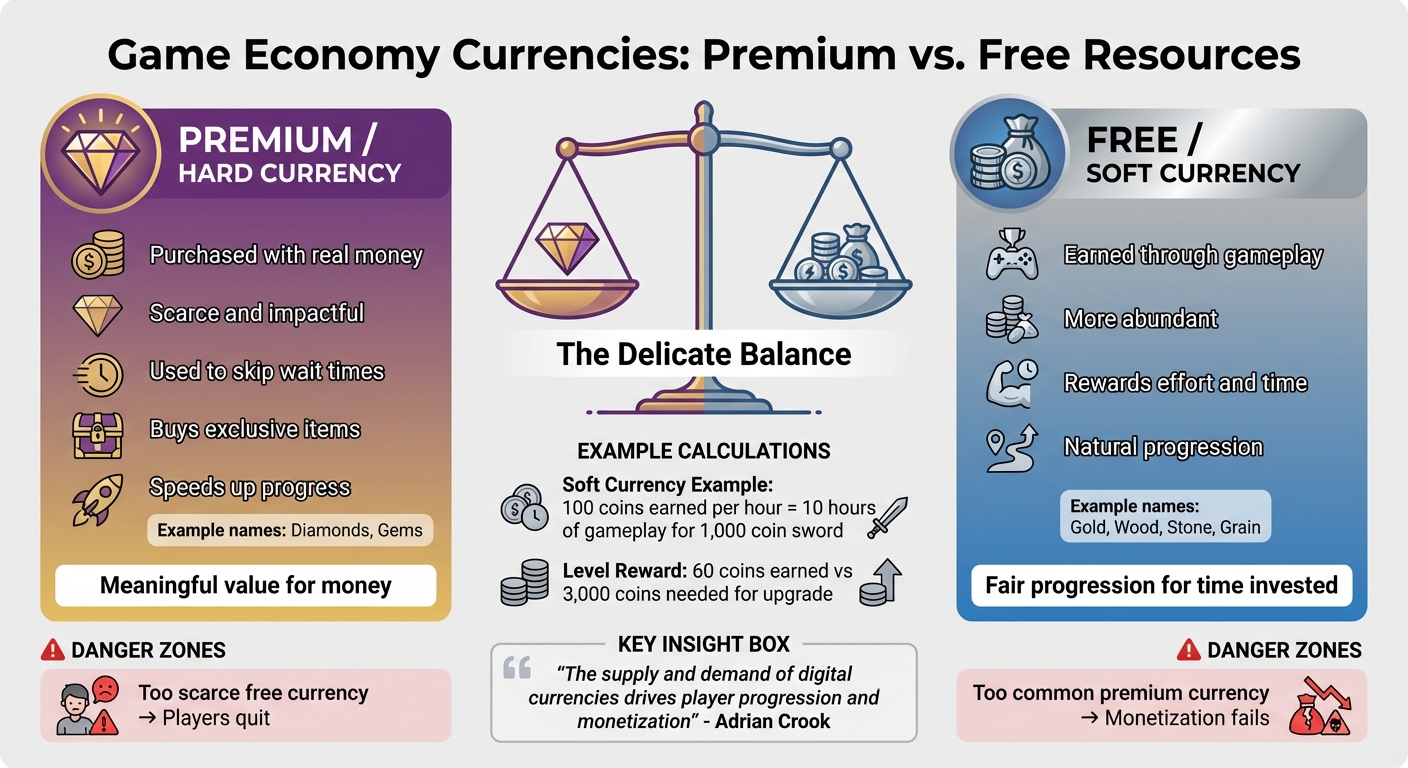
In the world of games, two types of in-game currencies dominate: hard currency (premium) and soft currency (free). Hard currency is bought with real money through microtransactions, while soft currency is earned by playing the game – like completing levels or finishing missions.
Defining Hard and Soft Currencies
Hard currency serves as a major revenue generator. It allows players to skip wait times, buy exclusive items, or speed up their progress[3]. For instance, in strategy games, players often spend premium currency – commonly called Diamonds – to bypass waiting periods or substitute for missing resources. On the other hand, soft currency, often referred to as Gold, and other resources like Wood, Stone, or Grain, are earned naturally during gameplay.
Soft currency rewards effort and progression. Imagine a player earns 60 coins for completing a level but needs 3,000 coins for a meaningful upgrade[7]. Or consider a sword that costs 1,000 gold coins. If a player earns 100 coins per hour, they’d need to play for 10 hours to afford it[4]. This clear link between time, effort, and reward helps players measure the value of their gameplay investment. By understanding these dynamics, it becomes clear why managing scarcity and accessibility is so important for maintaining the value of both types of currency.
The Role of Scarcity and Accessibility
Scarcity is what makes premium currency valuable. If hard currency were too easy to obtain, it would lose its appeal and hurt monetization efforts[2]. Keeping it scarce ensures it remains desirable for skipping time gates or gaining other advantages. On the flip side, soft currency needs to be more abundant to provide regular rewards and enable steady progression. Striking this balance is critical – if free currency is too scarce, players may feel pressured to spend money and might quit the game. But if premium currency becomes too common, it undermines your ability to monetize effectively, especially since most free-to-play players don’t make purchases.
"The supply and demand of digital currencies is what drives player progression through the content and serves as the pivotal element for monetizing players."
- Adrian Crook, Founder, Adrian Crook & Associates[1]
This delicate balance between scarcity and accessibility shapes how players progress and ensures there are meaningful paths for all types of players.
Creating Different Progression Paths for Players
The best free-to-play games strike a balance by letting players choose how they want to progress – either through grinding for rewards or by purchasing shortcuts. Both options should lead to the same level of power, ensuring no paywalls block essential content.
Balancing Pay-to-Win and Free-to-Play Progression
The term "pay-to-win" can destroy a player’s trust in a game. To avoid this, all gameplay-critical content must be accessible through normal play[5]. Premium purchases should speed up progress, not gatekeep powerful items[3].
"Any game that uses a free-to-play economy should allow non-paying users to unlock and progress to the point of any paying players."
- Adrian Crook, Founder, Adrian Crook & Associates [5]
Research from simulated strategy game economies reveals that the top 2% of highly skilled free-to-play players can outperform 19% of paying players by mastering resource management[3]. This proves that skill and strategy should outweigh spending power, fostering a fair and competitive environment.
Smart monetization focuses on offering permanent upgrades, like extra builders or expanded inventory slots, alongside cosmetic items such as character skins. These options provide lasting value or personal expression without forcing players into pay-to-progress scenarios[5][6].
Giving Players Choice in How They Progress
Players value having control over how fast they progress. Whether they invest time in extended gameplay or choose to pay to skip wait times, both paths should feel equally rewarding.
"Other players, who do not want or have time to grind, can bypass this through a purchase. In this way, both non-payers and payers alike are happy with the amount of content they can access."
- Adrian Crook, Founder, Adrian Crook & Associates [5]
Giving new players a small amount of premium currency early on lets them experiment with features like speeding up timers or buying booster packs. This removes the guesswork around premium options and helps players decide if future purchases align with their preferences[1][5].
Adding mid-tier currencies like "Skip-Its", which allow players to claim rewards without watching ads[6], or dual-track season passes can diversify progression options. These features cater to different playstyles while offering bonus perks to paying players, creating a more inclusive and engaging system.
Next, we’ll explore how resource sinks play a critical role in maintaining a balanced in-game economy.
Implementing Resource Sinks to Maintain Economy Health
To keep your in-game economy stable, it’s crucial to balance the ways players earn and spend currency. Economists often refer to earning opportunities as "faucets", but without effective ways to spend, or "sinks", inflation can spiral out of control. The solution? Create spending opportunities that are not only functional but also engaging for players[8].
As Jihoz from Axie Infinity puts it: "Ultimately, people need to be spending for fun, status, convenience, flexing for the economics to work permanently"[8]. In other words, the best sinks are those that enhance the gameplay experience without crossing into pay-to-win territory.
Using Time-Limited Events and Sales
Time-limited events are a fantastic tool for driving player spending. They create a sense of urgency – players know they only have a short window to take advantage of these opportunities. This taps into the fear of missing out (FOMO) while offering real value. For example, holiday events, seasonal cosmetics, or exclusive character variants give players a reason to spend their currency immediately rather than saving it indefinitely. This approach keeps the economy active and prevents large reserves of unused currency from piling up.
Premium currency can also play a role here, especially when it’s used to bypass "pinch points" like long wait times or progression bottlenecks[1]. By offering time-limited boosts or accelerators during events, you allow players to enjoy more content in less time, without disrupting the game’s overall balance. For those who prefer steady progression, the choice to spend is entirely optional. Pairing these events with cosmetic and utility-based sinks ensures players have a variety of meaningful ways to spend their currency.
Encouraging Cosmetic and Non-Essential Purchases
Cosmetic items are a go-to for removing currency from circulation without impacting competitive fairness. Things like character skins, emotes, profile customizations, or housing decorations give players a way to express their individuality while naturally reducing excess currency in the system[16, 19].
Utility-based upgrades are another effective sink. These include features like expanded inventory space, faster travel options, or the ability to reset stats. Such upgrades appeal to players who value convenience and efficiency, offering them time-saving perks without giving them a competitive edge[8].
The most resilient in-game economies combine multiple sink types to cater to different player motivations. For instance:
- Social players might spend on rare titles or collectibles that showcase their wealth or status.
- Achievement-driven players are more likely to invest in tools that streamline their progression.
Monitoring and Adjusting Based on Player Data
Creating a well-balanced game economy isn’t a one-and-done process – it needs constant fine-tuning to stay effective and profitable [1]. As Jon Radoff, CEO of Beamable, aptly states: "In a live game, you simply can’t monetize people who are no longer there" [9]. This highlights the importance of tracking meaningful metrics and running experiments to maintain a thriving economy over time.
Key Metrics for Economy Health
To keep your game economy on track, focus on metrics that provide a clear picture of its health. Retention rates – measured at intervals like day 1 (d1), day 7 (d7), and day 30 (d30) – are critical. These rates reveal how many players stick around after their first day, week, or month of gameplay [9]. Retention is the backbone of long-term monetization; if players drop off too soon, even the best currency sink adjustments won’t save your revenue streams.
Another key metric is your conversion rate, which measures the percentage of players who transition from free to paying users. Pair this with Average Revenue Per Daily Active User (ARPDAU) – calculated by dividing total daily revenue by the number of active players. ARPDAU often sees a two- to threefold boost during live events, offering valuable insights into what drives spending [9]. Keep an eye on Lifetime Value (LTV) as well, which represents the total revenue a player generates over their time in the game, and churn rate, which tracks how quickly players are leaving [9][10].
Balancing currency inflows and outflows is another crucial aspect. If players accumulate soft currency faster than they can spend it, inflation can set in, diminishing the sense of progression and engagement [1][9]. Also, monitor your catalog value – the total worth of all in-game purchases available. A robust catalog ensures dedicated players always have meaningful ways to spend, reducing reliance on unpredictable high-spending "whales" [9]. These metrics lay the groundwork for targeted A/B testing to fine-tune your game economy.
Using A/B Testing for Continuous Improvements
Once you’ve established the key metrics, A/B testing becomes your go-to tool for refining the economy. A prime example is experimenting with the point at which a player runs out of free premium currency and faces the decision to make a purchase [1]. By testing different amounts of free currency, you can find the sweet spot – giving players enough to explore premium features (like skipping timers) while still encouraging them to buy more [1].
Another useful strategy is modeling currency flows to estimate the value of free rewards, allowing for precise adjustments [1]. By tweaking one variable at a time and analyzing its impact on metrics like retention and ARPDAU, you can use these insights to adapt your economy to player behavior while ensuring long-term profitability.
Conclusion
Striking the right balance between premium and free resources requires constant fine-tuning. Experts stress this point: "If the tuning and balance is not optimized the game stands a chance at commercial failure" [1]. A healthy game economy relies more on thoughtful adjustments than on impressive visuals or a seamless user interface.
Earning and maintaining player trust is key to sustainable monetization. Premium currencies should act as time-saving options, not barriers that exclude free players from meaningful progress [3]. When free-to-play players can still compete effectively – despite a 60% average power gap with premium spenders – your economy feels fair rather than exploitative [3].
To ensure this balance, focus on performance metrics. Keep an eye on retention rates, conversion rates, ARPDAU, and currency flows to catch potential issues early. Use A/B testing to refine your system by tweaking one variable at a time. Additionally, model currency inflows and outflows over a player’s lifetime to understand the true monetary value within your economy [1].
Your economy needs to serve both the free-to-play majority and the paying minority. Offer multiple progression paths, integrate meaningful resource sinks, and implement gradual progression barriers that respect player choices [2][7]. Players can quickly detect when systems are designed to exploit them, and once trust is broken, it’s incredibly hard to regain [11].
The most successful game economies evolve based on real player behavior. By combining clear progression paths, dynamic resource sinks, and data-driven adjustments, you can create an economy that stays strong and keeps players engaged.
FAQs
How do I set the right price and scarcity for hard currency?
To strike the right balance between price and scarcity for hard currency, it’s crucial to align its perceived value with its availability. This approach encourages players to spend while avoiding frustration or alienation.
Using psychological pricing tactics can make a big difference. Strategies like price anchoring (showing a higher price first to make the actual cost seem like a deal), the decoy effect (offering a middle option that makes one choice more appealing), and limited-time offers can subtly guide players’ purchasing decisions.
Another effective method is creating urgency. Exclusive items or time-sensitive deals can make the currency feel more valuable without flooding the game with it. This way, you maintain its desirability while supporting a fair and engaging in-game economy.
What are safe ways to monetize without making the game pay-to-win?
To generate revenue without turning your game into a frustrating pay-to-win scenario, it’s crucial to focus on fairness and optional spending. A great approach is implementing a dual-currency system. In this setup, players can earn soft currency through gameplay, while hard currency is used for extras like convenience or purely cosmetic items – things that don’t give paying players an unfair edge.
Keep the emphasis on cosmetic or non-essential items, ensuring that your resource systems remain balanced and that free players still experience meaningful progression. Avoid creating paywalls that block access to core gameplay. Instead, introduce features like limited-time offers or social mechanics that encourage spending in a way that feels optional and rewarding, rather than forced.
Which metrics best reveal inflation or imbalance in my economy?
When it comes to spotting inflation or imbalance in your game economy, keeping an eye on specific metrics is crucial. Three key areas to focus on include:
- Resource Flow: Are resources piling up too quickly or becoming too hard to obtain? Tracking how resources enter and leave the economy can reveal if players are hoarding or struggling to acquire essentials.
- Spending Patterns: How are players using their resources? Monitoring spending behavior helps identify whether in-game items or upgrades are priced appropriately or if certain options are being ignored.
- Progression Speed: Are players advancing too fast or hitting walls? Keeping tabs on how quickly players progress can highlight whether your economy is rewarding effort fairly or skewing the experience.
Regularly diving into player data ensures you can spot and fix these issues before they spiral out of control. A well-balanced economy keeps players engaged and ensures gameplay remains fair and enjoyable.