
Game platforms eventually learn that distribution is not the same thing as access. A game can reach millions of players and still lose the people whose permission matters: parents, creators, licensors, brands, payment partners, or the players being asked to spend again.
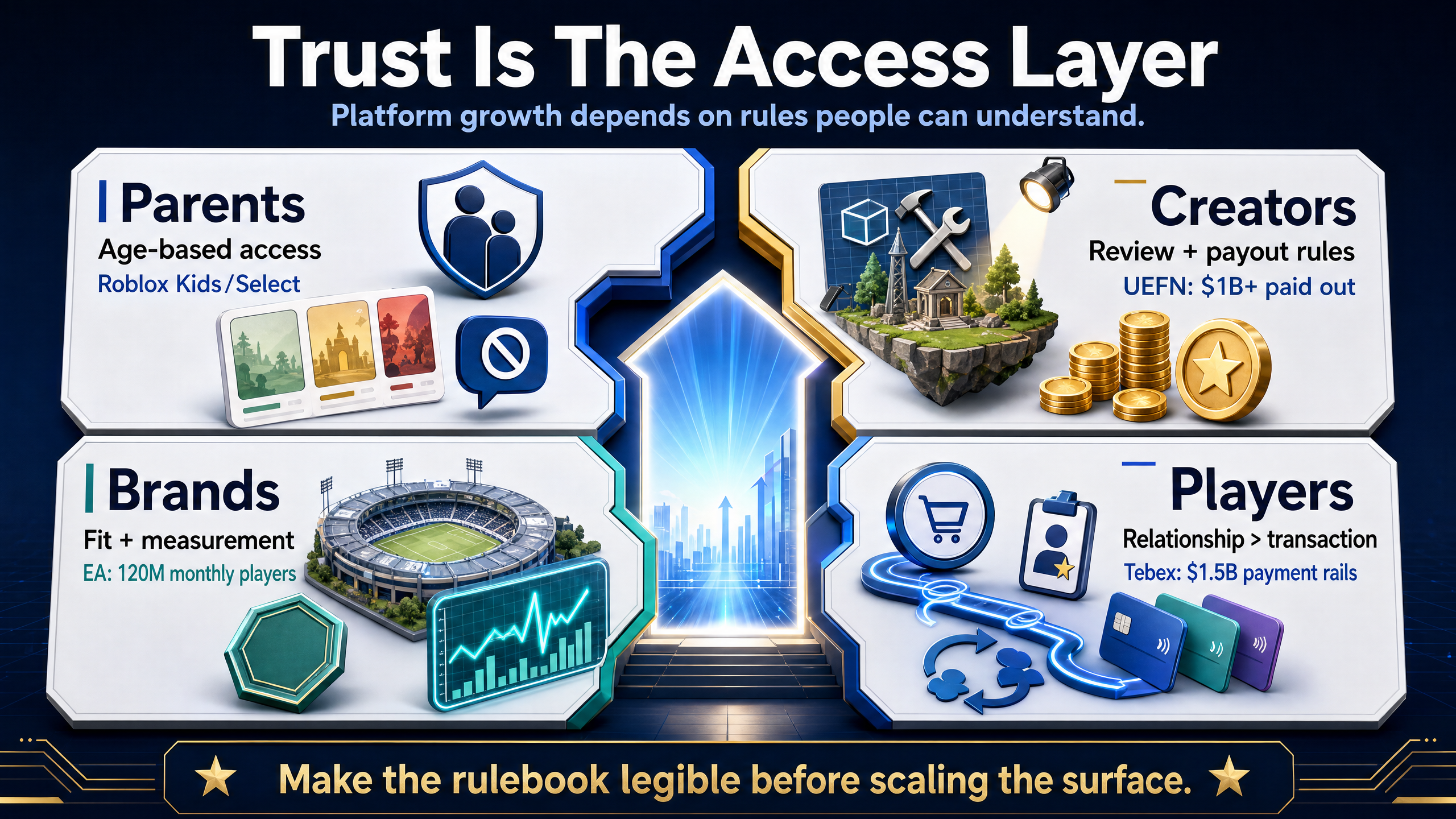
The evidence is getting harder to ignore. Roblox’s Kids and Select accounts turn safety rules into catalog access. Fortnite’s UEFN ecosystem has paid developers more than $1 billion, while Epic keeps rebuilding discovery, mobile input, and creator tooling around that economy. Naavik’s LEGO analysis shows a trusted family brand using games across console, Fortnite, Roblox, physical products, and first-party digital play without treating mobile IAP as the whole prize. EA Advertising is formalizing brand integrations inside sports-game worlds that reached more than 120 million monthly players in fiscal 2026.
The common thread is not “more platforms” or “more brands in games.” It is more specific: the rulebook is becoming part of the product. If people do not understand who gets access, how money moves, what is allowed, what is measured, and what happens when trust breaks, the new channel will not compound.
Roblox Shows Why Safety Is Growth Infrastructure
Roblox’s June rollout is easy to misread as a trust-and-safety update. It is more than that. Roblox Kids and Roblox Select split younger users into age-based experiences, limit chat unless an age check has been completed, give parents broader controls, and require additional reviews for games that want access to under-16 catalogs.1
The developer rules are especially revealing. To publish into the younger-user catalogs, developers must complete ID verification, secure their accounts with two-factor authentication, and either buy a Roblox subscription or pay a refundable publishing fee.1 That is not just moderation. It is platform eligibility.
Deconstructor of Fun’s Roblox piece makes the commercial logic explicit: Roblox’s growth has been built on trust among parents, kids, and developers, and safety investment is not separate from the business model.2 That should sound familiar to any studio operating around children, user-generated content, social play, creators, or licensed brands. The more sensitive the audience, the less a platform can rely on buried policy pages. The default experience has to make the promise visible.
AC&A read: if a platform asks parents to approve access, developers to build inside it, or brands to attach their reputation to it, trust has to be designed into the game. It cannot live only in compliance docs.
Creators Need Predictable Economics, Not Just Tools
Epic’s current UEFN numbers show how quickly a creator ecosystem becomes a business system. The official State of Unreal 2026 recap says Fortnite developers have been paid more than $1 billion since UEFN launched. Epic also says mobile playtime in developer-made games has more than doubled over the past year, and that recent Discover changes nearly doubled the rate at which newly published islands reach 100 players and 10,000 impressions.3

Roblox is moving through the same problem from a different angle. PocketGamer.biz reports that Roblox’s 2027 brand-integration fees will use a CPM model tied to audience exposure and geography, with creators able to forecast and lock a maximum fee before a campaign launches.4
Creators may object to the fee level. Brands may negotiate the value. But the strategic direction is clear: platforms are turning creator monetization into forecastable market rules. A serious creator economy cannot run only on tooling and informal norms. It needs eligibility rules, discovery rules, payout rules, appeal rules, and brand rules that teams can model before they invest.
Brand Integrations Are Product Work
LEGO is a useful counterweight to the usual game-brand conversation because it has resisted the obvious mobile monetization answer. Naavik notes that LEGO’s companion apps support the physical product, while its licensed free-to-play mobile catalog has produced only about $18.7 million in net revenue since 2018 – tiny beside LEGO’s broader business.5
Yet LEGO is not sitting out games. It is active in console licensing, LEGO Fortnite, Roblox collaborations, phygital products such as SMART Play, and a new LEGO Digital Play organization.
That is a brand-relationship strategy. LEGO Fortnite Odyssey has logged over a billion player hours, and Naavik cites seven Roblox collaborations reaching roughly 480 million monthly plays.5 Whether those channels monetize directly is not the only question. They help LEGO stay trusted, relevant, and playable across the places kids and families already spend time.
EA is approaching the same opportunity from the publisher side. EA Advertising gives brands dynamic placements, custom integrations, branded objectives, vanity items, targeting, measurement, and an EA SPORTS Partner Program across a portfolio with over 120 million monthly players.6 EA’s core claim is that brands should become part of the moment in ways that add value and respect the player experience.
Wooga’s June’s Journey case is the practical version. PocketGamer.biz’s PGC Barcelona writeup says the Wicked and Agatha Christie integrations worked because Wooga carried the license across the funnel: UA creative, store listing, loading screens, tutorial foreshadowing, live events, rewards, and licensor approvals. Wooga reported video CPI down 33%, static CPI down nearly 20%, stronger top-of-funnel metrics, and the game’s best store featuring in two years.7
The lesson is not that every game needs a famous IP or an ad platform. It is that brand integrations have to survive contact with the game loop. A licensed object is not a strategy until it changes acquisition, onboarding, retention, monetization, or reactivation in a way players accept.
Direct Relationships Turn Trust Into Margin
The prior argument around DTC often gets stuck on platform fees. GameMakers’ Tebex piece points to the deeper issue: the direct player relationship is itself a distribution channel. GameMakers, citing Tebex, says the merchant-of-record and DTC platform behind community-server and direct-payment economies has processed $1.5 billion in lifetime payments.8
The numbers matter because they connect trust to spend, even though they should be read as Tebex-reported figures rather than independent market benchmarks. GameMakers cites creator-code purchases where average spend rose from $24 to $41, and a Rust example where it rose from $18 to $60. It also frames merchant-of-record work – tax, fraud, chargebacks, billing support, and local payment methods – as infrastructure that lets world-builders spend less time on payment risk and more time on play.8
This is the same trust pattern in a different commercial wrapper. If a player is going to leave a platform checkout, use a creator code, buy through a web store, or support a community server, they need to believe the transaction will be fulfilled, supported, and worth repeating. The direct relationship is valuable only after the operating experience proves it deserves to be direct.
The Checklist Before Scaling A Platform Channel
Mobile teams are already under pressure to find new engagement levers. PocketGamer.biz’s coverage of a ZBD survey says up to 80% of mobile developers believe engagement and retention strategies are getting stale, while 51% struggle to balance monetization friction with fun.9 That pressure can push teams toward rewards, brands, creators, DTC, and social platforms before the rules are ready.
Before scaling one of those channels, a leadership team should be able to answer seven questions:
- Access: who is allowed into the channel, and what must they prove first?
- Economics: how do creators, brands, studios, and platforms forecast upside and downside?
- Player value: what does the player get that they can understand in the moment?
- Fit: how does the brand, creator, reward, or payment path fit the game rather than interrupt it?
- Measurement: which behavior proves the channel is strengthening retention, not just moving spend forward?
- Support: who handles disputes, refunds, moderation, and bad actors?
- Reversibility: what can be changed if the channel damages trust?
Those questions sound operational because that is the point. Trust compounds only when it is converted into product rules people can see. Platform growth is not just a matter of opening more doors. It is deciding which doors should exist, who receives a key, what happens after they enter, and why everyone involved should come back.
Sources
- Roblox – Age-Based Roblox Kids and Select Accounts Now Globally Available.
- Deconstructor of Fun – My Wife Uninstalled Roblox.
- Unreal Engine – State of Unreal 2026: Top news from the show.
- PocketGamer.biz – Roblox reveals creator fee structure for brand integrations from 2027.
- Naavik – 30 Years of Gaming at LEGO.
- Electronic Arts – Introducing EA Advertising.
- PocketGamer.biz – How Wooga turned Wicked and Agatha Christie into growth for June’s Journey.
- GameMakers – The Most Valuable Asset in Games Isn’t Your Game.
- PocketGamer.biz – Up to 80% of mobile devs say engagement strategies are losing effectiveness.