
The most useful F2P economy design story is not that cozy games are hot, or that UGC is hot, or that AI is coming for game development. Those are symptoms. The deeper shift behind the second game strategy is that the pressure profile of successful live games is changing.
For the last decade, many free-to-play economies have leaned on intensity: daily obligations, stat checks, time-limited events, competitive guild pressure, power ladders, and content drops that become work for both the studio and the player. That model still works in some genres. In 4X and deep RPG, pressure is often part of the product.
Recent games-industry coverage gives several reminders that intensity is getting more expensive to operate. Naavik wrote about China’s largest publishers moving from the anime-gacha ARPG race toward lifestyle-sim and “second game” formats.[1] Naavik’s Dorian podcast covered creator-led interactive fiction, female-first fandoms, and no-code UGC tools.[2] GameRefinery highlighted Township’s long transformation into a hybrid engine it cites at roughly $45M/month.[3] Mobile Dev Memo’s Phil Black episode put the same issue in economy-design terms: modern mobile games need broader acquisition and deeper monetization fit at the same time.[4]
The useful pattern is this: lower-pressure games can still monetize when they are built around identity, expression, convenience, collection, social value, UGC, and long-term attachment.
Pressure Is Getting Expensive
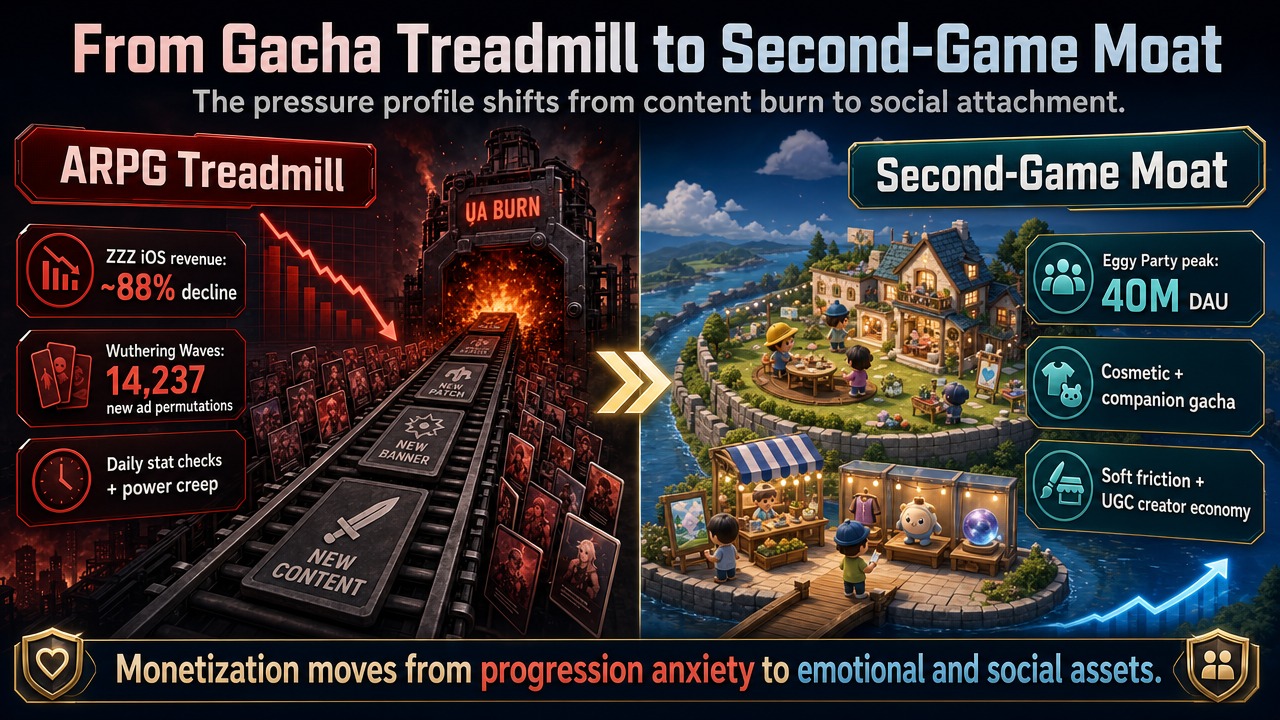
Naavik’s China analysis is useful because it frames the cozy/lifestyle-sim pivot as economics, not taste. The problem with combat-heavy gacha ARPGs is not simply that players want something cuter. It is that the model demands enormous content production, constant UA creative output, and a player base willing to tolerate progression anxiety.
That combination is difficult for incumbents and brutal for challengers. A high-pressure content treadmill trains players to consume novelty at the speed of the studio’s pipeline. Every update has to be big enough to matter, every monetization beat has to justify attention, and every acquisition campaign has to fight creative fatigue. Naavik points to lifestyle-sims as a way to shift monetization away from raw power and toward cosmetics, companions, soft convenience, and eventually UGC.[1]
Per Sensor Tower estimates cited by Naavik, Zenless Zone Zero’s China iOS revenue fell roughly 88% from its July 2024 launch-window peak to early 2026; DataEye metrics cited in the same article show Wuthering Waves adding 14,237 new ad permutations in December 2025 alone.[1] That is what a saturated pressure economy looks like: revenue compression on one side, creative exhaustion on the other.
This is why “second game” is a better phrase than “cozy game.” Cozy describes mood. Second game describes a role in the player’s life. A second game is designed to be returned to without demanding that the player reorganize their day around it.
The design question becomes: what does the player want to return to when they are not being forced back?
Second Game Strategy: F2P Economies Are Not Low Monetization
Many teams hear cozy, social, or lifestyle and assume soft engagement means weak revenue. Soft engagement does not mean weak revenue; it means the game is not primarily selling relief from pain.
A pressure-heavy economy asks, “What happens if the player skips today?” A second-game economy asks, “What makes this world worth checking in on even when nothing is on fire?”
That difference changes what the economy can sell:
- Identity: avatars, homes, companions, collections, and taste.
- Continuity: a world that gets richer over months, not just sharper during events.
- Convenience: soft acceleration and quality-of-life offers that respect the low-pressure promise.
- Social value: visible ownership, gifting, collaboration, and status that does not require power creep.
- Creation: player-made content that gives the community a reason to generate meaning faster than the studio can manufacture novelty.
Cosmetics do not monetize because they are cosmetics. They monetize when the game creates enough attachment, visibility, scarcity, and taste-making for cosmetic ownership to matter.
Township Shows the Long-Term Product Version
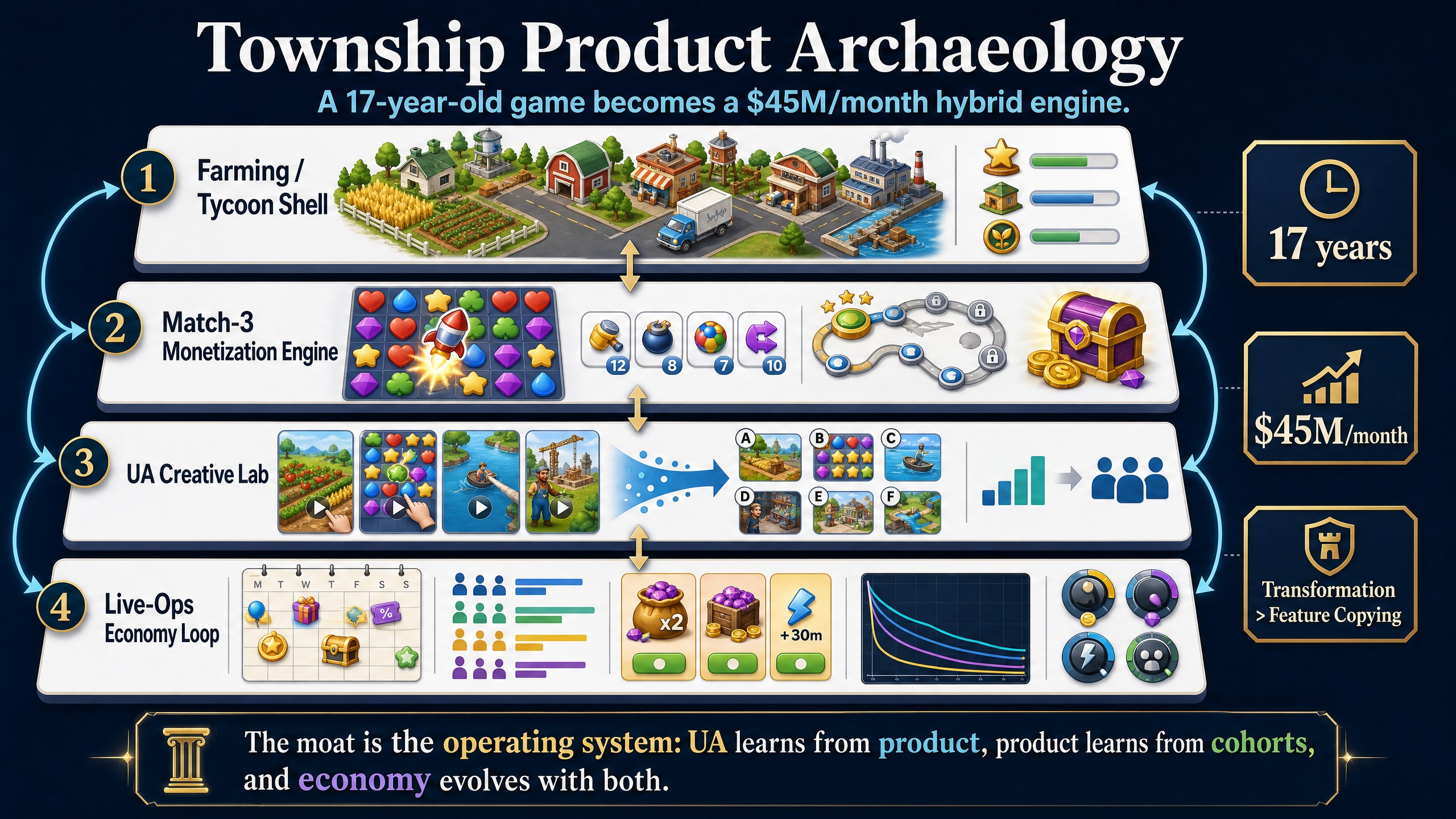
GameRefinery’s Township recap is interesting because it is not about one clever feature. It is about long-term product transformation. The article describes how Township evolved across eras, combining a tycoon-style front end, match-3 monetization, and years of UA adaptation into a coherent business.[3]
The $45M/month figure is not a feature story. You cannot import a farm, a wardrobe, a battle pass, a creator marketplace, or a puzzle layer and expect the market to reward the transplant. The advantage is usually the operating model underneath it: how the team tests, how UA feedback changes onboarding, how live ops talks to economy design, and how quickly the roadmap adapts to cohort behavior.
Source video: GameRefinery links to the Two & a Half Gamers episode on Township’s long-term evolution.
UGC Is Infrastructure, Not Garnish
The Dorian episode points at a related but distinct opportunity. Naavik frames Dorian around interactive storytelling, female-first fandoms, and a no-code platform that lets creators build and monetize free-to-play experiences.[2]
UGC can become a durability layer. It changes the content equation from a studio-only production problem into a marketplace and tooling problem. If creators can produce meaningful experiences, and if players can discover and value those creations, then the economy has more places to sell identity, status, convenience, and expression.
Deconstructor of Fun’s investment analysis makes the same point from the capital side. It argues that investors are more comfortable with consumer apps, tools, infrastructure, and recurring-engagement businesses than with hit-driven game studios.[5] For game teams, the implication is not to abandon games. It is to recognize that the market increasingly rewards durable systems, not only content bets.
AI Is About Fit, Not Output
The Mobile Dev Memo episode with Phil Black is worth watching because Black frames AI as a matching problem, not just a production problem. The important AI question for F2P is not only “Can we generate more assets?” It is “Can we match the economy more precisely to the user?”
That has direct implications for second-game design. If the game is selling identity, convenience, and social meaning rather than raw power, then personalization becomes more valuable. The system needs to understand what a player cares about, what kind of pressure they tolerate, which cosmetics signal taste, which goals feel relaxing rather than obligatory, and which offers feel like service rather than extraction. That is where retention and monetization stop being separate disciplines.
In other words, AI is most strategically useful when it helps the game become more legible, more adaptive, and more commercially precise.
Source video: Mobile Dev Memo’s episode on the modern mobile gaming economy with Phil Black.
Do Not Copy the Visible Practices
PocketGamer.biz has a useful piece about why copying “best practices” fails.[6] The point applies directly here.
You cannot look at a successful cozy game, UGC platform, merge game, puzzle game, or 4X product and simply import the visible features. The feature is the artifact. The advantage is the decision system underneath it.
For a studio, the practical questions are:
- What role should this game play in a player’s week?
- How much pressure is appropriate for that role?
- What does the player value besides power?
- Which systems compound without linear content production?
- Where does monetization express identity, convenience, or aspiration instead of frustration?
- Does the UA promise match the product the team actually operates?
- Does the organization have the rhythm to learn faster than the market copies?
The next wave of F2P opportunity may not come from making games softer. It will come from making their economies more precise.
Most studios that attempt this will not fail at the feature level. They will fail because the person running UA has never sat in an economy design review, and the person running economy design has never seen a UA creative brief.
Sources
- Naavik, “Beyond Gacha: Why China’s Gaming Giants Are Pivoting to Lifestyle-Sims” – https://naavik.co/digest/beyond-gacha-why-chinas-gaming-giants-are-pivoting-to-lifestyle-sims/
- Naavik Gaming Podcast, “Building for the Fandoms Gaming Forgot: Inside Dorian’s No-Code UGC Platform” – https://naavik.co/podcast/building-for-the-fandoms-gaming-forgot-inside-dorians-no-code-ugc-platform/
- GameRefinery, “How Playrix turned Township into a $45M/month engine” – https://www.gamerefinery.com/how-playrix-turned-township-into-a-45m-month-engine-a-two-a-half-gamers-episode-with-gamerefinery/
- Mobile Dev Memo, “Podcast: The modern mobile gaming economy (with Phil Black)” – https://mobiledevmemo.com/podcast-the-modern-mobile-gaming-economy-with-phil-black/
- Deconstructor of Fun, “Why Apps Are Beating Games for Investments” – https://www.deconstructoroffun.com/blog/why-apps-are-beating-games-for-investments
- PocketGamer.biz, “Why copying best practices won’t help your company grow” – https://www.pocketgamer.biz/why-copying-best-practices-wont-help-your-company-grow/