
Feedback loops are critical systems in game design that influence how resources move, how players progress, and how economies stay balanced. They come in two types:
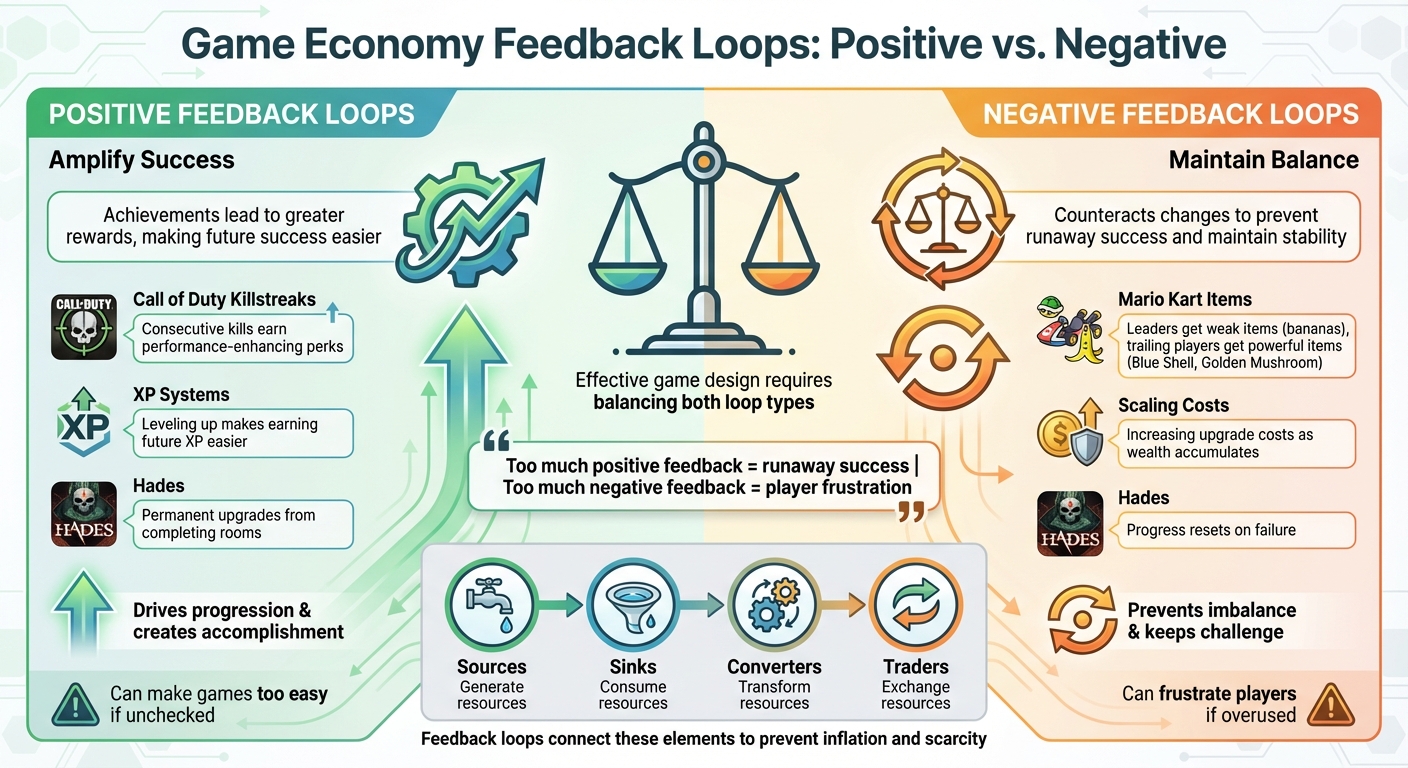
- Positive Feedback Loops: These amplify success. For example, earning XP to level up makes earning future XP easier. They drive progression but can make games too easy if unchecked.
- Negative Feedback Loops: These maintain balance. For instance, Mario Kart gives better items to players falling behind. They prevent runaway success but can frustrate players if overused.
Game economies rely on sources, sinks, converters, and traders to manage resources. Feedback loops connect these elements, ensuring players stay engaged without inflation or scarcity. Proper design involves mapping resource flows, using data like Monte Carlo simulations to model outcomes, and continuously monitoring live game data to adjust systems.
Balancing these loops is essential to keep players motivated, prevent economic instability, and optimize monetization. Tools like real-time telemetry and soft launches help fine-tune systems based on player behavior. Avoid overloading with content to mask issues – focus on refining the core systems for long-term engagement.
Positive vs Negative Feedback Loops in Game Design
How Video Game Economies are Designed

sbb-itb-fd4a1f6
Types of Feedback Loops in Game Economies
Grasping the two main types of feedback loops can help you understand how resources move within your game and how players react to your design decisions.
Positive Feedback Loops
Positive feedback loops amplify success, creating a cycle where achievements lead to even greater rewards. Essentially, when a player performs an action that yields a benefit, that benefit makes the same action even more impactful going forward [1][5]. A great example is the killstreak system in Call of Duty. Players who rack up consecutive kills earn perks that enhance their performance, making it easier to continue their streak [5]. As Machinations Game Design puts it:
"Positive feedback loops allow players to build on their successes, translating to a feeling of accomplishment" [5].
While these loops can make gameplay exciting and rewarding, they need careful moderation. If left unchecked, they can make a game too easy and reduce the challenge.
Negative Feedback Loops
On the flip side, negative feedback loops work to maintain balance by counteracting changes and steering the game economy back toward stability [1][5]. A classic example is Mario Kart’s item distribution system. Players in the lead receive weaker items, like bananas or green shells, while those farther behind get more powerful tools such as the Blue Shell or Golden Mushroom to help them catch up [1][5]. Machinations Game Design explains this concept well:
"The harder you push, the more the negative feedback loop pushes back. This prevents runaway success that could unbalance the game" [5].
The challenge lies in finding the right balance. Overcorrecting can frustrate players, while too little adjustment can allow the game to spiral out of control.
A standout example of blending both loop types is Hades by Supergiant Games. The game rewards players for completing rooms with permanent upgrades (a positive loop), but failure resets progress, introducing a negative loop. However, the narrative progression that follows a defeat helps soften the setback [5].
Recognizing how these loops interact is key to managing resources and shaping player experiences. For more guidance on crafting balanced game economies, experts like Adrian Crook & Associates (https://adriancrook.com) can provide valuable insights.
Designing Feedback Loops for Game Balance
Designing feedback loops that dynamically regulate resource flows is a key part of balancing your game and keeping players engaged. To achieve this, you’ll need to map your game’s economy, model it with data, and fine-tune the strength of these loops. Let’s break down how to approach each step to refine your game’s balance and economy.
Mapping System Flows, Sources, Stocks, and Sinks
Start by creating a clear picture of how resources move through your game. Every game economy is built around four main components:
- Sources: These are the faucets that generate resources (like gold, materials, or energy).
- Sinks: The drains that consume or remove resources (e.g., purchasing items or repairs).
- Converters: Systems that transform one type of resource into another.
- Stocks: Pools where resources are stored.
You can think of this like managing water in a tank – control both the input (faucet) and output (drain) to avoid flooding (inflation) or running dry (scarcity).
Identify the key progression path that drives players forward. Break down the core actions players take – like "Chop Tree" or "Craft Sword" – and represent them as blocks. Use symbols like ‘+’ for sources and ‘–’ for sinks, repeating them to show the scale of resource changes. Connect these blocks with arrows to map how resources flow between actions. Finally, define the anchor, or the psychological motivation (such as mastery or creativity) that gives your resources their perceived value.
Game designer Dylan Jones explains this well:
"Game economies aren’t just the total gold earned, they include everything from bullets left behind on the battlefield to an NPC’s opinion of you after a botched dialog situation." [3]
Using Data to Model Feedback Loops
Once you’ve visualized your resource flows, it’s time to back them up with data. One effective tool is Monte Carlo simulations, which can help you test a wide range of outcomes and spot potential imbalances before players encounter them.
For example, a case study from Machinations.io shows how designer Bogdan used a Monte Carlo simulation to model a strategy game economy. Simulating 100 players over 120 steps, the model tracked four player types – Grind Only, Ad Watcher, Small Bundle Buyer, and Hybrid. The results showed that premium players had an average 61% power advantage, but even free-to-play players in the top 2% could outperform 19% of spenders through smart resource management. [8]
Before diving into simulations, start with a simple spreadsheet to outline key resources, earning rates, and spending costs. This helps you spot basic issues like inflation or scarcity early on. Calculate time-to-reward to see how long it takes for players to achieve meaningful upgrades. If the grind feels too slow or unrewarding, adjust the progression curve. As Alex Mochi notes:
"A system that’s technically balanced can still come across as grindy or unrewarding if it doesn’t align with player expectations." [7]
Balancing Feedback Loop Strength
The strength of your feedback loops should match your game’s goals. For example, the impact of resource sinks should balance out the output of sources. Early in the game, offer generous pacing to provide quick wins and hook players. Later on, introduce steeper progression curves to make achievements feel more satisfying.
To prevent runaway success, use diminishing returns. This could mean increasing costs as players accumulate wealth or reducing the effectiveness of repetitive strategies. Real-time telemetry is a valuable tool here – it can reveal pressure points like players hoarding a specific currency or avoiding certain sinks. If stockpiling happens, it might signal a lack of appealing sinks or a fear of future shortages.
For developers tackling complex game economies, Adrian Crook & Associates (https://adriancrook.com) offers consulting services in economy modeling and live operations optimization, leveraging over 17 years of industry expertise.
Analyzing Feedback Loops in Live Games
Once your game is live, the real challenge begins. The carefully designed resource flows and feedback systems you created during development now face the ultimate test: actual player behavior. Live data will show how players interact with these systems, often in ways you didn’t anticipate. To keep players engaged and maintain a balanced game economy, you’ll need to monitor and tweak these feedback loops continuously.
Tracking Key Performance Indicators (KPIs)
One of the first steps is to track how well your core gameplay loop is performing. Suleman Ali, Co-Founder and CEO of TinyCo, offers a key benchmark:
"50% of DAU should complete core loop" [9].
If less than half of your daily active users (DAU) are finishing the core loop, it could mean your primary progression system needs reworking. This is a red flag that your game’s main engagement cycle might not be compelling enough.
You’ll also want to keep a close eye on ARPDAU (Average Revenue Per Daily Active User) by level and progression pacing. Sudden spikes or irregular patterns in ARPDAU can signal economic imbalances. For example, players should typically level up 1–2 times during their first five sessions to build momentum, and then slow down to about one level every 1–3 days for sustained engagement [9]. Tracking DAU activity by level ensures that player behavior aligns with your intended progression curve.
Monetization patterns are another critical area to analyze. In many games, 80% of revenue often comes from just a few items or categories [9]. Additionally, around 50% of monetization is frequently driven by "instant finish" mechanics, where players pay to bypass time gates [9]. Understanding which sinks drive revenue allows you to fine-tune monetization without overwhelming players with constant purchase prompts.
These KPIs provide the foundation for making informed adjustments to your feedback loops.
Adapting Feedback Loops Based on Player Behavior
Armed with KPI data, you can start refining your feedback loops to address imbalances. For instance, if players are hoarding currency instead of spending it, you likely have a sink problem – there aren’t enough appealing ways for them to use their resources. Introducing limited-time events or exclusive upgrades can encourage spending and help prevent inflation from devaluing your soft currency.
Soft launches lasting 30–60 days are a great way to test these adjustments. By feeding real-world analytics – such as averages, highs, and lows – into simulation tools, you can model how different player types interact with your economy [3]. This approach helps identify gaps between free-to-play players and premium spenders.
Keep an eye out for extreme player behaviors. A study of 100,000 players over three years uncovered an "inverted U-shaped" effect, where exceptionally high weekly performance often leads to lower future engagement and spending [6]. To counteract this, consider introducing targeted rewards or challenges to re-engage these players without disrupting the balance.
Finally, avoid relying on the "content treadmill" – adding more levels or features to mask deeper issues with your feedback loops. If engagement starts to drop, dig into whether your core systems are functioning as intended. Constantly refining your game economy is crucial as player behavior evolves over time. By staying proactive, you can ensure your game remains engaging and rewarding for all types of players.
Conclusion
Recap of Feedback Loop Principles
Positive and negative feedback loops are the backbone of a well-functioning game economy. Positive loops drive player progression, offering a sense of achievement and growth. Negative loops, on the other hand, act as a counterbalance, ensuring the game remains challenging and prevents unchecked success.
Striking the right balance between these two forces is key to creating an engaging experience. As tkdev.dss.cloud explains:
"Effective game design often involves a delicate balance between positive and negative feedback loops. Too much positive feedback without counteracting forces can lead to runaway successes, while too much negative feedback can result in frustration" [1].
Negative loops often introduce challenges – like scaling upgrade costs or tougher enemies – to maintain balance and keep players engaged without letting progression feel too easy.
A strong game economy also hinges on its four core components: Sources (where resources come from), Sinks (where resources are removed), Converters (how resources are transformed), and Traders (how resources are exchanged) [4]. To avoid inflation, every source must have a matching sink. Without effective sinks, your economy risks becoming unstable.
Next Steps for Game Developers
To refine your game economy, use these principles to make strategic adjustments. Revisit your feedback loop diagrams and clearly mark positive impacts with "+" and negative impacts with "-" to better visualize their effects [1][3].
Leverage data to guide your design decisions. As Machinations puts it:
"It’s time to fuel your system design process with data, not guesswork!" [5].
Simulate thousands of play sessions using modeling tools, then analyze real player data – averages, highs, and lows – to gain insights into how different player segments interact with your economy. Adrian Crook offers a critical reminder:
"If the tuning and balance is not optimized the game stands a chance at commercial failure" [2].
Instead of sweeping changes, focus on incremental tweaks. Launch with a streamlined set of core currencies, be transparent with players about any rebalancing efforts, and refine your loops continuously as player behaviors evolve. Sustaining engagement means treating feedback loops as a dynamic, ongoing process.
FAQs
How do I tell if a loop is too strong?
A feedback loop can become problematic if it disrupts balance or negatively impacts gameplay. Signs of this include inflation, declining player engagement, or lack of meaningful choices. For instance, rapid inflation, a shortage of effective currency sinks, or spoilage mechanics that deter players from engaging are clear warning signs. By analyzing player data, you can identify these issues early and fine-tune the loops to keep the game balanced – rewarding progress without causing frustration.
What KPIs best reveal economy imbalance?
When it comes to spotting imbalances in your game economy, there are a few critical metrics to keep an eye on:
- Currency inflation rates: If in-game currency is losing value too quickly, it could signal a lack of effective currency sinks or excessive rewards.
- Resource flow patterns: Tracking how resources move through the game can reveal inefficiencies or bottlenecks in your economy.
- Player spending behaviors: Understanding how players spend their currency can uncover issues with monetization strategies or highlight areas where balance adjustments are needed.
By keeping tabs on these KPIs, you can identify and address problems in your game economy before they spiral out of control.
How do I stop players from hoarding currency?
To keep players from stockpiling currency, consider adding currency sinks to your game. These are features designed to encourage spending, like limited-time shops, upgrades, or consumable items. You can also manage the flow of resources by tweaking earning rates or implementing diminishing returns for players who try to accumulate too much. These approaches help ensure steady spending, avoid inflation, and keep the in-game economy running smoothly.