
Did you know most players quit mobile games within hours of downloading them? Around 73% leave in the first 24 hours, and 80% are gone by Day 3. These early exits hurt your bottom line, especially with acquisition costs up 222% over the last decade. But here’s the good news: small tweaks to your onboarding process can make a huge difference.
Here’s what works:
- Simplify the first experience: Remove barriers like sign-ups or splash screens. Let players jump into the fun immediately.
- Show gameplay fast: Skip long tutorials and showcase the core mechanics within minutes.
- Use interactive tutorials: Teach by doing, not by overwhelming players with text.
- Reward early actions: Quick wins, like beating a first level or earning rewards, keep players engaged.
- Tailor the experience: Offer skip options for experienced players and extra guidance for beginners.
- Track and test: Use data to pinpoint where players drop off and A/B test changes to improve retention.
The goal? Create a smooth, engaging start that keeps players coming back. Every second counts in onboarding – make them count.
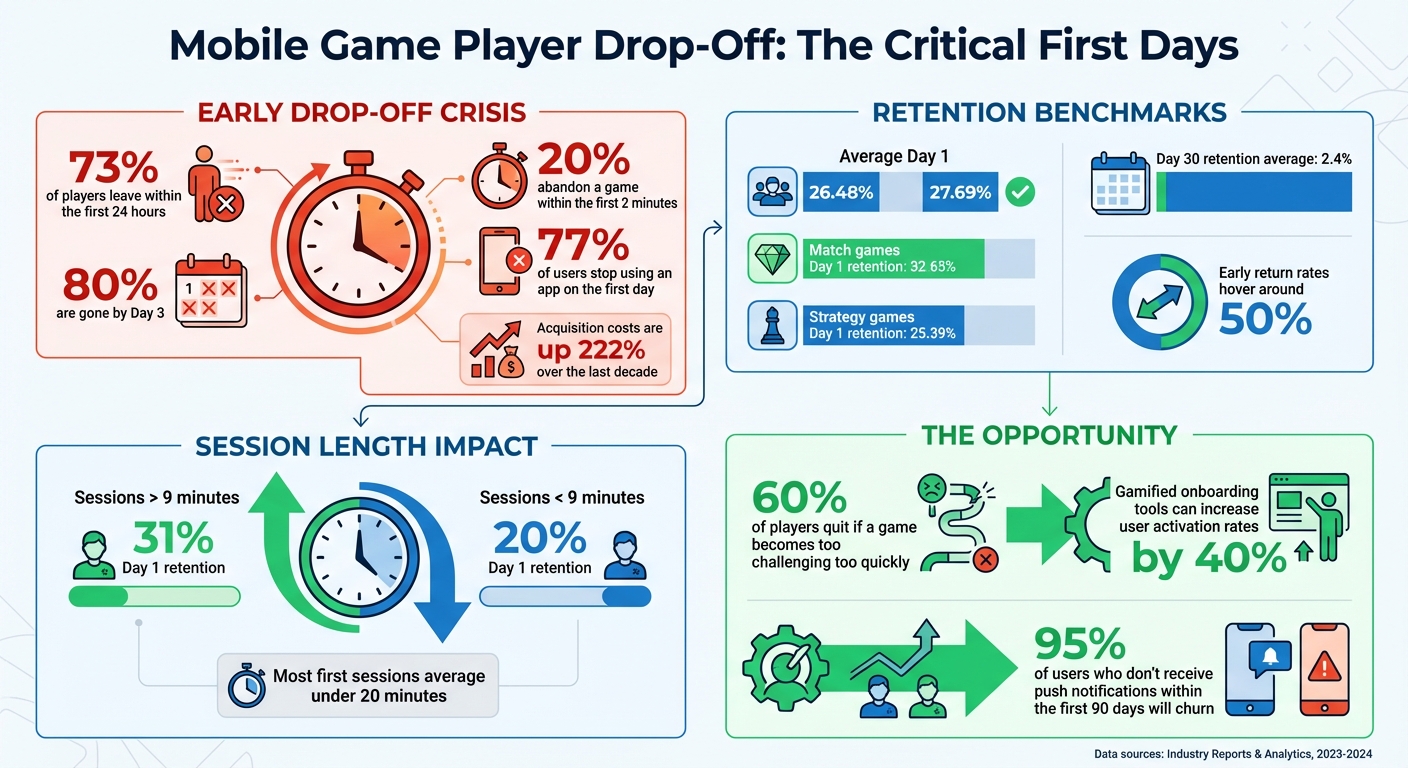
Mobile Game Player Drop-Off Statistics and Retention Benchmarks
How to Improve Your App’s Onboard Process
Simplify the First-Time User Experience
Did you know that 20% of players abandon a game within the first two minutes? [8] That’s a huge loss right at the start. To keep players engaged and improve retention, it’s crucial to make the initial experience as seamless as possible.
Remove Barriers to Entry
Nothing kills excitement faster than splash screens, legal disclaimers, or account sign-ups blocking the fun. Instead, shift legal agreements to your App Store page [2] and hold off on asking for app ratings, notifications, or social media connections until players have had a chance to enjoy your game [2][5]. As GameAnalytics aptly puts it:
"Users should do something fun as soon as they open your mobile game" [9].
Early engagement can also be derailed by forced account creation, immediate paywalls, intrusive ads, or a flood of purchase options [9]. These distractions only frustrate new players. Strip away anything that isn’t essential to the core experience and let the gameplay speak for itself.
Once these obstacles are gone, you can focus on building an onboarding process that feels natural and engaging.
Create a Smooth Onboarding Flow
With the initial hurdles cleared, it’s time to guide players through your game in a way that feels intuitive. Use progressive disclosure – gradually introduce features and UI elements instead of overwhelming players with everything at once [5][10]. For seasoned players, include skip options so they can dive straight into the action [2][5].
Tracking tutorial steps can help you identify where players get stuck or drop off. Remember, early return rates hover around 50% [8], so every step of the onboarding flow matters.
Show Core Gameplay Early
The faster players experience the heart of your game, the better. Within the first few minutes, they need to see why your game is worth their time [9]. Start with an exciting action or story sequence that showcases core mechanics without bogging players down in lengthy explanations [5].
Teach the core loop – the main activities players will repeat to progress. For example, battling monsters to earn gold and upgrading gear [2]. Data shows that sessions longer than nine minutes result in a 31% Day 1 retention rate, compared to just 20% for shorter sessions [8]. Since most first sessions average under 20 minutes [8], every second counts. Make it memorable.
Design Tutorials That Adapt to Players
Experienced players tend to breeze through tutorials, while newcomers often need more detailed guidance. To cater to this range of skill levels, tutorials should be flexible and adaptable. Breaking them into smaller steps, incorporating interactive learning, and tailoring the experience to different player types can make onboarding more effective.
Break Tutorials into Small Steps
Overloading players with too much information at once can lead to frustration and disengagement. Instead, introduce one concept at a time with clear, easy-to-follow instructions. For instance, Clash Royale breaks its onboarding into five short tutorials. Each segment introduces a new concept, such as combining cards for stronger attacks, helping players gradually build their skills and confidence. Gamified onboarding tools, like checklists with visual progress indicators, have been shown to increase user activation rates by 40% [2][12].
Use Interactive, Hands-On Learning
Passive tutorials often fall flat. Interactive, hands-on methods are far more effective at keeping players engaged and reinforcing key skills. As the BBC points out:
"Good onboarding is implicit, and children won’t even notice it. Bad onboarding is explicit, cumbersome, and can form a barrier to play" [7].
Let players learn by doing. Use visual cues and immediate in-game practice to teach actions, and include contextual help that triggers based on player behavior. This "just-in-time" assistance feels natural, keeps players immersed, and helps them build muscle memory [13].
Customize Tutorials for Different Player Types
After establishing clear and incremental learning steps, take it a step further by tailoring the tutorial experience to match the player’s skill level. Give players control over how much guidance they receive. For example, Carcassonne offers a choice between a beginner-friendly "Go ahead" option and a "Later" option for more experienced players [2]. Some games, like Call of Duty Mobile, go even further by using bot-filled lobbies to help new players secure early wins, easing them into competitive gameplay. This approach is crucial, as 60% of players quit if a game becomes too challenging too quickly [11].
To make tutorials even more accessible, always include a "Skip Tutorial" button and a reference section where players can revisit instructions as needed [2][13]. These small additions can make a big difference in ensuring a smooth onboarding experience for all players.
Use Early Rewards to Drive Engagement
Rewards play a crucial role in keeping players engaged, from their first interaction with the game to becoming regular participants. The secret lies in knowing the right timing and type of rewards to offer.
Time Rewards for Maximum Impact
The first few moments of gameplay are incredibly important. Giving players a quick and easy win – like defeating a minor enemy or completing a starter level – creates a positive emotional connection they’re likely to remember [3]. These "Quick Wins" help players feel accomplished early on, encouraging them to stick around.
Capitalize on this window by front-loading rewards. For example, hand out in-game currency, power-ups, or cosmetic items as players complete tutorial steps. Linking these rewards to learning new game mechanics reinforces the desired behaviors [3].
Once the first session wraps up, transition to offering variable rewards. This shift, inspired by operant conditioning principles, keeps players intrigued without overwhelming them [3]. These early successes pave the way for deeper engagement strategies down the line.
Personalize Rewards for New Players
After building early momentum, the next step is tailoring rewards to match individual player preferences. Some players value faster progression, while others focus on customization or social interactions. By analyzing early gameplay behavior, you can offer rewards that resonate. For example, if a player gravitates toward combat, provide boosters or extra lives. If they spend time on customization, offer skins or decorative items.
Personalization also fosters a sense of ownership, which boosts engagement [3]. Take Two Dots, for instance: the game introduces players to a free "shuffler" power-up before Level 10. Shortly after, it highlights where they can purchase premium items, giving them a taste of advanced features without pressure [2].
The results of personalization speak for themselves. In 2023, East Side Games partnered with Mistplay on a campaign that rewarded specific in-game actions, leading to a 9.5% increase in Day 7 retention [6]. Similarly, justDice launched an early churn prevention campaign that triggered shortly after installation. Players who hadn’t completed the setup process received reminders to finish onboarding and claim a welcome bonus, cutting early churn by 26% [16].
Build Positive Feedback Loops
Once early and personalized rewards are in place, maintain engagement by creating ongoing feedback loops. Rewards should be part of a cycle that keeps players motivated. Tools like progress bars and checklists tap into the Zeigarnik Effect – the natural urge to complete unfinished tasks [12]. For example, over 6 million Duolingo users have kept streaks of seven days or more, driven by point systems and streak rewards [12].
Pair these rewards with sensory cues like sparkles and sound effects to amplify their impact [14]. These subtle enhancements make each reward feel more satisfying and encourage players to keep playing. As Amol Bhalerao, an experienced game developer, explains:
"The onboarding process is the bridge between download and habit-forming gameplay. In other words, it’s your best chance to keep players past the first session" [3].
You can also build anticipation by showcasing advanced rewards that are locked for now. Let players see what they can earn at higher levels or through specific achievements. This sparks curiosity and motivates them to return, even after the initial excitement starts to wear off [3][1].
sbb-itb-fd4a1f6
Optimize Onboarding Messages and Communication
Clear and timely communication is key to guiding players effectively, especially during their first interactions with your app. Considering that 77% of users stop using an app on the first day [15], how you approach these early moments can make a huge difference in retaining them.
Use Behavior-Triggered Messages
Instead of overwhelming players with instructions right at the start, deliver guidance when it’s most relevant. For example, the puzzle game Two Dots introduces the "shuffler" power-up only after players have completed several levels. This tutorial appears just before Level 10, ensuring players understand its value after experiencing normal gameplay [2].
Behavior-triggered messaging also allows you to adjust based on player performance. If a player struggles with a task, you can offer additional hints or slow the pace. On the other hand, if they’re breezing through, you can skip unnecessary explanations [3]. This approach helps balance the experience, reducing both frustration and boredom. Fruit Ninja 2 uses a clever two-step permission prompt during gameplay rather than at launch, ensuring players see the benefit – like virtual rewards – before being asked to grant permissions [17].
Similarly, Apple recommends delaying permission requests until players understand their value through provisional notifications. As Apple puts it: "Make the request in a context that helps the user to understand why your app needs authorization" [17].
Design for Silent Play Sessions
Many players mute their devices during gameplay, making visual signals just as important as audio cues. If you rely solely on sound, you risk leaving players confused. To avoid this, pair every audio message with visual elements like animated arrows, glowing highlights, or hand icons that appear when players approach an objective [3][7].
The BBC UX&D team emphasizes this concept:
"Good onboarding is implicit, and children won’t even notice it. Bad onboarding is explicit, cumbersome, and can form a barrier to play" [7].
Keep instructions short and seamlessly integrated into the game environment. For critical mechanics like jumping or special controls, consider briefly pausing the action to ensure clarity [7]. This approach not only improves understanding but also supports accessibility for all players.
Segment Messages for Player Types
Tailoring your messages to different player types ensures they feel relevant and engaging. Segmentation based on behavior, skill level, and preferences can make a big impact. For instance, Beach Bum Games boosted its push notification click-through rate from under 1% to 12% by segmenting messages. They also achieved a 250% increase in average CTR for quest-related notifications by using specific "Quest_ID" tags [18].
For new players, offer clear tutorials, while experienced players should have the option to skip them [2][3][15]. As OneSignal explains:
"Personalization begins with user segmentation. Gaming apps often attract a diverse audience with varying levels of skill, engagement, and preferences. If you are to accurately drive each of these player groups in the right direction… you must meet them where they are" [18].
Targeted strategies can also drive measurable results. Betmate, for example, saw an 11% increase in ID verification and a 30% rise in new user deposits by tailoring messages using behavioral data like "Deposit_Status" [18].
Adjust your tone to match each player’s style. Casual players might respond better to friendly nudges like, "Claim your daily bonus!" Competitive players, on the other hand, may prefer a challenge-focused tone: "New leaderboard rewards await!" [18]. And since 95% of users who don’t receive push notifications within the first 90 days will churn [15], establishing a regular communication pattern early – aligned with each player’s activity – keeps them engaged without feeling overwhelmed [17].
Measure and Improve Onboarding Performance
To make your onboarding process better, you need to measure it first. Tracking the right metrics helps you understand where players are thriving and where they’re getting stuck. Start with Day 1 retention – this is your main benchmark. For mobile games, average Day 1 retention typically ranges between 26.48% and 27.69%, though it varies by genre [1]. For example, match games often see higher retention at 32.65%, while strategy games average around 25.39% [15]. Beyond Day 1, keep an eye on Day 7 and Day 30 retention to gauge long-term engagement. Across the gaming industry, Day 30 retention is notably low, averaging just 2.4% [4]. These benchmarks offer a roadmap for selecting the most relevant metrics to track during onboarding.
Track Key Onboarding Metrics
Some metrics are especially important for onboarding success. Start with the onboarding completion rate and Time to Value (TTV) – this measures how quickly players reach their "Aha!" moment, the point where they see the value in your game. Another critical metric is the activation rate, which tracks how many users achieve key milestones, like completing the first level or using a core feature. Will Egan, CMO at Ausmed, sums it up well:
"Being able to measure each interaction in the onboarding workflow is the key to helping you methodically design and optimize a great onboarding experience" [19].
Ausmed is a great example of how this works in practice. Between 2022 and 2024, they boosted their activation rate from 15% to 75%. They achieved this by using behavioral tracking and surveys to identify friction points, then simplifying the onboarding process to remove unnecessary steps [19].
Run A/B Tests for Optimization
Once you’ve identified your key metrics, A/B testing is your next step. Controlled experiments let you fine-tune the onboarding experience. Test different elements like tutorial lengths, the timing of signups, or where rewards are placed to see what improves retention. For instance, Marvel Snap condensed its complex card game mechanics into a tutorial under four minutes, making the game more approachable for a broader audience outside of traditional CCG players [15]. Focus on key actions and measure their impact on Day 1 retention and ARPU (Average Revenue Per User). Quick split-testing for onboarding and monetization has been shown to boost ARPU by anywhere from 20% to 400% [20]. Just be sure to test these changes with new users only [20].
Find and Fix Friction Points
Funnel analysis is a powerful tool for pinpointing where players drop off during the onboarding process. Map out every step, from the initial install to activation, to see where the bottlenecks are. For example, Wordscapes uses real-time data to identify players stuck on specific levels. When this happens, the game sends personalized notifications with hints to help them move forward [21]. Tools like session replays and heatmaps can also show where players hesitate or ignore cues [19]. Eliminating these friction points can have a big impact – just a 25% increase in activation can lead to a 34% boost in Monthly Recurring Revenue over a year [22]. By smoothing out these rough patches, you’ll not only improve retention but also set the stage for stronger long-term revenue growth.
Conclusion
Onboarding is the gateway between a download and creating a loyal player base. The reality is harsh – early player drop-off happens fast, and those first few minutes can make or break the connection. Every tactic we’ve discussed – whether it’s simplifying the first-time experience or running A/B tests – works together to keep players engaged beyond that critical first day.
As Amol Bhalerao wisely says:
"Onboarding is your best opportunity to make that connection – so make it fun, fast, and unforgettable" [3].
By showcasing core gameplay early, rewarding progress, and removing unnecessary barriers, you’re laying the groundwork for better retention and higher lifetime value (LTV). But it doesn’t stop there. The onboarding process must evolve as player preferences and market trends shift. Regular updates, data tracking, and testing are key to ensuring that every new install has the best shot at becoming a loyal, paying player.
The most successful games treat onboarding as an ongoing service, not just a one-time tutorial. By analyzing cohort data, addressing friction points, and adapting to player behavior, you can transform initial interest into a habit-forming experience.
It all boils down to this: your onboarding flow is vital – make every moment count. Start small, experiment often, and keep refining.
FAQs
How can I find out where players drop off during onboarding?
To figure out where players drop out of your onboarding process, start by mapping their journey step by step. Use analytics tools to track key events – like when users install the app, complete tutorial checkpoints, or take their first in-game action. By comparing the number of players entering each stage to those who leave, you can calculate drop-off rates and spot the areas where players are most likely to disengage.
Break down your data by categories such as device type, operating system, or region. This helps identify whether specific groups face unique challenges. For a closer look, gather qualitative insights using tools like in-app surveys, heatmaps, or session replays. These methods can reveal why players are leaving certain stages. Once you’ve pinpointed the trouble spots, focus on refining those areas. Test your updates with A/B experiments to see how they affect retention rates.
How can I personalize the onboarding experience to keep different types of players engaged?
To make onboarding more engaging, it’s essential to recognize that players come with varying motivations and skill levels. Start by segmenting your audience into groups like casual players, who enjoy straightforward, quick experiences; core players, who appreciate a gradual build in complexity; and advanced users, who thrive on challenges and premium features. Design the onboarding process to cater to these groups. For instance, casual players might appreciate the option to skip tutorials, core players could benefit from milestone-based tutorials, and advanced users may enjoy detailed guides or early access to premium content.
Another way to personalize onboarding is through dynamic difficulty adjustment. By analyzing how players perform early on, you can tweak the gameplay – making it easier for beginners while introducing a steeper challenge for seasoned players. Additionally, reward customization can play a big role. Casual players may respond well to simple, easy-to-achieve rewards, while advanced users might be drawn to exclusive, high-value items.
Lastly, leverage real-time analytics to track player behavior during onboarding. Pay attention to which features each group interacts with most and use this data to fine-tune the experience. A thoughtful, data-driven approach ensures that every player feels engaged and appreciated from the very start.
How do early rewards impact player retention and engagement in mobile games?
Early rewards are a key strategy for grabbing players’ attention and keeping them engaged. By giving out incentives like bonus items, extra in-game currency, or small power-ups right at the start, developers can create a quick sense of achievement and excitement. This early boost not only leaves a positive first impression but also helps improve Day-1 retention, encouraging players to stick around and start building a routine.
For these rewards to work well, they need to be simple to earn, closely tied to the main gameplay, and spaced out thoughtfully to keep the experience exciting without overwhelming the player. When included as part of the onboarding process, early rewards make it easier for players to keep going, increase the time they spend playing, and motivate them to come back. This method not only turns first-time players into regular ones but also sets the stage for long-term engagement and potential monetization.