
Subscription models are reshaping mobile gaming by offering recurring payment options like battle passes, VIP memberships, and premium access. These models provide developers with consistent revenue streams and players with perks like exclusive content, ad-free experiences, or in-game benefits. In 2022, subscriptions accounted for 36% of mobile gaming revenue, and spending is projected to reach $11 billion by 2025.
Key points include:
- Battle Passes: Time-limited rewards tied to seasonal challenges.
- VIP Memberships: Passive benefits like ad removal and daily bonuses.
- Premium Access: Unlocks exclusive game content or features.
While subscriptions boost player retention and lifetime value, challenges like high churn rates and pricing sensitivity require careful planning. Combining subscriptions with in-app purchases and ads, alongside offering free trials and tiered pricing, can maximize engagement and revenue.
The balance lies in providing meaningful perks without creating "pay-to-win" dynamics, ensuring fairness and long-term player trust.
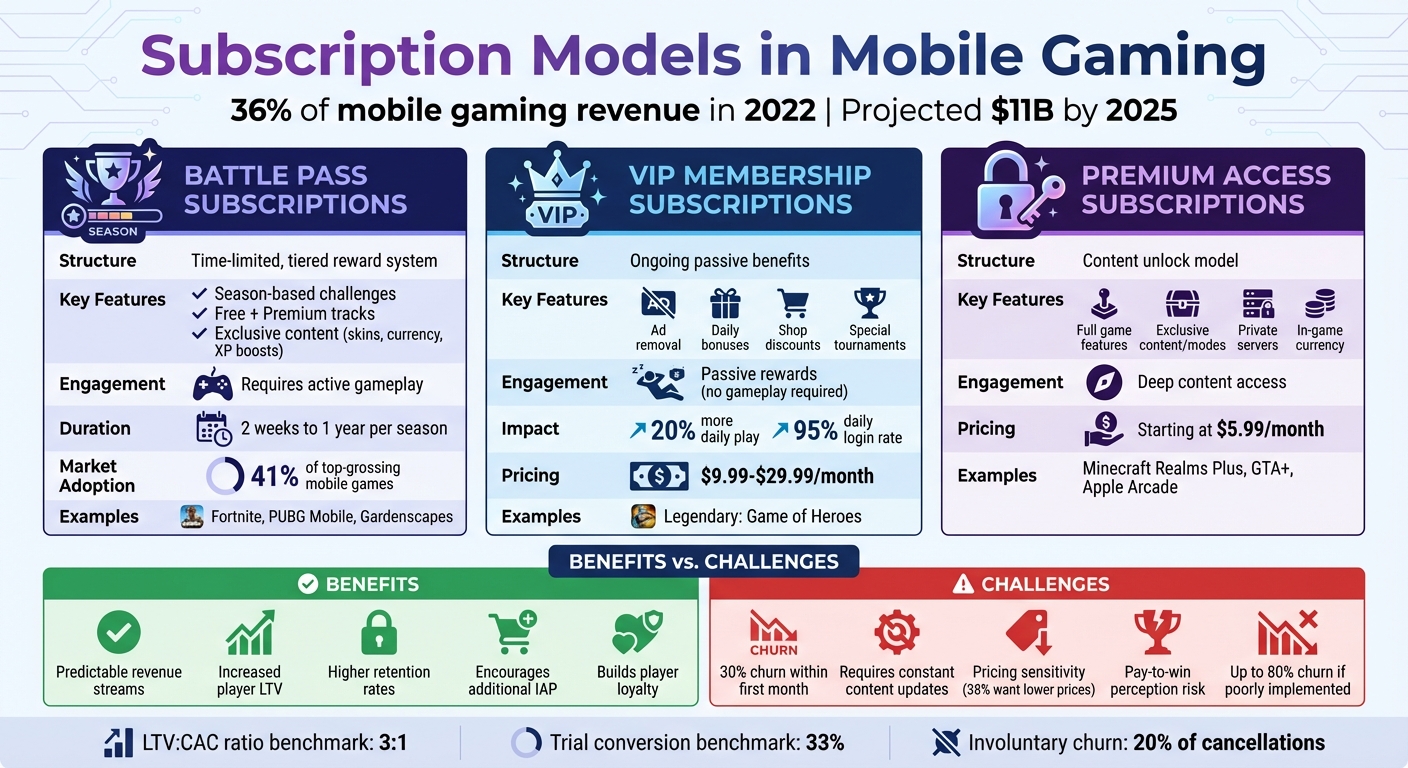
Mobile Game Subscription Models: Types, Benefits, and Challenges Comparison
Types of Subscription Models in Mobile Games
Subscriptions have become a key strategy in expanding revenue streams for mobile games, offering tailored options to suit different player preferences. Let’s dive into some of the most prominent subscription models.
Battle Pass Subscriptions
Battle passes are structured around a tiered reward system that encourages players to complete season-based challenges. These challenges unlock exclusive content such as skins, in-game currency, and XP boosts [2][1]. Typically, games offer two tracks: a free one with basic rewards and a premium one that requires payment, which increases player engagement. This model has gained significant traction, with 41% of the top-grossing mobile games incorporating season passes as part of their monetization strategy [2].
Games like Fortnite and PUBG Mobile were early adopters in the shooter genre, but this model has since spread to other genres, including puzzle games like Gardenscapes and Homescapes. Teis Mikkelsen from Multiscription highlights the appeal of this system:
"Battle passes have become a really popular way to monetize F2P games… It’s essentially a time-limited subscription, but brilliant in that it drives both spend and engagement, as players must play to earn the potential rewards they paid to get access to."
- Teis Mikkelsen, Multiscription [6]
Seasons typically last anywhere from two weeks to a year, creating a sense of urgency that keeps players engaged. Some publishers now offer auto-renewing subscriptions to ensure seamless access to new seasons, turning one-off purchases into consistent revenue.
While battle passes focus on time-limited rewards, other models provide ongoing perks without requiring active gameplay.
VIP Membership Subscriptions
VIP memberships are all about convenience and exclusivity, offering perks like ad removal, daily bonuses, shop discounts, and access to special tournaments. Unlike battle passes, VIP rewards are passive, meaning players benefit simply by maintaining their subscription.
This model has a notable impact on player retention. For instance, XFLAG reported that VIP subscribers play 20% more daily [8]. Similarly, in Legendary: Game of Heroes, VIP members achieved a 95% daily log-in rate [8]. This heightened engagement directly boosts lifetime value, as Scopely explains:
"Due to the retention associated with monthly subscriptions, the ARPU curves for subscribers are steeper than those of non-subscribers leading to much higher overall LTVs for these players." [8]
Pricing for VIP memberships typically ranges from $9.99 per month for standard games to $29.99 per month for RPGs with deeper progression systems [7][8].
Premium Access Subscriptions
Unlike battle passes or VIP memberships, premium access subscriptions provide entry to substantial content that is otherwise locked behind a paywall. These subscriptions grant access to full game features, exclusive content, or special modes. For example, Minecraft Realms Plus offers private server access, while GTA+ provides exclusive vehicles and in-game currency for $5.99 per month [2][1].
Some publishers have taken this a step further with subscriptions that span multiple games. For instance, Apple Arcade bundles hundreds of games for casual players, while single-game premium subscriptions are better suited for "AAA-like" titles with deeper engagement [6].
This model emphasizes content depth and exclusivity, making it ideal for games with expansive libraries or episodic releases. Players are drawn in by the promise of unique experiences they can’t find elsewhere.
Benefits and Challenges of Subscription Models
Subscription models have redefined how mobile games earn revenue and keep players engaged, but they come with their own set of trade-offs that developers need to handle carefully.
Advantages of Subscription Models
One of the biggest perks of subscription models is the steady stream of income they provide. Unlike the unpredictable earnings from one-time purchases or ad revenue, subscriptions create a consistent cash flow. This makes financial planning easier and allows developers to focus on long-term content updates without worrying about sudden drops in revenue [1].
Subscriptions also boost the lifetime value (LTV) of players by extending their engagement with the game. Matej Lančarič, a UA Mobile Growth Expert, highlights this:
"Subscription models increase customer lifetime value (LTV) by maximizing the revenue earned per customer over time" [1].
This recurring interaction not only builds player loyalty but also encourages stronger emotional ties to the game.
Interestingly, subscriptions can also lead to more in-app purchases. Once players commit to a subscription, they often see the fee as a sunk cost, which makes them more likely to spend on additional in-game items to enhance their experience [6][12]. This creates an opportunity for developers to capture even more value from their most engaged players, without relying entirely on big spenders (often referred to as "whales").
However, while the benefits are clear, subscription models also bring several challenges that developers must address.
Challenges of Subscription Models
One major hurdle is the high churn rate. Nearly 30% of annual subscriptions are canceled within the first month, often due to a lack of fresh content or right after the initial billing cycle [5][9]. This means developers are under constant pressure to deliver top-notch content to keep subscribers engaged [9][10].
Pricing is another tricky area. Developers need to strike a balance – set the price too high, and players may feel excluded; set it too low, and the revenue might not cover development costs. In fact, 38% of subscribers reported they would have kept their subscription if there were lower-priced options available [5]. Additionally, compared to free-to-play games, subscription models can create a higher barrier to entry, which might limit the initial player base [9]. Guy Kroupp from Getgud.io cautions:
"Poorly chosen monetization models can lead to player churn rates as high as 80% within the first month" [9].
Finally, there’s the risk of a “pay-to-win” stigma. If the benefits offered through subscriptions give players an unfair competitive edge, the game might feel unbalanced. This perception can lead to frustration and, ultimately, player attrition [10][11]. Designing a subscription model that feels valuable without tipping the scales too far is an ongoing challenge for developers.
Benefits vs. Challenges Comparison Table
Here’s a quick look at how the advantages and challenges of subscription models stack up:
| Key Metric | Advantages | Challenges |
|---|---|---|
| Retention | Builds long-term loyalty and daily habits | High churn if value isn’t consistently refreshed |
| Revenue | Steady, predictable cash flow | Converting free users to paid remains difficult |
| Design | Enables deep progression and meta-layers | Requires constant content updates (LiveOps) |
| Market | Perceived as a safer option than loot boxes | Competes with other subscriptions for player budgets |
| User Experience | Offers ad-free, premium gameplay | Risk of being seen as “pay-to-win” if unbalanced |
How to Implement Subscription Models
Creating a successful subscription model involves careful timing, smooth integration with other revenue streams, and pricing that clearly communicates the value being offered.
Timing and Paywall Placement
Timing plays a huge role in how players perceive subscription offers. Instead of immediately hitting users with a paywall, let them first engage with the core gameplay or reach a meaningful milestone. This way, they can experience the value of your game before being asked to commit financially.
Take Legendary: Game of Heroes by N3TWORK, for example. The game introduced a $29.99 monthly VIP subscription after players had progressed beyond the initial stages. They highlighted VIP perks with unique UI markers and offered benefits like a dedicated VIP store, early access tokens for bosses, and premium customer support. This strategy paid off with a D425 retention rate of about 20% and a 95% daily log-in rate among its 30,000 active subscribers [8].
Another effective approach is to use contextual prompts or metered paywalls. These appear when players hit a natural stopping point, like running out of daily lives or failing a level multiple times. This makes the subscription feel less like a sales tactic and more like a helpful solution [3].
For instance, Scopely’s Wheel of Fortune introduces its $9.99 per month "All-Access Pass" immediately after the first-time user experience. This subscription bundles exclusive rewards, discounts, and energy boosts, encouraging players to develop a daily playing habit [2][8].
These timing strategies lay the groundwork for combining subscriptions with other revenue streams.
Combining Subscriptions with IAP and Ads
Once the timing is right, blending subscriptions with in-app purchases (IAP) and ads can significantly boost revenue. Many successful mobile games rely on a mix of subscriptions, IAP, and ads to give players flexibility while maximizing earnings [6]. Subscriptions can even encourage additional spending by offering exclusive discounts on IAP, creating a loop of continuous engagement and spending [6].
NEOWIZ’s Cats & Soup is a great example. The game combines interstitial and rewarded ads with IAP and multiple subscription tiers, generating $230,000–$270,000 in monthly revenue. Players can choose from options like a 7-day ad-removal for $0.99, a 30-day ad-removal for $3.99, or premium daily reward packages for $9.99 [4].
Setting Up Pricing Tiers
Pricing tiers are essential for balancing affordability with perceived value, making it easier for players to try out subscriptions and commit long-term. Offering a variety of plans – weekly, monthly, and annual – can cater to different budgets and preferences [13]. For example, weekly subscriptions often hover around $4.99, monthly plans around $9.99, and annual plans start at $29.99 or more [2][4]. Annual plans often include significant discounts, encouraging long-term commitment and reducing churn.
To lower the barrier to entry, start with a low-tier option and build in opportunities for upselling [6]. Introductory offers, such as free trials or discounted rates (e.g., $1.99 per month for the first three months), can also make the initial decision easier for players [3].
Don’t forget about platform-specific incentives. For instance, on the iOS App Store, developers’ revenue share increases from 70% to 85% after a subscriber has been active for one year [3]. Organizing pricing tiers into subscription groups – where players can only select one option at a time – helps avoid confusion and accidental multiple purchases. It also makes it easier to manage upgrades, downgrades, and crossgrades [3].
Lastly, each pricing tier should offer something distinct. Higher tiers should provide exclusive perks like unique content or VIP support, rather than just "more of the same" [14][8].
sbb-itb-fd4a1f6
Best Practices for Subscription Models
Once your subscription model is live, fine-tuning it becomes essential. The key lies in tracking the right metrics, experimenting with offers, and earning player trust through fair and transparent design.
Key Performance Indicators to Track
Keeping an eye on the right metrics can make or break the success of your subscription model. Here are a few critical ones:
- Monthly Recurring Revenue (MRR): This helps smooth out revenue inconsistencies across varying subscription durations.
- Lifetime Value (LTV): Predicts the total revenue per player by multiplying ARPDAU (Average Revenue Per Daily Active User) by the average player lifetime.
- Churn Rate: Divided into voluntary churn (users canceling subscriptions) and involuntary churn (billing issues like expired credit cards). Involuntary churn accounts for about 20% of cancellations [15]. Reducing churn by recovering 50% of failed payments – through push notifications or in-app reminders – can lower overall churn by around 10% [15].
- Conversion Rates: Track key moments like trial start rates and trial-to-paid conversion rates. A trial conversion rate of 33% is a solid benchmark for mobile apps [15].
- LTV:CAC Ratio: A ratio of 3:1 is often seen as the gold standard for sustainable growth [16].
Don’t forget to monitor proceeds versus gross revenue. App store fees, typically 30%, often drop to 15% after a user has subscribed for a year – a crucial detail for accurate financial planning [15].
These metrics not only provide insights into revenue stability but also guide future testing and promotional strategies.
A/B Testing and Seasonal Promotions
A/B testing is invaluable for fine-tuning everything from onboarding flows to pricing strategies and messaging about subscription benefits. Testing different subscription tiers, pricing models, and perks can reveal what resonates most with your audience [17][6].
Timing your promotions with major content updates or seasonal events can also boost results. Players are more likely to see value in subscriptions right before significant in-game events or updates [8]. Battle Passes are a great example – they package perks within a defined timeframe, creating urgency and driving engagement [6].
Introductory pricing can also lower the barrier to entry. For instance, offering the first three months at $1.99 instead of $9.99 can significantly increase initial conversions [8]. Another option is "time cards", which temporarily unlock subscription features (e.g., a 3-month pass) without requiring auto-renewal, appealing to players hesitant about ongoing commitments [8].
Visual cues can further highlight the value of subscriptions. For example, using distinct color schemes – like purple for VIP features versus blue for standard gameplay – helps players quickly understand what they’re getting [8].
Avoiding Pay-to-Win Perceptions
To maintain trust, subscription benefits should enhance convenience rather than provide unfair advantages. Non-paying users must still be able to progress through normal gameplay, even if it takes longer.
Focus on perks like time-saving features (e.g., faster building times or shorter cooldowns) or cosmetic items (e.g., exclusive skins or emotes) that let players express themselves without disrupting game balance. Battle Passes are a great example, as they reward players based on skill and time rather than direct purchases [6]. Dual progression tracks – where all players can advance but subscribers gain access to an enhanced premium track – also help maintain fairness.
Consider adding features that benefit the entire community. For instance, troop donations or shared buffs foster cooperation rather than individual advantages. XP or soft currency multipliers can cater to different play styles while keeping the competition fair.
It’s also important to clearly distinguish subscription perks from standard gameplay using unique UI elements. Avoid placing paywalls on core content – keeping game modes and levels accessible to free players helps preserve trust and community cohesion.
For deeper insights into optimizing subscription models, Adrian Crook & Associates offers expertise in freemium mobile game design and live operations.
Conclusion
Subscription models now contribute to 36% of mobile gaming revenue, with projections estimating they’ll hit $11 billion by 2025. This highlights their growing importance in providing steady income streams and delivering enhanced player value [2]. The secret to success lies in striking the right balance between value and trust. Players need to see clear, meaningful benefits – whether it’s through Battle Passes, VIP memberships, or ad-free gameplay – that genuinely enhance their gaming experience. These perks serve as the foundation for effective and thoughtful implementation strategies.
Getting implementation right takes careful consideration. Decisions like when to introduce paywalls or how to structure tiered pricing significantly impact both player perception and revenue [2][4]. Offering free trials can lower the barrier to entry, while consistent perks such as XP boosts and exclusive cosmetics keep players engaged without veering into pay-to-win territory.
As mentioned earlier, maintaining subscription value and player trust requires constant attention and refinement. Avoiding "regretted benefits" and addressing platform-specific challenges are just part of the equation. As Teis Mikkelsen puts it:
"Being successful with subscription requires as much thought and expertise as ads and IAP, so you need to do your research" [6].
With around 83% of mobile games failing within three years [10], this underscores the critical need for a well-crafted subscription strategy that supports a game throughout its lifecycle.
For developers looking to maximize their chances of success, expert guidance can make all the difference. Adrian Crook & Associates brings over 17 years of experience and has worked with more than 300 clients to create profitable, player-focused subscription models. Their consulting services – ranging from KPI analysis to soft launch planning – are designed to tackle the challenges outlined in this guide, helping developers build subscription systems that deliver long-term results.
FAQs
How do subscription models help retain players in mobile games?
Subscription models are a powerful tool for keeping players engaged by offering continuous value. Whether it’s exclusive content, special in-game perks, or monthly rewards, these benefits create a sense of commitment that motivates players to log in regularly. Over time, this steady interaction helps nurture player loyalty.
For developers, subscriptions provide a steady stream of revenue, allowing them to fund regular updates, seasonal events, and tailored features that keep the gameplay experience dynamic and engaging. By crafting subscription tiers that work seamlessly with free-to-play elements, developers can enhance player satisfaction while boosting retention for the long haul.
How can developers reduce churn in subscription-based mobile games?
To keep players hooked on subscription-based mobile games, developers must focus on delivering consistent value and crafting an experience that keeps players coming back. When players feel they’re getting exclusive perks, frequent updates, and a genuine connection to the game, they’re far less likely to cancel their subscriptions.
Some effective approaches include starting with a smooth and enjoyable onboarding process, offering subscription plans that cater to different spending habits, and keeping the game fresh with regular updates like exclusive items or limited-time seasonal events. Features that build a sense of community – like guilds or leaderboards – can deepen player loyalty. Additionally, rewarding long-term subscribers with special anniversary gifts or increasing perks over time can be a great way to encourage renewals.
Adrian Crook & Associates specializes in helping developers fine-tune retention strategies, optimize subscription models, and design engaging live operations to boost revenue while reducing churn.
How can mobile games offer subscription benefits without being seen as ‘pay-to-win’?
To steer clear of the dreaded "pay-to-win" label, focus on crafting subscription perks that add value to the player experience without tipping the competitive scales. Perks like ad-free gameplay, unique cosmetic items, early access to new content, or quality-of-life upgrades (think faster crafting timers) can make players feel rewarded without disrupting the game’s fairness.
Transparency is just as important. Be upfront about what the subscription includes, highlighting benefits like cost savings or exclusive content rather than anything that might give a gameplay edge. When players feel assured that the game remains balanced, they’re more likely to embrace the subscription model.
Lastly, keep an eye on how these perks affect the overall game experience. Regularly assess and tweak the offerings to ensure they enhance enjoyment without compromising fairness. A well-thought-out subscription plan can keep players engaged while maintaining a level playing field.